Financial & Forex Market Recap: Nov. 9, 2026


Monday, Nov. 9, 2026: Oil fell about 4% on disputed Iran deal reports, the S&P 500 jumped 2.4%, and the U.S. dollar slipped as the kiwi led the majors.
Iran diplomacy headlines dominated Monday’s markets. Reports that talks to reopen the Strait of Hormuz may be moving forward probably drove oil down about 4%, and cheaper oil likely eased inflation worries a day before the U.S. Consumer Price Index (CPI) report and helped the S&P 500 jump about 2.4% even as Nvidia slid. The U.S. dollar weakened against every major, gold climbed about 1.9%, and Bitcoin lagged.
In short: On Monday, Nov. 9, 2026, reports that U.S.-Iran talks may be advancing likely pushed WTI crude oil down about 4% to near $87.60, and the S&P 500 jumped about 2.4% to near 7,551 even as Nvidia fell. The Dollar Index slipped 0.6% to near 101.67, the New Zealand dollar led the majors, and gold rose about 1.9% to near $4,140.
Monday’s Market Scoreboard: Oil Slides, Stocks Surge and the Dollar Dips
| Asset | Close (approx.) | Day change | Driver |
|---|---|---|---|
| S&P 500 | 7,551 | +2.4% | Lower oil, chip dip buying |
| U.S. 10-year yield | 4.88% | +0.3% (about +2 bp) | Hawkish Fed talk, risk-on |
| U.S. Dollar Index | 101.67 | -0.6% | Risk-on, Iran deal reports |
| WTI crude oil | $87.58 | -4.0% | Disputed Iran deal reports |
| Gold | $4,140 | +1.9% | Softer dollar, Iran headlines |
| Bitcoin | $74,876 | +0.2% | Lagged stocks after Nvidia probe |
| USD/JPY | 157.90 | -0.4% | Broad dollar softness |
| EUR/USD | 1.1225 | +0.7% | Broad dollar softness |
| GBP/USD | 1.3444 | +0.7% | Broad dollar softness |
| USD/CHF | 0.8195 | -0.1% | Franc lagged other majors |
| AUD/USD | 0.6930 | +0.9% | Risk-on, China tariff relief |
| NZD/USD | 0.5635 | +1.4% | Risk-on, softer dollar |
| USD/CAD | 1.4120 | -0.05% | Lower oil capped loonie |
Approximate levels, 6:00 pm ET Sunday to 4:00 pm ET Monday. Drivers are likely factors, not confirmed causes.
Forex News Headlines & Data: China Inflation, German Trade, Fed Speakers and Iran Talks
- U.S. President Donald Trump told CNN that new strikes on Iran are “highly unlikely” to be needed if talks make real progress, while Secretary of State Marco Rubio said talks had not been very productive and called some Iranian demands “outrageous and ridiculous”
- China extended its suspension of an extra 24% tariff on U.S. goods for two months while keeping a 10% levy in place, effective Nov. 10
- China Inflation Rate for October 2026: 0.7% y/y (0.8% y/y forecast; 0.9% y/y previous); core 0.8% y/y (1.0% y/y previous)Below forecast
- China PPI for October 2026: 5.7% y/y (5.3% y/y forecast; 5.0% y/y previous)Above forecast
- Japan Leading Economic Index Prel for September 2026: 116.4 (117.0 forecast; 118.0 previous)Below forecast
- Germany Balance of Trade for September 2026: €15.6B (€17.6B forecast; €17.9B previous, revised)Below forecast
- Euro area Sentix Investor Confidence for November 2026: 2.4 (2.1 forecast; 2.7 previous)Above forecast
- Reserve Bank of Australia (RBA) Assistant Governor Sarah Hunter said artificial intelligence (AI) investment is adding some near-term inflation pressure and that some asset prices could face “sharp repricing” if returns on AI disappoint
- Israel Hayom, citing diplomatic sources, reported that Iran had “apparently” dropped its demand to control the Strait of Hormuz and charge transit fees; a Qatari official told Bloomberg the report was false and that negotiations were ongoing
- Nvidia’s board opened an independent investigation into reports that CEO Jensen Huang was the target of a foreign intelligence effort, and the shares fell about 4.3%
- The Office of the U.S. Trade Representative (USTR) further suspended its Section 301 action on China’s maritime, logistics and shipbuilding sectors until Jan. 10, 2027, and extended 178 China tariff exclusions through Jan. 9, 2027
- U.S. Wholesale Inventories Final for September 2026: 0.7% m/m (0.6% m/m forecast; 0.6% m/m previous)Above forecast
- Chicago Federal Reserve (Fed) President Austan Goolsbee said officials must “come to terms with this cost-side and inflation-side failure,” adding that the AI data-center build-out is starting to look like “old-fashioned demand overheating”
- Richmond Fed President Tom Barkin said the direction of policy is “relatively straightforward” with inflation stubbornly elevated, but that it is wise to “move policy with care”
- Trump met Qatari Prime Minister Sheikh Mohammed bin Abdulrahman Al Thani at the White House to discuss Iran mediation; no deal was announced, and Trump later told Reuters that “Qatar would rather see a peaceful solution” but that the U.S. is ready to strike
- Al Arabiya, citing unnamed sources, reported a Qatari-Pakistani proposal under which the Strait of Hormuz would reopen and the U.S. naval blockade would be lifted immediately, with $6 billion to $9 billion in Iranian assets released if a deal is reached; neither Washington nor Tehran confirmed the terms
- Bank of England (BoE) Governor Andrew Bailey said a “shock prone world” makes independent central banks more important and flagged financial stability risks from a possible AI asset bubble
Broad Market Price Action: Iran Deal Reports Sink Oil as Stocks Rebound
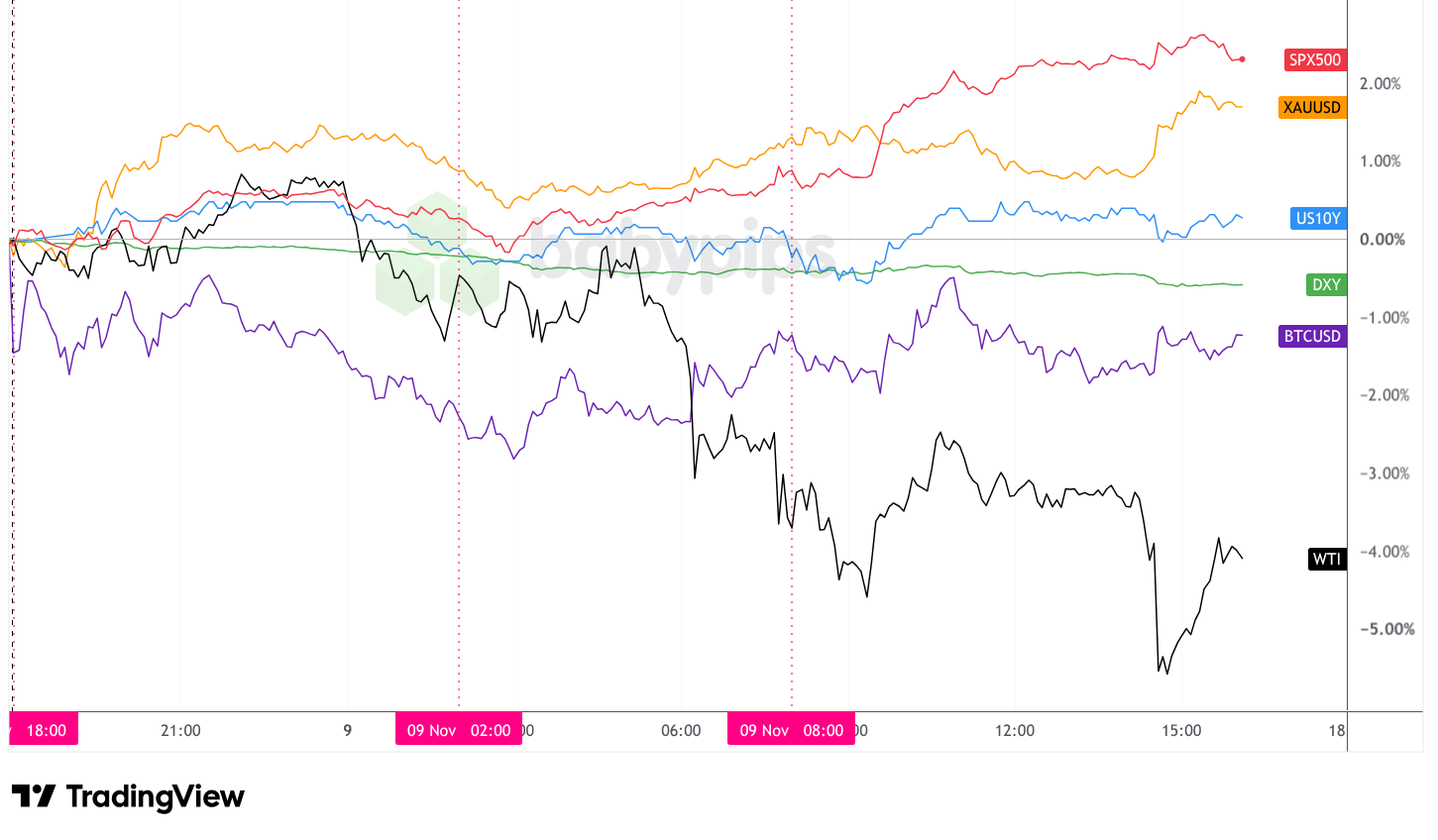
WTI crude oil fell about 4% to near $87.60, and Iran diplomacy headlines were probably the main reason. A report cited by Israel Hayom said Iran had “apparently” dropped its demand to control the Strait of Hormuz and charge ships transit fees. A Qatari official told Bloomberg the report was false, but traders may still have treated it as a sign that Gulf supply could flow again sooner than expected.
Trump then met Qatar’s prime minister at the White House to discuss Iran mediation. No deal came out of the talks, and Trump said afterward that the U.S. is “ready to go anytime we want” with strikes. The sharpest oil drop of the afternoon, around 2:35 pm ET, came within minutes of Al Arabiya reports, citing unnamed sources, of a proposed framework that would reopen Hormuz and lift the U.S. naval blockade right away. Neither government confirmed those terms, so the move rested on a leak.
The S&P 500 jumped about 2.4% to near 7,551 even though Nvidia fell about 4.3% after its board opened an independent investigation into reports that CEO Jensen Huang was targeted by a foreign intelligence effort. Cheaper oil likely eased inflation worries ahead of Tuesday’s CPI report, and chip stocks rebounded broadly. Trade relief may have added to the mood: the U.S. Trade Representative extended its pause on China shipping fees into January, while Beijing kept its own tariff truce in place.
The 10-year Treasury yield rose only about 2 basis points to near 4.88%. Lower oil probably held yields down, while the stock rally and hawkish Fed talk pushed the other way. Chicago Fed President Austan Goolsbee warned that inflation is running too hot, and Richmond Fed President Tom Barkin said the direction of policy is “relatively straightforward” with inflation stubbornly high.
Gold gained about 1.9% to near $4,140, likely helped by the weaker dollar, and it jumped during the same afternoon Iran reports that sank oil. Bitcoin lagged with a gain of about 0.2% to near $74,880. It slid soon after the Sunday reopen, possibly on spillover from the Nvidia news and worries about the AI trade, since no crypto-specific catalyst turned up, and it never caught up with stocks.
FX Market Behavior: U.S. Dollar vs. Majors
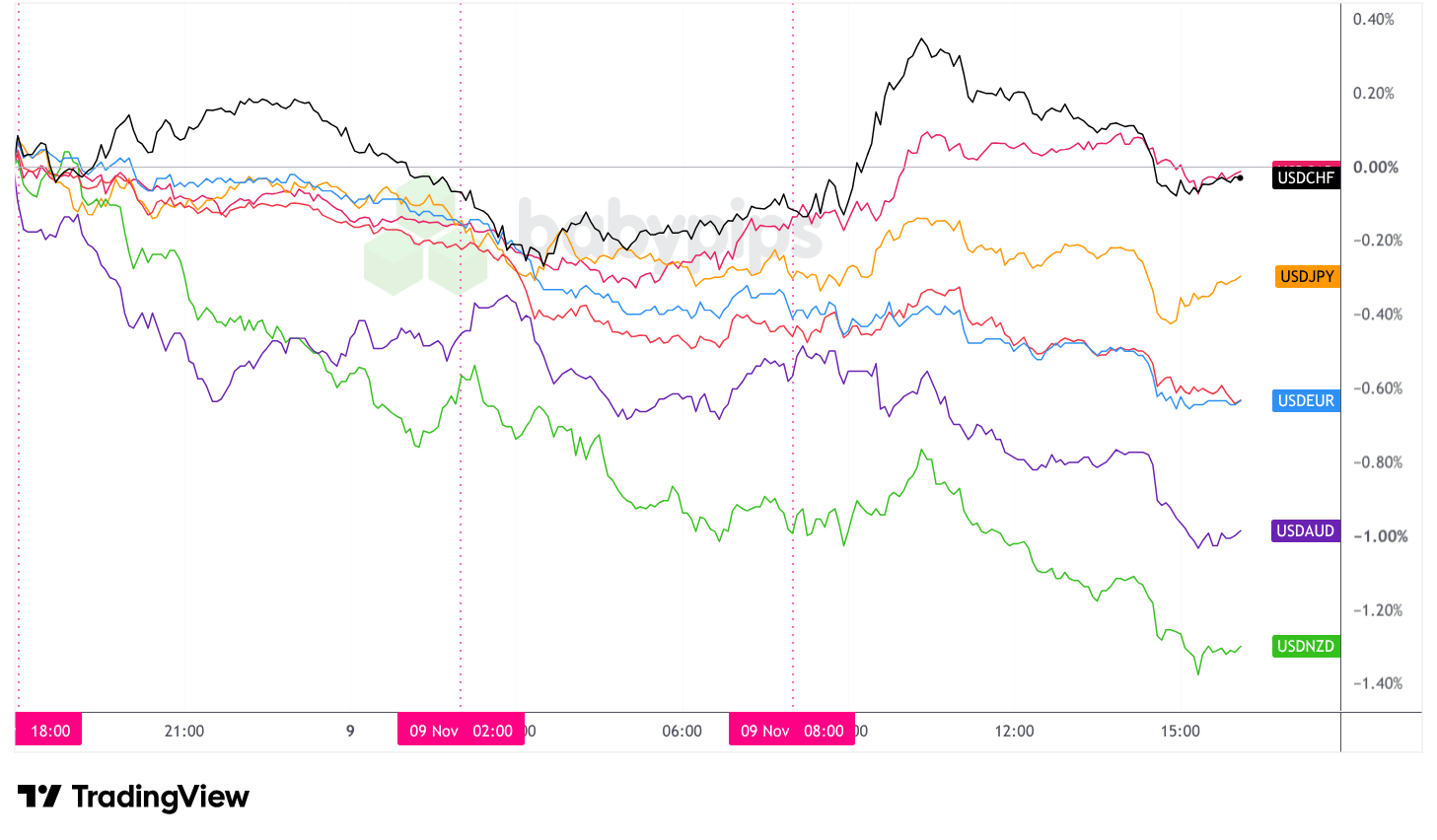
The New Zealand dollar finished as the strongest major, up about 1.4% against the U.S. dollar, followed by the Australian dollar at about 0.9%. The euro and the pound each gained about 0.7%, and the yen rose about 0.4%. The Swiss franc and the Canadian dollar barely moved, so USD/CHF slipped only about 0.1% and USD/CAD ended nearly flat. The Dollar Index fell about 0.6%.
Market concept of the dayWhy Do the Aussie and Kiwi Tend to Rise When Stocks Rally?
Traders often treat the Australian and New Zealand dollars as risk-sensitive currencies, because both economies lean on exports and global growth. When investors feel more confident, as they did on Monday with the S&P 500 up about 2.4%, money tends to move out of the safety of the U.S. dollar and toward these higher-beta currencies. That pattern likely helped the kiwi and the Aussie finish as the strongest majors, up about 1.4% and 0.9% against the dollar. The link does not hold every day, so it helps to read it alongside rates and commodity news, as explained in Risk-On / Risk-Off: How Global Mood Moves Currencies.
Risk appetite was probably the main story for the dollar. With stocks rallying and oil sliding on the Iran reports, traders had less reason to hold the safety of the greenback, which likely lifted the euro and the pound. Europe’s own data likely played a small part, since a better-than-expected Sentix reading and a jump in German exports left the euro little changed when they came out.
The kiwi and the Aussie probably got an extra lift from calmer U.S.-China trade ties. China’s tariff extension and the U.S. pause on China shipping fees both point to a steadier trade backdrop, and China is a major buyer of Australian and New Zealand exports. The kiwi stayed firm even with New Zealand’s election result still too close to call.
The franc and the loonie lagged for different reasons. As a safe haven, the franc usually draws less demand when risk appetite improves, which likely kept it near unchanged. The Canadian dollar was pulled both ways: the weaker U.S. dollar helped it, while the 4% drop in oil, one of Canada’s biggest exports, probably weighed on it. The yen’s gain was modest, likely because Japan benefits from cheaper energy while the risk-on mood worked against it.
On Premium this weekMonday leaned on two stories that this week’s Fundies Cheat Sheet had already flagged: talks with Iran and the AI trade. The Cheat Sheet also lines up Tuesday’s U.S. CPI report and Friday’s producer prices as the inflation tests that follow last week’s strong jobs data. It’s part of Babypips Premium.
Upcoming Potential Catalysts on the Economic Calendar: U.S. CPI and China Trade
- U.S. CPI for October 2026 at 1:30 pm GMT Tuesday, Nov. 10: economists expect 0.3% m/m for headline CPI and 0.2% m/m for core, slower than September’s 0.6% and 0.3%. It is the last inflation report before the Fed’s Dec. 8-9 meeting, and the BLS won’t publish an annual rate this month because of data gaps from last year’s government shutdown, so the monthly figures may carry extra weight for the dollar, yields and gold.
- China Balance of Trade for October 2026 at 3:00 am GMT Tuesday, Nov. 10: exports are expected to grow 33% y/y after 36.3% in September. China is a top buyer of Australian and New Zealand exports, so a big miss could test Monday’s gains in the Aussie and kiwi.
Also on the calendar (GMT):
- Japan Household Spending for September 2026 at 11:30 pm GMT Monday
- Australia Westpac Consumer Confidence for November 2026 at 11:30 pm GMT Monday
- BoJ Summary of Opinions at 11:50 pm GMT Monday
- Japan Current Account for September 2026 at 11:50 pm GMT Monday
- Australia NAB Business Confidence for October 2026 at 12:30 am GMT Tuesday
- China New Yuan Loans for October 2026 (tentative, from 8:00 am GMT Tuesday)
- U.S. NFIB Business Optimism Index for October 2026 at 11:00 am GMT Tuesday
- U.S. 10-Year Note Auction at 6:00 pm GMT Tuesday
- API Crude Oil Stock Change for the week ending Nov. 6, 2026 at 9:30 pm GMT Tuesday
With oil swinging on unconfirmed Iran reports and Fed officials leaning hawkish, Tuesday’s CPI report may decide whether Monday’s softer dollar holds. Any official word from Washington or Tehran on the proposed Hormuz framework could matter just as much for crude.
Prefer email updates? The Babypips Daily Newsletter sends market news and trading best practices to your inbox.
Stay frosty out there, forex friends!
Disclaimer: This article is for educational purposes only. It isn’t investment or trading advice or a recommendation to trade. Prices, levels, and percentage moves here are approximate because the market data was not captured at the exact close. The explanations for market moves are possible reasons, not confirmed causes.
AI disclosure: The Babypips editorial team used AI tools to help research, write, and check this article. A Babypips editor reviewed and edited it before publication. AI tools can misread data, make arithmetic errors, and state wrong information in a confident tone. Check figures and quotes against the linked sources before you rely on them. Our Editorial Policy explains how we create and review our content.