Financial & Forex Market Recap: Nov. 2, 2026


On Monday, Nov. 2, 2026, WTI oil sank about 6.5% on U.S.-Iran peace-talk hopes, gold rebounded 1.3%, and a chip selloff left the S&P 500 down 0.7%.
Oil did the talking on Monday. WTI crude oil sank about 6.5% to near $96.90 as Iran signaled it is ready to negotiate an end to the war, and that slide likely helped pull the 10-year Treasury yield down to about 4.90% and lift gold about 1.3% off a one-year low. A chipmaker selloff kept the S&P 500 from joining the relief rally, and Bitcoin lost about 1.4%.
In short: On Monday, Nov. 2, 2026, hopes for U.S.-Iran peace talks sent WTI crude oil down about 6.5% to near $96.90. Gold rose 1.3% to near $3,947 and the 10-year Treasury yield slipped to about 4.90%, but a chip selloff left the S&P 500 down 0.7%. The Swiss franc led the majors, and the Australian dollar lagged.
Monday’s Market Scoreboard: Oil Slump, Gold Rebound and a Franc-Led FX Board
| Asset | Close (approx.) | Day change | Driver |
|---|---|---|---|
| S&P 500 | 7,547 | -0.7% | Chip selloff outweighed cheaper oil |
| U.S. 10-year yield | 4.90% | -0.6% (about -3 bp) | Lower oil eased inflation worries |
| U.S. Dollar Index | 101.8 | -0.2% | Slid in London, steadied later |
| WTI crude oil | $96.90 | -6.5% | U.S.-Iran peace talk hopes |
| Gold | $3,947 | +1.3% | Cheaper oil, lower yields |
| Bitcoin | $76,690 | -1.4% | Binance outflows, tech weakness |
| USD/JPY | 157.93 | +0.2% | Yen soft despite Katayama warnings |
| EUR/USD | 1.1194 | +0.3% | Hawkish ECB talk, PMI beat |
| GBP/USD | 1.3410 | +0.2% | Early London dollar slide |
| USD/CHF | 0.8182 | -0.8% | Franc led, strong Swiss PMI |
| AUD/USD | 0.6998 | -0.4% | Weakest major before RBA |
| NZD/USD | 0.5618 | -0.2% | Slipped after China PMIs |
| USD/CAD | 1.3993 | +0.2% | Cheaper oil, weak Canada PMI |
Approximate levels, 6:00 pm ET Sunday to 4:00 pm ET Monday. Drivers are likely factors, not confirmed causes.
Forex News Headlines & Data: Iran Talks, China and Euro Area PMIs, U.S. ISM Beat
- Iranian President Masoud Pezeshkian said Supreme Leader Mojtaba Khamenei had granted the government certain authorities for peace talks after days of talks with Qatari mediators, and President Donald Trump later said a deal with Iran “could happen”
- Attacks on Gulf shipping continued, with the U.K. Maritime Trade Operations centre reporting a tanker hit by two projectiles about 72 nautical miles off Saudi Arabia
- Japan S&P Global Manufacturing PMI Final for October 2026: 53.3 (53.3 forecast; 54.1 previous)In line
- China RatingDog Manufacturing PMI for October 2026: 52.0 (51.7 forecast; 52.1 previous)Above forecast
- Germany Retail Sales for September 2026: -2.0% m/m (0.1% m/m forecast; 1.2% m/m previous)Below forecast
- Switzerland Retail Sales for September 2026: 1.6% y/y (2.4% y/y forecast; 3.9% y/y previous)Below forecast
- Switzerland procure.ch Manufacturing PMI for October 2026: 56.7 (54.7 forecast; 55.3 previous)Above forecast
- Euro area HCOB Manufacturing PMI Final for October 2026: 52.7 (52.4 forecast; 52.9 previous)Above forecast
- ECB policymaker Peter Kazimir said the question is “not whether further action will be needed but how much more will be required”
- U.K. S&P Global Manufacturing PMI Final for October 2026: 52.8 (52.8 forecast; 51.9 previous)In line
- Canada S&P Global Manufacturing PMI for October 2026: 49.6 (51.0 forecast; 51.5 previous)Below forecast
- U.S. S&P Global Manufacturing PMI Final for October 2026: 54.9 (56.0 forecast; 55.9 previous)Below forecast
- U.S. ISM Manufacturing PMI for October 2026: 55.5 (54.7 forecast; 54.5 previous)Above forecast
Why it mattered: the production index jumped to 59.0, its highest since November 2021, while the prices index eased to a still-high 75.2. USD/JPY and the 10-year yield rose for about 45 minutes after the 10:00 am ET release, and the S&P 500 hit its day high shortly after. - U.S. Construction Spending for September 2026: -1.9% m/m (0.2% m/m forecast; 2.0% m/m previous)Below forecast
Broad Market Price Action: Oil Sinks 6.5% on Iran Talks as a Chip Selloff Caps Stocks
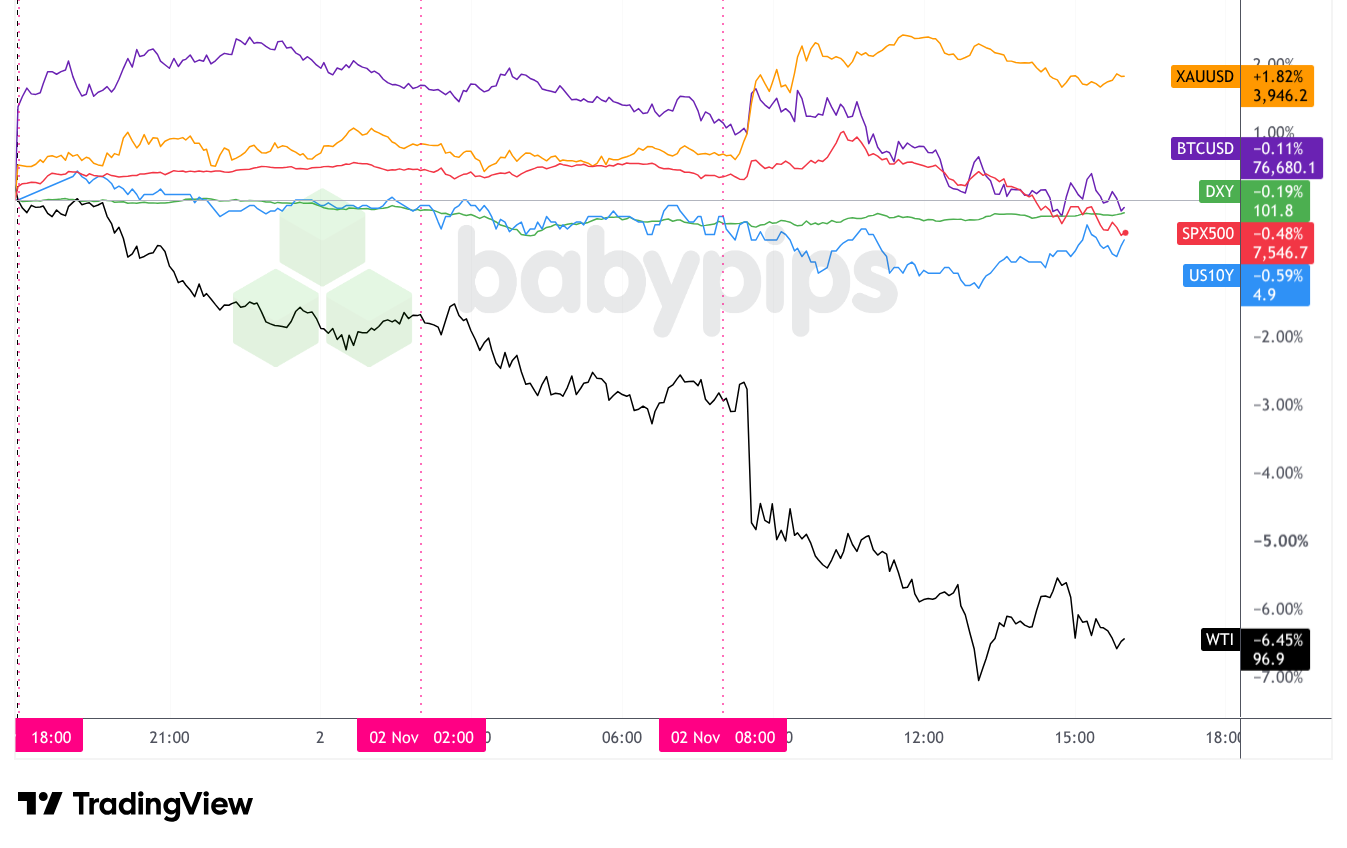
Iran diplomacy drove most of Monday’s moves. Iranian negotiators spent the weekend in talks with Qatari mediators, and around 8:30 am ET Iranian state media reported that Pezeshkian said the Supreme Leader had handed the government new authority to negotiate. Pezeshkian added that Tehran “will try to resolve the problem with dialogue”. Within about 10 minutes, WTI fell about $2, gold jumped about $30 and stocks climbed, which looks like traders pricing out some war risk. The stronger-than-expected ISM manufacturing report at 10:00 am ET gave yields and the dollar a short lift, but oil stayed in charge for the rest of the day.
WTI crude oil opened the week near $103.60, a little below Friday’s close near $104.10, and slid through the Asian session as the Doha talks went on. It broke below $101 in early London trade and was near $100.70 just before the 8:30 am ET headline, which knocked it under $99 within minutes. WTI hit a day low near $96.30 around 1:05 pm ET and ended near $96.90, down about 6.5%. Some analysts still see supply risks keeping prices high: Goldman Sachs raised its December Brent forecast to $105 a barrel on Monday.
The 10-year Treasury yield ended about 3 basis points lower near 4.90% (a basis point is 0.01 percentage point). It peaked near 4.95% early in the Asian session, then eased as oil fell, since cheaper energy can cool inflation worries and bets on more Fed hikes. The yield dipped after the 8:30 am ET Iran headline, climbed from about 4.88% to 4.91% in the 45 minutes after the ISM beat, then fell to its day low near 4.87% around 1:05 pm ET, the same moment WTI hit bottom. Longer-dated Treasury yields moved lower on the day, and the 10-year drifted back to about 4.90% by the close.
The S&P 500 slipped about 0.7% to near 7,547 on the chart, while the cash index closed near 7,542, down 0.5% from Friday. Stocks climbed after the Iran headline and hit a day high near 7,660 around 10:25 am ET, up about 0.8%, but that morning rally petered out as chipmakers sold off again. Marvell tumbled after agreeing to buy Lumentum in a $115 billion all-stock deal, Intel extended Friday’s plunge and Oracle fell on plans to raise $20 billion. The index slid through the afternoon to its low near 7,544 around 3:55 pm ET. Cheaper oil likely helped the rest of the market, since most stocks on Wall Street still rose while the AI names dragged the index lower.
Gold rose about 1.3% to near $3,947, bouncing from Friday’s one-year low near $3,876. After a day low near $3,892 around 3:15 am ET, it jumped from about $3,900 to $3,950 between 8:15 and 9:05 am ET as the Iran headline hit oil and yields, and peaked near $3,970 around 11:35 am ET. Lower oil likely eased fears that energy-driven inflation would push the Fed into more hikes, and gold pays no interest, so it tends to gain when those bets fade.
Bitcoin fell about 1.4% to near $76,690. It touched a high near $78,600 around 10:35 pm ET Sunday, then slid for most of the day. Binance customers pulled a net $3.64 billion after the exchange reopened withdrawals following its $6.3 billion hack, which likely weighed on prices. The 8:30 am ET Iran headline lifted Bitcoin toward $78,000 for a few minutes, but it faded with tech stocks and touched its low near $76,580 around 2:45 pm ET.
Forex concept of the dayWhy can cheaper oil lift gold and Treasury bonds?
Oil feeds into fuel, shipping and factory costs, so a big oil rally can push inflation higher and keep a central bank leaning toward rate hikes. When oil drops, traders often trim those hike bets, bond yields slip and gold, which pays no interest, gets cheaper to hold. On Monday, WTI fell about 6.5%, the 10-year yield eased about 3 basis points and gold rose about 1.3%. The yield move was small next to gold’s jump, so part of gold’s gain was probably a bounce from Friday’s selloff. Learn how yields connect to currencies and other markets in How Bond Yields Affect Currency Movements.
FX Market Behavior: U.S. Dollar vs. Majors
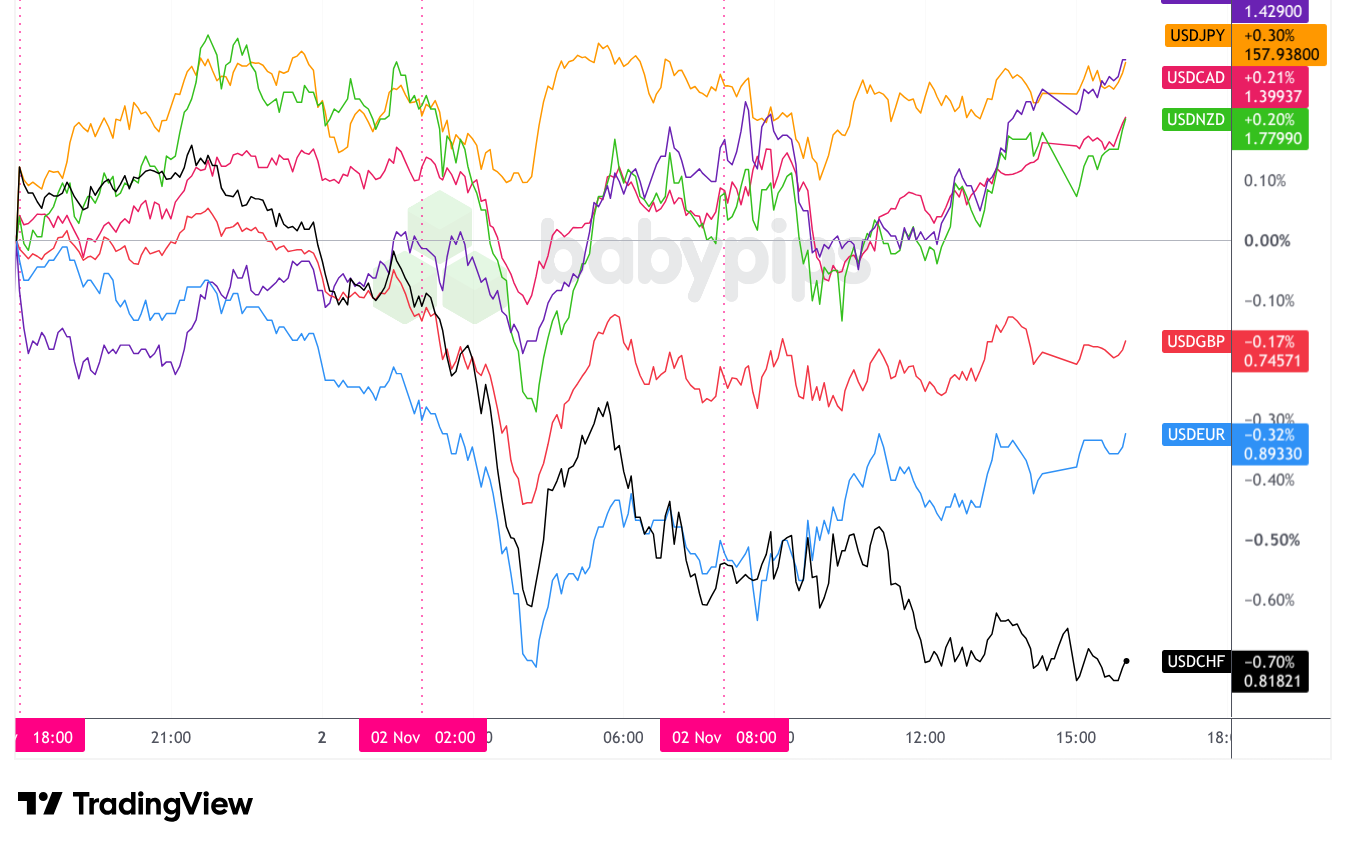
The Swiss franc led the majors, up about 0.8% against the dollar, while the Australian dollar lagged with a loss of about 0.4% ahead of Tuesday’s Reserve Bank of Australia (RBA) decision. The euro gained about 0.3% and the pound about 0.2%, while the Canadian dollar, kiwi and yen each slipped about 0.2%. The U.S. Dollar Index fell about 0.2% to near 101.8, and the London session did most of that work.
The Asian session opened with a small weekend gap. EUR/USD started about 0.2% above Friday’s close, while most other pairs opened near their Friday levels. Weekend data showed China’s official manufacturing PMI back in contraction at 49.3, and the private RatingDog PMI held at 52.0 at 8:45 pm ET. The kiwi slid to its day low near 0.5610 around 9:45 pm ET, so the weak official survey likely weighed more than the upbeat private one. USD/JPY climbed toward 157.90 even as Japan’s Finance Minister Satsuki Katayama warned against disorderly yen moves, then dipped to about 157.70 shortly after midnight ET with no clear catalyst. The loonie softened after Trump said the U.S. and Canada had the “concept” of a trade deal.
The dollar slid at the start of the London session. Between about 3:00 and 4:10 am ET, the Dollar Index fell from near 101.75 to its day low near 101.43, EUR/USD rose to its high near 1.1238 and GBP/USD reached its high near 1.3447. Oil was falling over the same stretch, and Brent was down about 4% by the European morning after Secretary of State Marco Rubio said Trump wants to resolve the Iran war peacefully, so the dollar probably lost some of its war-risk support. The euro also got help from an above-forecast euro area PMI at 4:00 am ET and from ECB policymaker Peter Kazimir, who said markets may still underestimate how much more tightening the ECB needs. The franc firmed after a strong Swiss PMI at 3:30 am ET. The dollar steadied after about 4:15 am ET, USD/JPY reached its day high near 158.00 around 5:30 am ET, and the kiwi gave back its London gains between about 4:50 and 5:50 am ET with no clear catalyst.
The 8:30 am ET Iran headline gave the U.S. session a quick jolt. The Dollar Index dipped to about 101.56 and USD/JPY slipped toward 157.79 as oil fell. The ISM beat at 10:00 am ET then lifted USD/JPY from about 157.63 to 157.89 within the hour as yields rose. USD/CAD dropped to about 1.3955 around 10:00 am ET, even after Canada’s manufacturing PMI fell to 49.6 at 9:30 am ET, then climbed through the afternoon to finish at its day high near 1.3993, likely because oil kept sliding. The Aussie drifted to its day low near 0.6998 into the close, and USD/CHF bottomed near 0.8179 around 3:00 pm ET.
On Premium this weekThis week’s Fundies Cheat Sheet: Nov. 2 to 6, 2026 warned that “the calendar and the headlines may collide,” with Iran strike reports landing in the same week as the U.S. midterms and Friday’s jobs report. Next up is the RBA, and our Event Guide: RBA Monetary Policy Statement (November 2026) previews whether the central bank hikes again and keeps the door open to more. Both are part of Babypips Premium.
Upcoming Potential Catalysts: RBA Decision, U.S. Midterms and JOLTS
- RBA Interest Rate Decision at 3:30 am GMT Tuesday (press conference at 4:30 am GMT): 31 of 32 economists in a Reuters poll expected a hike to 4.85% from 4.60%, so the Aussie, Monday’s weakest major, may react more to Governor Michele Bullock’s guidance than to the decision itself.
- U.S. midterm elections on Tuesday: voters decide control of Congress, and polls suggest Democrats are likely to win the House. Trump has threatened at times to resume strikes on Iran after the vote, so the results, which arrive late Tuesday U.S. time, may feed into oil and the dollar.
- U.S. JOLTS Job Openings for September 2026 at 3:00 pm GMT Tuesday: forecasts call for about 7.13 million openings, up from 7.08 million, and the report is the first labor test before Friday’s jobs data.
Also on the calendar (GMT):
- Switzerland Inflation Rate for October 2026 at 7:30 am GMT (1.3% y/y forecast; 1.0% y/y previous)
- U.S. Factory Orders for September 2026 at 3:00 pm GMT
- AMD earnings after the U.S. close Tuesday
- API Crude Oil Stock Change for the week ending October 30, 2026 at 9:30 pm GMT
- New Zealand Unemployment Rate and Employment Change for Q3 2026 at 9:45 pm GMT
Oil’s 6.5% drop rests on talks that Iran says depend on Washington, and Trump has floated renewed strikes before, so crude may stay jumpy around Tuesday’s vote. The RBA gets the first shot at the Aussie a few hours earlier.
Prefer email updates? The Babypips Daily Newsletter sends market news and trading tips to your inbox.
Stay frosty out there, forex friends!
AI disclosure: A Babypips editor researched and directed this article, and AI tools helped analyze the intraday price data, research sources, initiate the draft, before a Babypips editor did the final review and edit. AI tools can misread data, make arithmetic errors, and state wrong information in a confident tone. Prices, levels, and percentage moves here are approximate because the market data was not captured at the exact close, so check the figures against your own data source before you rely on them. The explanations for market moves are possible reasons, not confirmed causes. This article is for education and is not a recommendation to trade.
Related Articles
- Forex News
Financial & Forex Market Recap: Oct. 26, 2026
- Forex News
Financial & Forex Market Recap: Nov. 3, 2026
- Forex News
Financial & Forex Market Recap: Nov. 4, 2026
- Forex News
Financial & Forex Weekly Recap: October 19 – 23, 2026
- Crypto News
Bitcoin Price Heads Lower as Apple Earnings, US Midterms Weigh on Stocks