Financial & Forex Market Recap: Nov. 5, 2026


Nov. 5, 2026: AI investment concerns and chip weakness hit stocks and Bitcoin, while bonds and gold gained. Oil rebounded as Iran uncertainty persisted.
Investors dumped technology shares on Thursday as chip earnings disappointments and worries about the post-election outlook for artificial intelligence spending overwhelmed Wednesday’s relief rally. The S&P 500 and Bitcoin sank, while investors seeking safety likely helped lift government bonds and gold. Oil rebounded despite the equity rout, while the 10-year Treasury yield fell despite persistent energy risks.
In short: On Thursday, Nov. 5, 2026, chip-sector weakness and fears about artificial intelligence investment likely drove a broad retreat from risk. The S&P 500 fell 4.6% to about 7,348 and Bitcoin lost 5.5% to $76,036. Gold rose to $4,096, while WTI oil rebounded to $91.47.
Thursday’s Market Scoreboard: Stocks Retreat, Oil Rebounds
| Asset | Close (approx.) | Day change | Driver |
|---|---|---|---|
| S&P 500 | 7,348 | -4.60% | Chip earnings, AI investment worries |
| U.S. 10-year yield | 4.843% | N/A* | Demand for safer assets |
| U.S. Dollar Index | 101.609 | +0.12% | Uneven demand across currencies |
| West Texas Intermediate (WTI) crude oil | $91.47 | +2.78% | Iran war uncertainty |
| Gold | $4,096.08 | +0.79% | Safety demand, lower yields |
| Bitcoin | $76,036 | -5.54% | Likely broader risk reduction |
| USD/JPY | 157.819 | -0.36% | Lower yields, yen haven demand |
| EUR/USD | 1.1222 | -0.12% | Dollar gains despite lower yields |
| GBP/USD | 1.3452 | -0.16% | BoE support, broader dollar demand |
| USD/CHF | 0.81722 | +0.07% | Uneven haven demand |
| AUD/USD | 0.6935 | -1.00% | Risk aversion outweighed trade surplus |
| NZD/USD | 0.5597 | -0.45% | Likely risk-sensitive currency selling |
| USD/CAD | 1.40136 | +0.30% | Risk aversion despite oil rebound |
Approximate levels, 6:00 pm ET Wednesday to 4:00 pm ET Thursday. Drivers are likely factors, not confirmed causes.
*The 10-year yield has no 6:00 pm ET opening observation, so its full-window change is unavailable. EUR/USD, GBP/USD, AUD/USD and NZD/USD use the last available quotes at 3:55 pm ET, five minutes before the endpoint.
Forex News Headlines & Data: BoE Hike, U.S. Claims and Productivity
- Australia Goods Trade Balance for September 2026: A$2.826B (A$0.810B forecast; A$0.184B previous)Above forecast
- Germany Factory Orders for September 2026: 4.4% m/m (4.8% forecast; -10.1% previous)Below forecast
- Switzerland Unemployment Rate, Seasonally Adjusted, for October 2026: 3.1% (3.1% forecast; 3.1% previous)In line
- Euro area Producer Price Index for September 2026: 11.1% y/y (10.9% forecast; 8.3% previous)Above forecast
- U.K. Bank of England Bank Rate for November 2026: 4.00% (4.00% forecast; 3.75% previous)In line
Why it mattered: Eight policymakers backed a 25 bp hike, while Catherine Mann wanted 50 bp. The prospect of further tightening likely supported sterling around the decision. - U.S. Initial Jobless Claims for week ended October 31, 2026: 189K (196K forecast; 195K previous, revised)Below forecast
- U.S. Nonfarm Business Labor Productivity for Q3 2026, Preliminary: 3.6% annualized (2.8% forecast; 2.1% previous, revised)Above forecast
- U.S. Nonfarm Business Unit Labor Costs for Q3 2026, Preliminary: -0.7% annualized (0.6% forecast; 1.9% previous, revised)Below forecast
- Chip shares sold off after Qualcomm handset revenue disappointed and investors worried that the U.S. midterm outcome could slow AI infrastructure investment.
Broad Market Price Action: AI Concerns Spread Beyond Tech
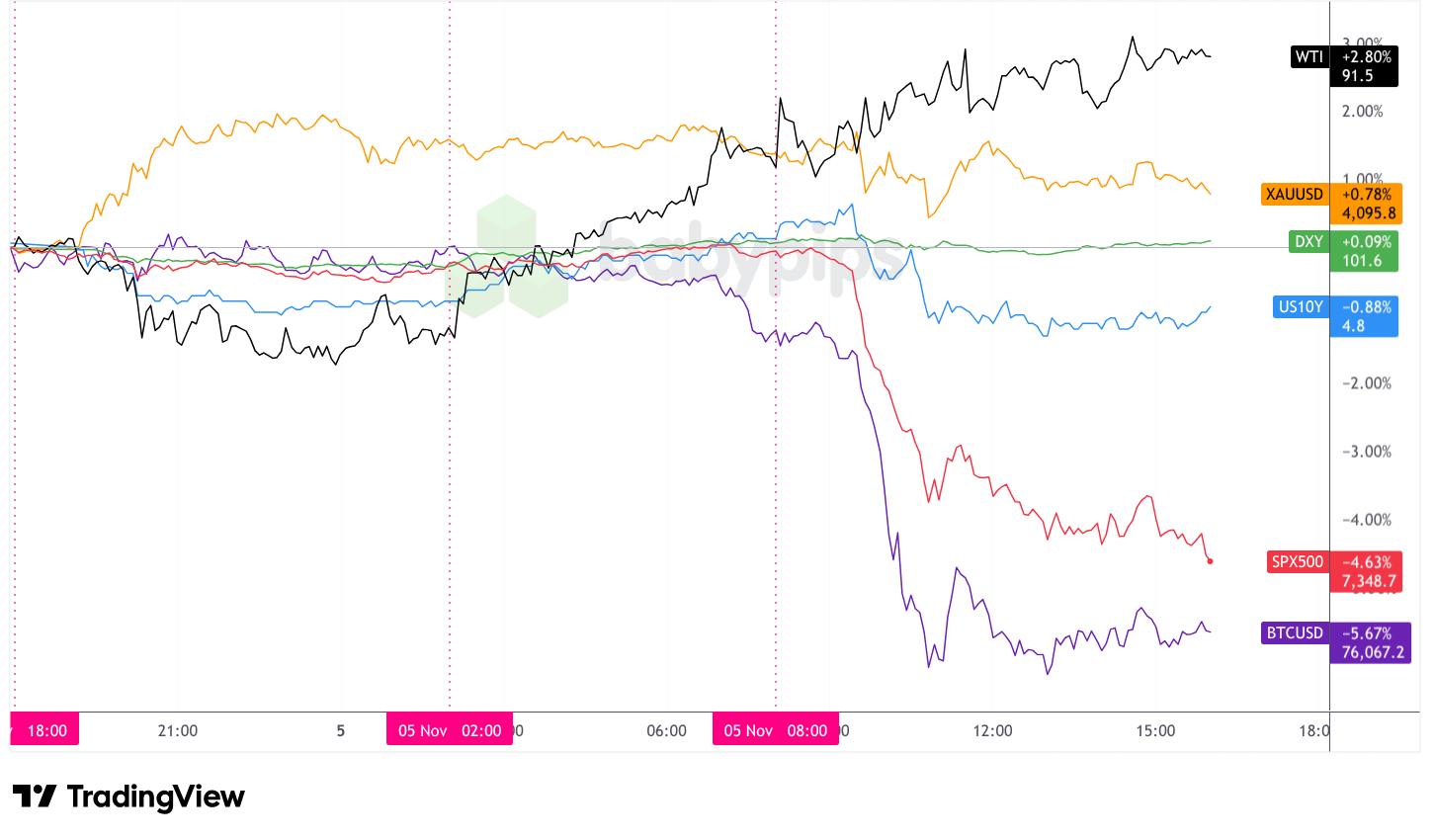
Qualcomm’s disappointing smartphone-chip sales and concerns about AI infrastructure spending likely sparked the equity retreat. Investors worried that the Democratic sweep of Congress, alongside victories for candidates opposing data-center expansion, could make new projects harder to approve. Those concerns threaten the spending assumptions behind chipmakers’ earnings expectations. They describe a change in expectations, not an enacted nationwide ban on data centers.
The selloff spread beyond the companies that triggered it. The S&P 500 lost about 4.6%, erasing the previous day’s advance. Large technology companies account for a substantial share of the benchmark, so heavy selling in that group can pull down the index even before weakness spreads to other sectors. Disappointing outlooks at Qualcomm and Arm added to investors’ concerns as the rotation into defensive shares developed into broader selling.
Investors seeking safety likely supported Treasuries even as oil rose. The 10-year yield finished near 4.84%, and gold gained about 0.8%. Lower yields reduce the income investors give up when holding gold, while worries about equities can add demand for the metal. Gold had already rallied before the main U.S. stock decline; no single verified headline explained that earlier burst, so attributing the entire gain to the Wall Street selloff would overstate the evidence.
Bitcoin fell about 5.5% alongside equities. Its sharpest decline overlapped the equity selloff. That combination suggests investors likely reduced exposure to volatile assets. No clear Bitcoin-specific catalyst stood out, and lower Treasury yields did not prevent the decline.
Renewed uncertainty about the Iran war likely helped oil rebound after its post-election slump. Wednesday’s election result had encouraged hopes for a quicker resolution; Thursday’s rebound suggests investors were less willing to price in a smooth diplomatic outcome. Oil’s rise alongside falling stocks and bond yields shows that supply and geopolitical risks can support energy prices even when investors become more cautious about growth.
Market concept of the dayWhy Can Stocks and Treasury Yields Fall Together?
Investors can sell shares and seek government bonds when they worry about corporate profits or economic growth. Their bond purchases push prices up and yields down, so lower yields can accompany weaker stocks when demand for safety dominates. Thursday’s equity decline and lower Treasury yield fit that pattern, although the relationship varies with the catalyst. See What Is Intermarket Analysis? for the links among stocks, bonds, commodities and currencies.
FX Market Behavior: U.S. Dollar vs. Majors
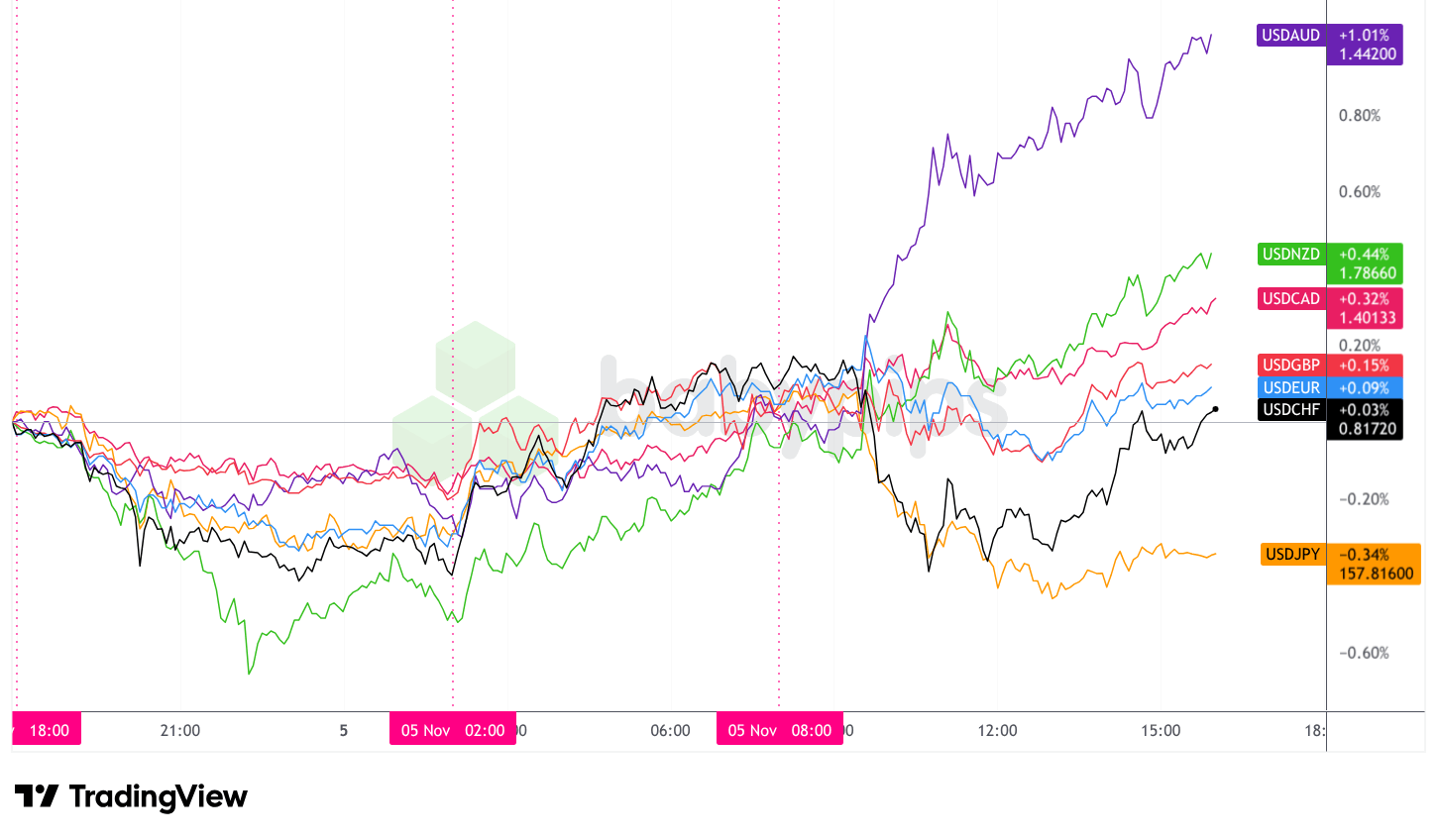
The yen led the majors against the dollar, gaining about 0.4%, while the Australian dollar fell about 1.0% to finish weakest. The kiwi lost about 0.4% and the Canadian dollar about 0.3%; sterling, the euro and the Swiss franc slipped less. The Dollar Index rose about 0.1%, so the session combined broad dollar resilience with a stronger yen.
Lower U.S. yields likely supported the yen by narrowing the return advantage on dollar assets. Investors’ retreat from equities may also have encouraged demand for the Japanese currency. That combination fits the simultaneous drop in USD/JPY, stocks and yields better than an explanation based solely on higher U.S. rate expectations. The franc gained during the sharp equity decline but finished slightly weaker against the dollar, a reminder that haven currencies do not move in lockstep.
The Bank of England raised rates as expected, but its inflation warning and discussion of further tightening likely supported the pound around the announcement. Policymakers projected inflation near 5% by mid-2027, and several saw a case for another near-term increase. Sterling still finished lower against the dollar. An expected hike and a hawkish message can support a currency temporarily without overpowering wider demand for dollars throughout the trading day.
Risk aversion likely weighed on the Australian and New Zealand dollars as investors reduced exposure to growth-sensitive currencies. Australia’s larger goods surplus offered a positive domestic signal, but it did not keep the Aussie from finishing last. The Canadian dollar also weakened despite the oil rebound. Stronger crude can improve Canada’s export outlook, yet that link competed with the broader retreat from risk and Friday’s employment reports.
U.S. data gave investors a mixed policy message: fewer jobless claims pointed to limited layoffs, while stronger productivity and falling unit labor costs likely eased concerns about labor-driven inflation. The dollar nevertheless gained against most peers as stocks sold off. Friday’s payrolls report would offer a separate test of hiring and wages.
On Premium this weekFriday’s jobs report follows a day when stock-market stress and lower yields moved together. The U.S. Non-Farm Payrolls Event Guide discusses the release and dollar scenarios. It is part of Babypips Premium.
Upcoming Potential Catalysts on the Economic Calendar: U.S. and Canadian Jobs
- U.S. Employment Report for October 2026, Friday, Nov. 6, at 1:30 pm GMT: The current calendar expects 65K payroll gains, unemployment at 4.2% and hourly earnings up 0.3% m/m. Hiring and wages may reset Federal Reserve rate expectations after Thursday’s risk retreat.
- Canada Employment Report for October 2026, Friday, Nov. 6, at 1:30 pm GMT: The calendar expects employment to rise 13.6K and unemployment to remain at 6.5%. The simultaneous U.S. release makes the relative labor-market results important for USD/CAD.
- U.S. University of Michigan Consumer Sentiment, Preliminary, for November 2026, Friday, Nov. 6, at 3:00 pm GMT: The index is expected at 48.0 versus 46.3 previously. Inflation expectations may show whether households anticipate more lasting pressure from energy prices.
Also on the calendar (GMT):
- Thursday, Nov. 5: Japan average cash earnings for September at 11:30 pm.
- Friday, Nov. 6: Germany industrial production at 7:00 am; France trade balance at 7:45 am; Switzerland consumer confidence at 8:00 am.
- Friday, Nov. 6: Euro area retail sales at 10:00 am; Canada Ivey PMI at 3:00 pm; U.S. consumer credit at 8:00 pm.
Friday’s data will arrive while investors are still reassessing AI spending and the political outlook. A firm jobs report could renew concerns about further Fed tightening; softer hiring could ease those concerns while adding to growth worries. Oil remains a separate source of inflation risk, so a calmer equity market alone would not resolve the policy trade-off.
Prefer email updates? The Babypips Daily Newsletter sends market news and trading best practices to your inbox.
Stay frosty out there, forex friends!
Disclaimer: This article is for educational purposes only. It isn’t investment or trading advice or a recommendation to trade. Prices, levels, and percentage moves here are approximate because the market data was not captured at the exact close. The explanations for market moves are possible reasons, not confirmed causes.
AI disclosure: The Babypips editorial team used AI tools to help research, write, and check this article. A Babypips editor reviewed and edited it before publication. AI tools can misread data, make arithmetic errors, and state wrong information in a confident tone. Check figures and quotes against the linked sources before you rely on them. Our Editorial Policy explains how we create and review our content.