Financial & Forex Market Recap: Nov. 25, 2026

On Wednesday, Nov. 25, 2026, stocks and gold clawed back a steep AI-led drop, Treasury yields fell despite hot PCE inflation, and oil jumped about 3%.
Wednesday swung hard in both directions. An AI-led stock selloff, new U.S. tariff proposals and hotter core inflation sent the S&P 500, gold and Bitcoin sharply lower in the morning, before dip buyers in thin pre-Thanksgiving trade erased most of those losses. Treasury yields fell anyway as investors crowded into bonds, the U.S. dollar slipped against most majors, and oil jumped about 3% after Yemen’s Houthis said they hit Saudi Arabia’s largest refinery.
In short: On Wednesday, Nov. 25, 2026, an AI-led selloff briefly pushed the Nasdaq 100 to the edge of a bear market before stocks recovered. The S&P 500 ended about 0.2% lower near 7,183, the 10-year Treasury yield fell to near 4.86% despite hot core PCE inflation, and WTI crude rose about 3% to near $85.22.
Wednesday’s Market Scoreboard: AI Rout Reversal, Falling Yields and an Oil Jump
| Asset | Close (approx.) | Day change | Driver |
|---|---|---|---|
| S&P 500 | 7,183 | -0.22% | AI selloff, late rebound |
| U.S. 10-year yield | 4.86% | -1.34% (about -7 bp) | Haven bond buying |
| U.S. Dollar Index | 103.70 | -0.12% | Early gains faded with yields |
| WTI crude oil | $85.22 | +2.99% | Houthi strike on Saudi refinery |
| Gold | $3,574 | +0.50% | Recovered from below $3,500 |
| Bitcoin | $60,194 | +0.51% | Rebounded with stocks |
| USD/JPY | 159.23 | -0.02% | Lower yields offset risk swings |
| EUR/USD | 1.0978 | +0.10% | Softer dollar after tariffs |
| GBP/USD | 1.3119 | +0.06% | Flat despite BoE hawks |
| USD/CHF | 0.8309 | -0.56% | Franc led on haven demand |
| AUD/USD | 0.6630 | -0.17% | Risk-off beat hot CPI |
| NZD/USD | 0.5489 | +0.17% | Rode the midday rebound |
| USD/CAD | 1.4210 | -0.39% | Oil and BoC hike bets |
Approximate levels, 6:00 pm ET Tuesday to 4:00 pm ET Wednesday. Drivers are likely factors, not confirmed causes.
Forex News Headlines & Data: U.S. PCE, Q3 GDP, Australia CPI and New Tariffs
- Japan Services PPI for October 2026: 4.2% y/y (3.6% forecast; 3.8% previous)Above forecast
- Australia Monthly CPI for October 2026: 4.9% y/y (4.8% forecast; 4.3% previous)Above forecast
- Trimmed mean: 3.8% y/y (3.6% forecast; 3.6% previous)Above forecast
- 0.5% m/m (0.4% forecast; 0.8% previous)Above forecast
- Germany Final GDP for Q3 2026: 1.2% y/y unadjusted (1.3% forecast; 1.0% previous), with quarterly growth revised down to 0.1% from 0.2%Below forecast
- France Consumer Confidence for November 2026: 82 (82 forecast; 81 previous)In line
- Bank of England Governor Andrew Bailey told lawmakers that U.K. inflation could peak below the Bank’s roughly 5% forecast if energy prices hold near recent levels, but repeated that more rate hikes are more likely than not if energy prices stay high
- U.S. Core PCE Price Index for October 2026: 0.3% m/m (0.3% forecast; 0.3% previous); 3.3% y/y (3.2% forecast; 3.1% previous)Above forecast
- Personal income: 0.7% m/m (0.4% forecast; 0.3% previous)Above forecast
- Personal spending: 0.3% m/m (0.4% forecast; 0.6% previous)Below forecast
- U.S. GDP Second Estimate for Q3 2026: 4.3% annualized (3.5% forecast; 3.4% advance estimate)Above forecast
- U.S. Durable Goods Orders for October 2026: 0.2% m/m (0.6% forecast; 1.8% previous)Below forecast
- Ex-transportation: 0.5% m/m (0.5% forecast; 0.5% previous)In line
- U.S. Initial Jobless Claims for the week to Nov. 21: 189K (200K forecast; 202K previous)Below forecast
- U.S. New Home Sales for October 2026: 701K annualized (650K forecast; 614K previous)Above forecast
- EIA Crude Oil Inventories for the week to Nov. 20: +1.1M barrels (forecasts of +1.3M and +1.5M; +3.4M previous)Forecasts differ
- The Fed’s Beige Book showed slight to moderate growth in most districts and a pickup in wage pressures
- The U.S. Trade Representative proposed new Section 301 tariffs on 14 economies, including China, the European Union and Japan, over excess factory capacity. A comment period comes first, so nothing takes effect before January at the earliest
- Yemen’s Houthis said they attacked Saudi Arabia’s Ras Tanura refinery, the kingdom’s largest
Broad Market Price Action: AI Fears Hit Early, Dip Buyers Show Up by Midday
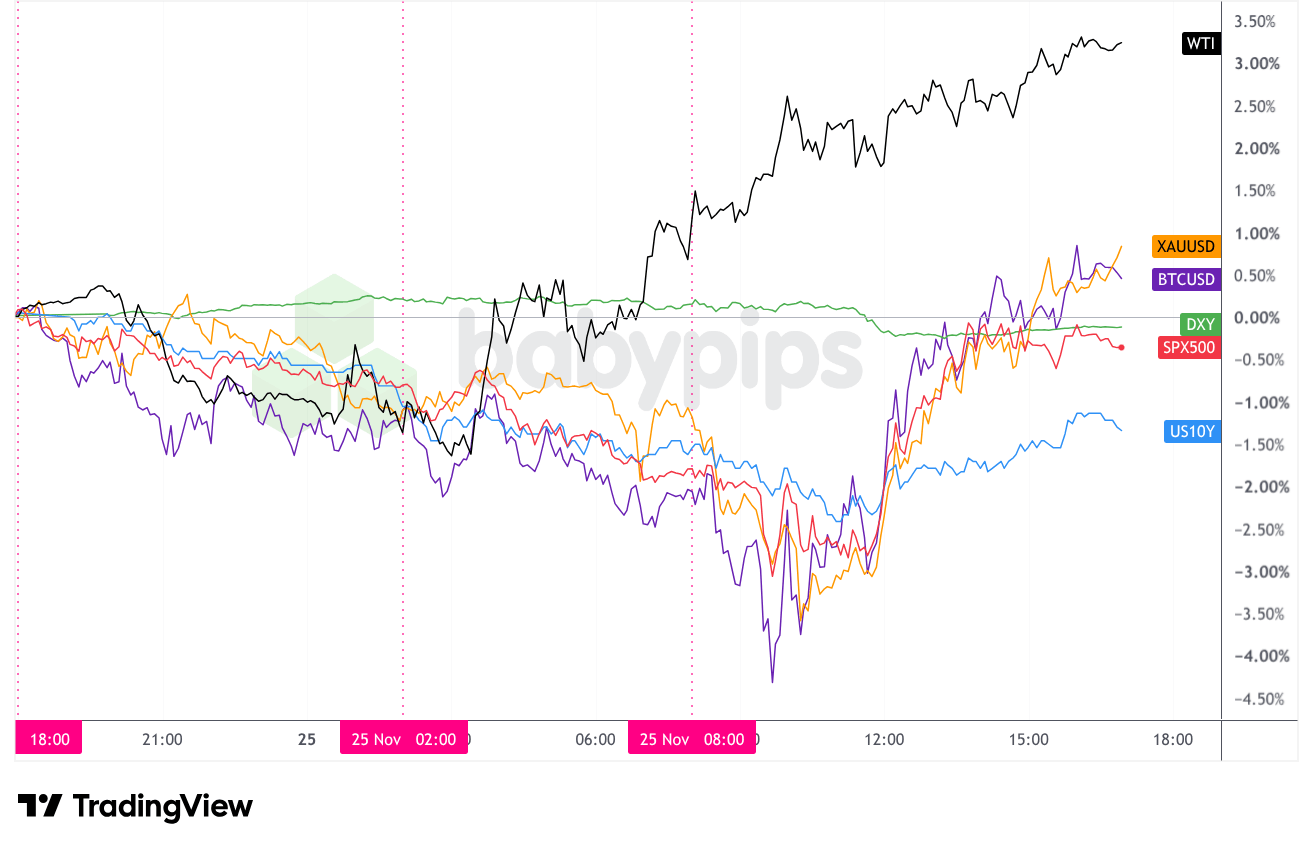
The morning slide had three likely ingredients. Doubts about the payoff from AI spending returned after Monday’s Nvidia-led relief rally, and the Nasdaq 100 briefly fell 20% from its October high, the textbook line for a bear market. Washington’s new tariff proposals added a trade-war worry, and core PCE came in a notch hot. At the low, around 9:45 am ET, the S&P 500 CFD was down about 3.2% near 6,970.
Then the selling ran out of steam. Stocks clawed back most of the drop by the close, helped in part by light holiday trading and a widely shared blog post from investor Michael Burry, who said he sold the rest of his Nasdaq 100 puts and now holds mostly bullish positions. Money also rotated into materials, energy and real estate while Nvidia still lost about 4%. The S&P 500 CFD ended about 0.2% lower near 7,183. A holiday-week bounce on thin volume may say more about traders closing bearish bets than about a change in the AI story.
Bonds showed how nervous investors were. The 10-year Treasury yield fell about 7 basis points to near 4.86%, its eighth straight daily drop, even though the inflation data argued for higher rates. That combination usually points to safe-haven buying: when investors dump stocks and other leveraged bets, they often park the cash in Treasuries, which pushes yields down.
Gold took a wild ride. It slid below $3,500 for the first time since September 2025 as the stock rout and Fed-hike bets weighed on it, bottoming near $3,427 around 10:15 am ET. It then climbed back with stocks and lower yields to finish up about 0.5% near $3,574. Bitcoin followed the same path, dropping to near $57,200 in the morning before ending about 0.5% higher near $60,194, which suggests crypto traded as one more risk asset on Wednesday.
WTI crude rose about 3% to near $85.22, the day’s biggest mover. Brent and WTI climbed after the Houthi statement about the Ras Tanura strike, and one oil analyst said traders were likely closing bearish bets before the holiday. A modest U.S. crude build did little to cool the move, with this weekend’s OPEC+ meeting on 2027 output still ahead.
Market concept of the dayWhy Did Treasury Yields Fall on a Hot Inflation Day?
Hot inflation normally pushes yields up, because traders expect the Fed to keep rates higher. On Wednesday, fear of a deeper stock slump mattered more. As the Nasdaq 100 slid toward a bear market, investors bought Treasuries as a safe place to wait, and that demand pulled the 10-year yield down about 7 basis points to near 4.86%. On scary days, that safe-haven demand can outweigh the inflation news for a while. You can dig deeper in Geopolitical Risk, Trade Policy, and Safe Haven Flows in the School of Pipsology.
FX Market Behavior: U.S. Dollar vs. Majors as Havens Win and the Aussie Lags
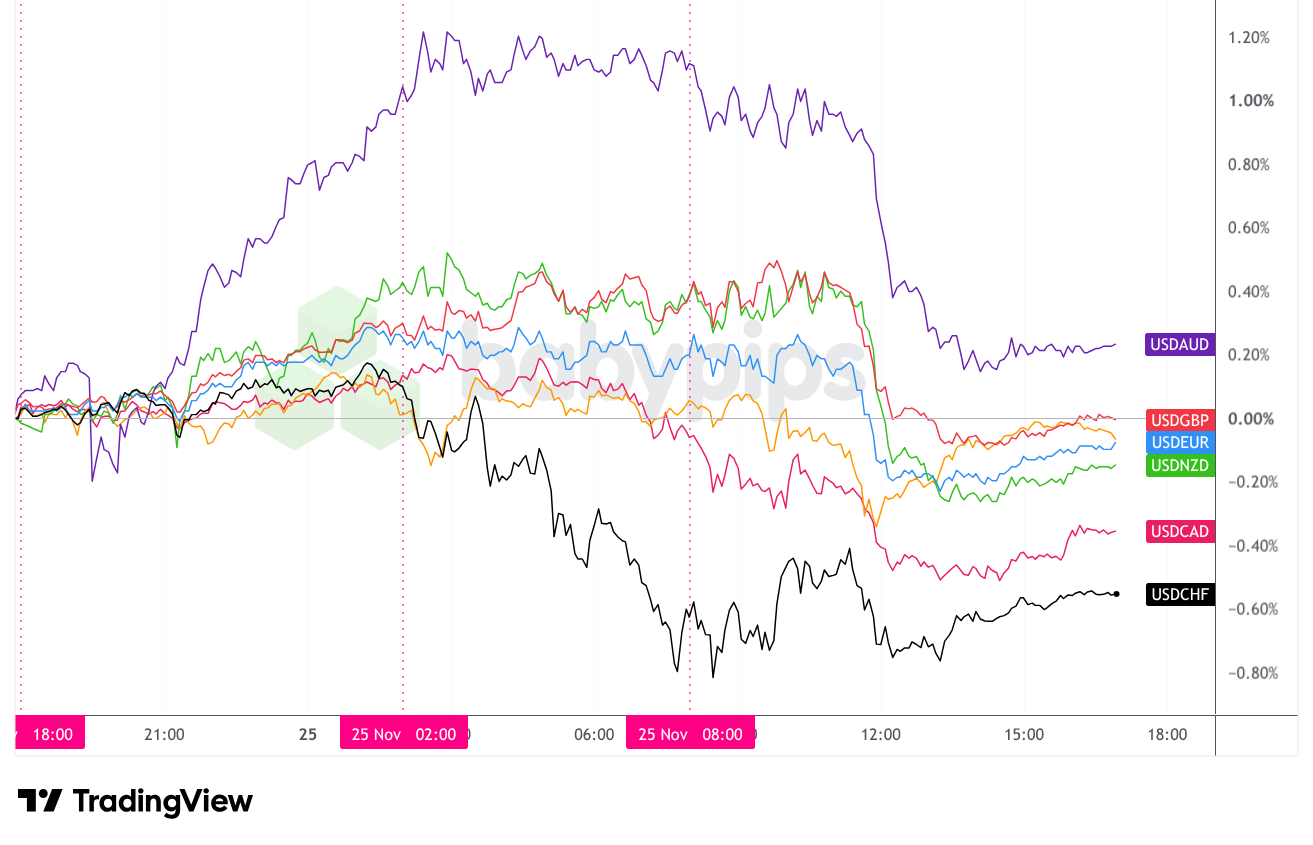
Overlay of USD vs. Major Currencies – Chart Faster With TradingView
The dollar lost ground against every major except the Australian dollar, and the Dollar Index eased about 0.1% to near 103.70. The Swiss franc was the strongest major, with USD/CHF down about 0.56% to near 0.8309, and the Canadian dollar came next as USD/CAD fell about 0.39% to near 1.4210. The kiwi, euro and pound gained less than 0.2%, the yen ended roughly flat near 159.23, and the Australian dollar was the weakest, with AUD/USD down about 0.17% to near 0.6630.
The dollar firmed early as the stock selloff likely lifted demand for cash, but that bid faded as Treasury yields sank toward the day’s lows near 4.80% in late morning and the tariff proposals revived worries about U.S. growth and trade. Strong U.S. numbers, including the GDP upgrade and a four-month low in jobless claims, didn’t rescue it. A December Fed hike already looks fully priced, so traders may have focused more on how many hikes come after that.
The franc fits the haven story best. Investors fleeing stocks often buy Swiss assets, and the euro slipped below 0.91 francs, its lowest level since May, according to Swiss news agency Keystone-SDA. The loonie had extra help: Reuters reported that it hit a two-week high as oil rose and traders kept betting on a Bank of Canada hike in December after Governor Tiff Macklem’s Tuesday speech.
The Aussie shows how risk mood can trump data. Australia’s faster-than-expected inflation should, on paper, support the currency through higher rate expectations, but AUD/USD sank to its lowest level since Dec. 3 before recovering some ground with stocks. The yen held steady as lower U.S. yields and haven demand probably offset the swings in risk appetite.
This week’s Fundies Cheat Sheet warned that the short holiday week would squeeze the big U.S. releases into one Wednesday morning, with growth, inflation, spending, durable goods and jobless claims all landing at 8:30 am ET. Subscribe to Babypips Premium to read the full sheet and the rest of this week’s event coverage.
Upcoming Potential Catalysts on the Economic Calendar: Tokyo CPI, Euro Area Inflation and ISM
- Tokyo CPI for November 2026 at 11:30 pm GMT Thursday, Nov. 26: the measure excluding food and energy rose 2.4% y/y last time. After Wednesday’s hot services producer prices, a firm print could add to the case for a Bank of Japan hike in December.
- France Preliminary Inflation for November 2026 at 7:45 am GMT Friday, Nov. 27: the yearly rate is seen easing to 3.2% from 3.4%, with Spain’s flash reading (4.6% forecast; 4.9% previous) at 8:00 am GMT. These early reads feed into bets on another European Central Bank hike in December.
- U.S. ISM Manufacturing PMI for November 2026 at 3:00 pm GMT Tuesday, Dec. 1: seen at 55.2 after 55.5, alongside JOLTS job openings. It’s one of the first big U.S. reads after the holiday and before the Fed’s December 8-9 meeting.
Also on the calendar (GMT):
- Bank of Korea rate decision at 1:00 am GMT Thursday (3.25% forecast; 3.00% previous)
- Germany GfK Consumer Confidence for December 2026 at 7:00 am GMT Thursday (-29.9 forecast; -30.8 previous)
- Germany Unemployment Change for November 2026 at 8:55 am GMT Friday (4K forecast; 4K previous)
- Euro area Economic Sentiment for November 2026 at 10:00 am GMT Friday (97.2 forecast; 96.9 previous)
- OPEC+ ministers meet Sunday, Nov. 29, to set 2027 output policy
- China NBS Manufacturing PMI for November 2026 at 1:30 am GMT Monday (49.5 forecast; 49.3 previous)
- Canada GDP for Q3 2026 at 1:30 pm GMT Monday
- Euro area Flash Inflation for November 2026 at 10:00 am GMT Tuesday (3.9% forecast; 4.0% previous)
U.S. stock markets are closed Thursday for Thanksgiving and close early, at 1:00 pm ET, on Friday, so liquidity may stay thin into the weekend.