Financial & Forex Market Recap: Nov. 12, 2026


Thursday, Nov. 12, 2026: Fed hike bets pushed the 10-year yield above 5%, gold fell 2.8%, oil jumped on Trump’s Iran post and Nvidia’s CEO resigned.
Treasury traders came back from the Veterans Day break and sold bonds on Thursday, pushing the 10-year yield back above 5% as bets on more Federal Reserve rate hikes grew and oil rebounded on President Donald Trump’s Iran comments. That rate jump likely lifted the U.S. dollar against every major and knocked gold down about 2.8%. Jensen Huang’s sudden exit as Nvidia CEO rattled tech stocks, Bitcoin and the Australian dollar, though the S&P 500 won back most of its early losses.
In short: On Thursday, Nov. 12, 2026, Fed hike bets and an oil rebound likely pushed the 10-year Treasury yield up about 12 basis points to near 5.12%. The Dollar Index rose 0.2% to near 103.17, gold fell 2.8% to near $3,875, WTI gained 2.9% to near $89.36, and Bitcoin slid 3.4% after Nvidia’s CEO resigned.
Thursday’s Market Scoreboard: 10-Year Yield Tops 5% as Gold Drops and Oil Rebounds
| Asset | Close (approx.) | Day change | Driver |
|---|---|---|---|
| S&P 500 | 7,594 | +0.1% | Nvidia shock mostly absorbed |
| U.S. 10-year yield | 5.12% | +12 bp (vs. Tuesday) | Bond selloff after holiday, hike bets |
| U.S. Dollar Index | 103.17 | +0.2% | Higher yields, 19-month high |
| WTI crude oil | $89.36 | +2.9% | Trump: no Iran deal needed |
| Gold | $3,875 | -2.8% | Higher yields, stronger dollar |
| Bitcoin | $71,342 | -3.4% | Nvidia turmoil, long liquidations |
| USD/JPY | 159.89 | +0.1% | Briefly topped 160, then snapped back |
| EUR/USD | 1.1060 | -0.3% | Lowest since April 2025 |
| GBP/USD | 1.3239 | -0.3% | In-line GDP, firm dollar |
| USD/CHF | 0.8353 | +0.3% | One-month high on rate gap |
| AUD/USD | 0.6808 | -0.5% | Risk-off, RBA pause bets |
| NZD/USD | 0.5548 | -0.3% | Broad dollar strength |
| USD/CAD | 1.4256 | +0.1% | Oil rebound cushioned the loonie |
Forex News Headlines & Data: Nvidia CEO Exit, Trump on Iran, U.K. GDP and Fed Speakers
- New Zealand Electronic Retail Card Spending for October 2026: -0.7% m/m (-0.5% m/m previous)
- Japan Producer Price Index for October 2026: 7.1% y/y (6.5% y/y forecast; 6.8% y/y previous)Above forecast
- Japan’s top currency diplomat Atsushi Mimura said recent yen moves were excessively rapid and that it is “too early to forget” this summer’s intervention
- U.K. RICS House Price Balance for October 2026: -36 (-34 forecast; -34 previous)Below forecast
- U.K. GDP Growth Rate Prel for Q3 2026: 0.7% q/q (0.7% q/q forecast; 0.5% q/q previous, revised)In line
- GDP: 0.2% m/m for September (0.0% m/m forecast; 0.0% m/m previous)Above forecast
- Industrial Production: 0.3% m/m for September (-0.3% m/m forecast; 0.7% m/m previous)Above forecast
- Goods Trade Balance: -£22.3 billion for September (-£19.5 billion forecast; -£19.6 billion previous)Below forecast
- Jensen Huang resigned as Nvidia CEO effective immediately, and CFO Colette Kress became interim CEO; Nvidia shares fell as much as 16% before closing down 4.3%
Why it mattered: Nvidia sits at the center of the AI trade, so the leadership shock likely hit risk appetite well beyond one stock, from Bitcoin to the Australian dollar. - President Donald Trump wrote on Truth Social that “We don’t need a deal with Iran” and said Washington has “their Strait”
Why it mattered: Oil traders had priced in an end to the fighting, so the post likely revived supply worries and lifted crude, which may have added to inflation fears in the bond market. - U.S. Initial Jobless Claims for the week ending Nov. 7, 2026: 200K (195K forecast; 191K previous)Above forecast
- Cleveland Fed President Beth Hammack said the Fed needs to move rates higher to reach a restrictive stance, though she prefers smaller, steadier increases
- U.S. Existing Home Sales for October 2026: 3.75 million annualized (3.85 million forecast; 3.97 million previous)Below forecast, the slowest pace since August 2010
- U.S. EIA Crude Oil Stocks Change for the week ending Nov. 6, 2026: +4.7 million barrels (-1.5 million forecast; -0.9 million previous)Above forecast
- Yemen’s Houthis said they attacked a Saudi oil pipeline pumping station, an oil facility in Yanbu and an Aramco building in Riyadh
- The U.S. Treasury sold $25 billion of 30-year bonds at 5.441%, a 0.4 basis point tail, with a 2.36 bid-to-cover ratio (2.54 previous)
- San Francisco Fed President Mary Daly said “further tightening will be needed” but that higher bond yields give the Fed time for “calibrated decisions”
Broad Market Price Action: Bond Selloff Sinks Gold as Oil Rebounds
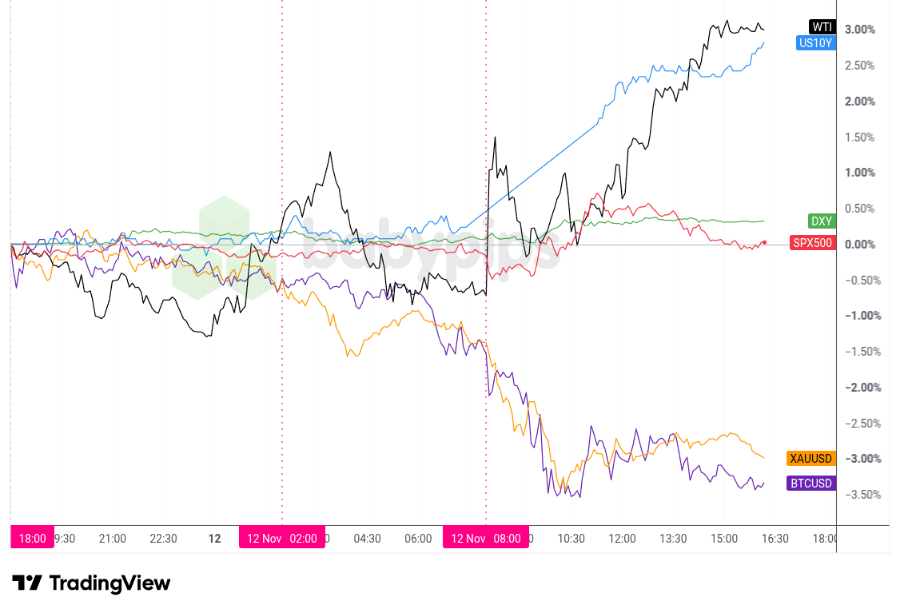
The cash Treasury market reopened after Wednesday’s holiday and made up for lost time. The 10-year Treasury yield climbed about 12 basis points from Tuesday’s close to near 5.12%. The 2-year yield rose even more, a sign that traders were mostly repricing the Fed. Tuesday’s hot inflation report had already put a December hike on the table, and Cleveland Fed President Beth Hammack said on Thursday that rates need to go higher, though in smaller steps. CME FedWatch showed a December hike fully priced, with about a 13% chance of a half-point move, CNBC reported in its afternoon update. A soft 30-year bond auction probably didn’t help.
Those higher yields likely did the most damage to gold. Bullion pays no interest, so a Fed that keeps hiking raises the cost of holding it, and a firmer dollar makes it pricier for buyers outside the U.S. Gold fell about 2.8% to near $3,875 and hit its lowest level in more than a week.
Oil went the other way. Trump’s post that the U.S. doesn’t need a deal with Iran lifted WTI by more than a dollar early in the U.S. session, as traders who had bet on peace likely priced a longer conflict. Crude kept climbing in the afternoon after Yemen’s Houthis claimed attacks on Saudi oil sites, even though the government reported a surprise 4.7 million barrel crude build. WTI finished up about 2.9% near $89.36. Pricier oil may also have fed the bond selloff, since energy costs can keep inflation sticky.
Nvidia set the tone for stocks. Jensen Huang resigned as CEO after reports of multiple affairs, and Nvidia fell as much as 16% before closing down 4.3%. The cash S&P 500 erased an early drop of nearly 1% and ended about 0.4% lower, so the shock stayed mostly inside chip and AI names. Bitcoin didn’t bounce with stocks. It slid about 3.4% to near $71,340, its lowest in nearly 12 weeks, as more than $600 million in long crypto positions were liquidated over 24 hours and MSCI confirmed it will drop Strategy, a big Bitcoin holder, from its indexes on Nov. 30. Rising yields probably added to the pressure on crypto.
FX Market Behavior: U.S. Dollar vs. Majors
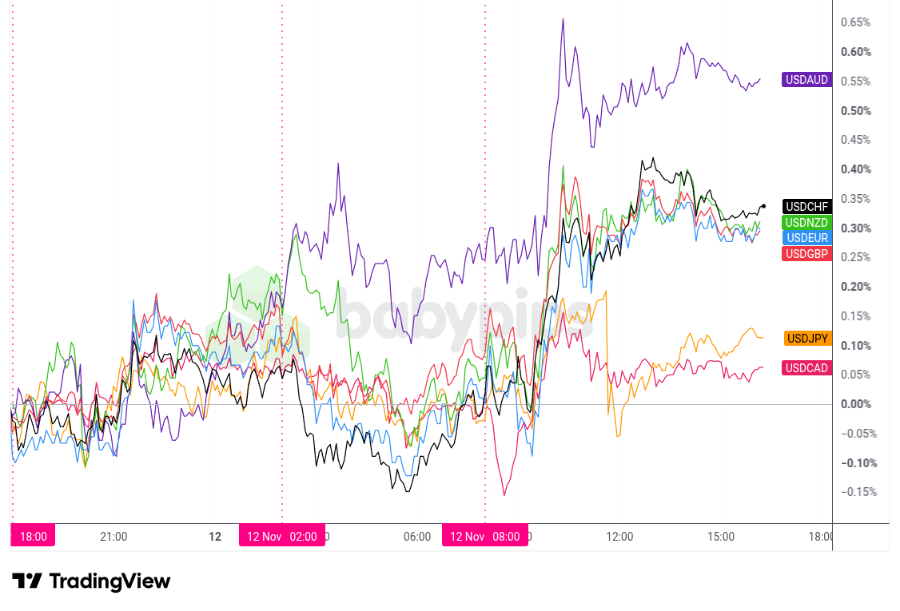
The U.S. dollar rose against all seven majors, and the Dollar Index added about 0.2% to near 103.17, still at its highest since April 2025. The Australian dollar was the weakest major, down about 0.5% to near 0.6808, its lowest since January. The Swiss franc, the euro, the pound and the New Zealand dollar each lost about 0.3%. The yen dipped about 0.1%, and the Canadian dollar held up best, nearly flat against the greenback.
Rate expectations likely did most of the work again. Moneycorp’s Eugene Epstein told Reuters the dollar “has strengthened almost exclusively based on Fed expectations,” and the euro slid to its lowest level since April 2025. The dollar’s sharpest push came in the first hour of U.S. stock trading, when Hammack’s comments hit the wires and Nvidia shares opened deep in the red. That timing suggests rate bets and some safe-haven demand both helped.
The Aussie probably took hits from both sides. The Nvidia news soured risk appetite, and traders expect the Reserve Bank of Australia (RBA) to pause after it dropped its explicit reference to further hikes last week, while the Fed looks set to keep going. A shrinking rate gap leaves the Aussie with little cushion when the mood turns.
USD/JPY edged up about 0.1% to near 159.89, but it had a wild few minutes. The pair poked above 160 for the first time since September at about 11:40 am ET, then snapped back to near 159.30. Nobody confirmed intervention, so it’s likely the reversal may reflect profit-taking near a level where traders expect Tokyo to push back. Earlier, Japan’s Atsushi Mimura warned that yen moves were too fast, and Japan’s wholesale inflation accelerated to 7.1% y/y, which may keep a December Bank of Japan (BOJ) hike in play.
The Canadian dollar likely held up best because oil rebounded, which supports Canada’s export income after a steep slide in crude had weighed on the loonie. The pound barely reacted to U.K. GDP, which grew 0.7% in the third quarter as expected, and mostly tracked the broad dollar along with the euro and the franc. The kiwi slipped as risk appetite faded.
Market concept of the dayWhy Does the Australian Dollar Drop When Tech Stocks Wobble?
Traders treat the Aussie as a “risk-on” currency. Australia sells commodities tied to global growth, so traders tend to buy the Aussie when they feel confident and sell it when fear rises. The AI buildout has also been linked to stronger demand for raw materials, so a shock at Nvidia can sour the mood around the Aussie fast. When fear spikes, money often moves toward the U.S. dollar, and higher-risk currencies like the Aussie usually feel it first. You can learn how this works in Risk-On / Risk-Off: How Global Mood Moves Currencies in the School of Pipsology.
On Premium todayThursday’s USD/JPY Analysis flagged the pair’s breakout toward 160.00, where Japanese authorities have stepped in before, and asked whether Fed hike bets or the intervention threat would win out. Both forces showed up within minutes of each other. It’s part of Babypips Premium.
Upcoming Potential Catalysts on the Economic Calendar: US PPI
U.S. PPI for October 2026 at 1:30 pm GMT Friday, Nov. 13: economists expect 0.4% m/m after 1.3% in September, with core PPI seen at 0.3% after 0.7%. Producer prices are the last big inflation read before the Fed’s Dec. 8-9 meeting.
Also on the calendar (GMT):
- New Zealand Business NZ PMI for October 2026 at 9:30 pm GMT Thursday
- Germany Wholesale Prices for October 2026 at 7:00 am GMT Friday
- Euro area Employment Change Prel for Q3 2026 and Balance of Trade at 10:00 am GMT Friday
Friday’s producer prices could revive talk of a half-point Fed hike if they run hot, or cool it if they don’t. Weekend headlines on Iran and the Houthis may also decide where oil opens on Sunday evening.
Prefer email updates? The Babypips Daily Newsletter sends market news and trading best practices to your inbox.
Stay frosty out there, forex friends!
Disclaimer: This article is for educational purposes only. It isn’t investment or trading advice or a recommendation to trade. Prices, levels, and percentage moves here are approximate because the market data was not captured at the exact close. The explanations for market moves are possible reasons, not confirmed causes.
AI disclosure: The Babypips editorial team used AI tools to help research, write, and check this article. A Babypips editor reviewed and edited it before publication. AI tools can misread data, make arithmetic errors, and state wrong information in a confident tone. Check figures and quotes against the linked sources before you rely on them. Our Editorial Policy explains how we create and review our content.