Gold Takes Another Hit as Yields Rise: More Losses in Sight?

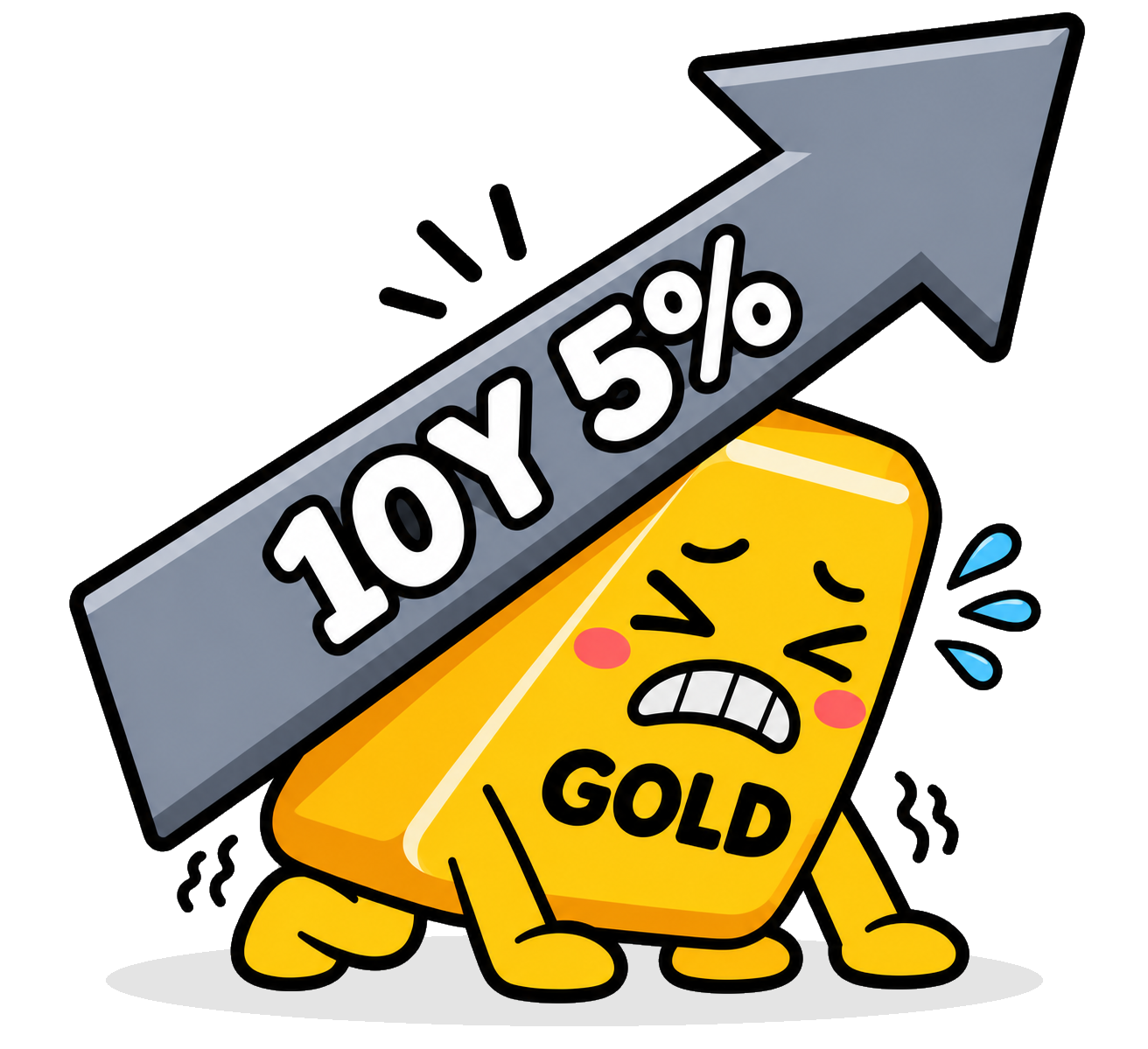
Gold fell about 2.8% to near $3,875 an ounce on November 12, as the 10-year U.S. Treasury yield climbed back above 5%.
Rising bets on more Federal Reserve rate hikes likely did most of the damage to the precious metal. After all, a Treasury note now pays you more than 5% a year while holding on to a gold bar pays you nothing.
Thursday’s slide came two days after a drop of nearly 3%, and both moves fit the textbook pattern where gold falls as yields rise.
What Happened to Gold This Week?
Gold took two hits in three sessions.
On Tuesday, Nov. 10, the U.S. Bureau of Labor Statistics (BLS) reported that consumer prices rose 0.4% in October, above the 0.3% forecast, while core CPI rose 0.3% against a 0.2% forecast. Gold dropped nearly 3% from a high near $4,146, and the 10-year yield jumped about 12 basis points in reaction.
 The Treasury cash market closed Wednesday for Veterans Day, so bond traders caught up the next day. The 10-year yield climbed about 12 basis points from Tuesday’s close to near 5.12%, and the 2-year yield rose even more.
Fed officials added fuel. Cleveland Fed President Beth Hammack said the Fed needs higher rates to reach a restrictive stance, though she prefers smaller steps. San Francisco Fed President Mary Daly said “further tightening will be needed.” CME FedWatch showed a December hike fully priced, with about a 13% chance of a half-point move.
Why Does Gold Fall When Yields Rise?
Rising yields can hurt gold in three ways.
1. Opportunity Cost
Say you want to park $1,000 for a year. A 10-year Treasury near 5.12% pays you about $51.20. A gold bar pays $0 and still expects you to cover storage. Economists call that missed income opportunity cost a.k.a. the return you give up by choosing one asset over another. Each time yields climb, holding gold costs you more.
2. Real Yields
A real yield is a bond’s yield minus expected inflation. Traders track it through TIPS (Treasury Inflation-Protected Securities). The 10-year real yield sat near 2.63% on Nov. 6, according to U.S. Treasury data.
The reason behind a yield move matters. If yields rise because traders expect more inflation, gold can hold up as an inflation hedge. If yields rise because traders expect Fed hikes, real yields climb, and gold tends to suffer.
Thursday looked like the second case since the 2-year yield, which is the one most tied to Fed expectations, outran the 10-year yield.
3. The U.S. Dollar
Markets price gold in dollars (XAU/USD). The U.S. Dollar Index rose about 0.2% to near 103.17 on Thursday, its highest since April 2025. A stronger dollar makes gold pricier for buyers using euros or yen, which can cut demand.
Gold may keep reacting to any data that shifts Fed hike odds. A hot report tends to lift yields and the dollar together, a rough mix for XAU/USD. A cool report could reverse that.
Why Didn’t Gold Act Like a Safe-Haven?
Thursday brought plenty of bad news. Jensen Huang resigned as Nvidia CEO, Yemen’s Houthis claimed attacks on Saudi oil sites, and President Donald Trump wrote that the U.S. doesn’t need a deal with Iran. But gold fell anyway. What’s up with that?!
The headlines seem to have fed the rate story instead. WTI crude gained about 2.9% to near $89.36, and pricier oil can keep inflation sticky, which supports more hikes. Nervous investors also had a safety option that pays interest: the dollar.September 2026 ran a similar script. The 10-year yield hit 5% on Sept. 15 for the first time since July 2007, and the Fed hiked the next day for the first time in three years. On Sept. 28, gold fell as much as 4% to $4,111 as yields touched their highest since June 2007.
Quick Takeaways
- Gold falls as yields rise through opportunity cost: a bond paying above 5% makes a zero-yield metal harder to justify.
- Real yields reveal more than headline yields. Watch the 10-year TIPS yield next to the regular 10-year.
- A stronger dollar can deepen gold’s losses, since gold trades in dollars.
- Safe-haven demand may be overshadowed when bad news feeds inflation worries and rate-hike bets.
- No single driver explains every move, so check yields, the dollar, and the news flow together.
What to Watch Next
- U.S. PPI for October: Friday, Nov. 13, at 8:30 a.m. Economists expect 0.4% month-over-month after September’s 1.3%. Producer prices track what businesses charge, and big jumps can show up in consumer prices later. A hot reading could revive talk of a half-point Fed hike, while a cool one might take some pressure off gold.
- Fed decision: Dec. 8-9, 2026. Markets already price a quarter-point hike, so gold may react more to the Fed’s hints about 2027 than to the hike itself. The November CPI report lands Dec. 10, one day after the decision.
- 10-year TIPS yield: A drop could signal easing pressure on gold. The Fed publishes this real yield every business day, so you can compare it with the regular 10-year and see which one is driving the move.
- Oil headlines: Iran and Houthi news may move crude, inflation bets and gold with it. Thursday’s 2.9% jump in WTI showed how fast Middle East news can reach the bond market, and weekend headlines could set the tone when oil reopens Sunday evening.

Financial & Forex Weekly Recap: October 19 – 23, 2026
Oil climbed about 4% on Saudi attacks and Iran strike fears, gold fell 4.0% to near $4,000, tech stocks sold off, and the dollar index slipped.

Financial & Forex Market Recap: Nov. 10, 2026
Tuesday, Nov. 10, 2026: A hot U.S. CPI report and hawkish Fed talk lifted the 10-year yield near 4.99%, gold fell 2.5%, and the U.S. dollar beat every major.
Financial & Forex Market Recap: Nov. 12, 2026
Thursday, Nov. 12, 2026: Fed hike bets pushed the 10-year yield above 5%, gold fell 2.8%, oil jumped on Trump’s Iran post and Nvidia’s CEO resigned.

Why Gold Rallied Even as Election Fears Faded
Gold climbed above $4,000 even as election jitters eased. What made traders buy the precious metal as markets calmed down?

Gold Is Down 35%—Is the Bull Case Broken or Just Bruised?
Market Analysis by Chris Markoch covering: Gold Spot US Dollar, Newmont Corporation, SPDR® Gold Shares. Read Chris Markoch's Market Analysis