Alice Huang and the Nvidia chip network: what the FT found

A Financial Times investigation has found that Alice Huang, the businesswoman romantically linked to former Nvidia chief executive Jensen Huang, was connected to a network that supplied AI chips to China-based users. The FT says it included an alleged Cambodian criminal enterprise.
The FT says the web also took in Nvidia's cloud partners, gaming entrepreneurs and hundreds of shell companies. Together they made billions of dollars from moving restricted chips into China, the paper says, without necessarily knowing the full picture.
Alice Huang is at the centre of US inquiries into whether Megaspeed, Nvidia's largest client in south-east Asia, took part in the underground chip trade. Some US officials suspect she was a Chinese spy; Beijing calls that a "smear". No charges against her have been reported.
What the investigation found
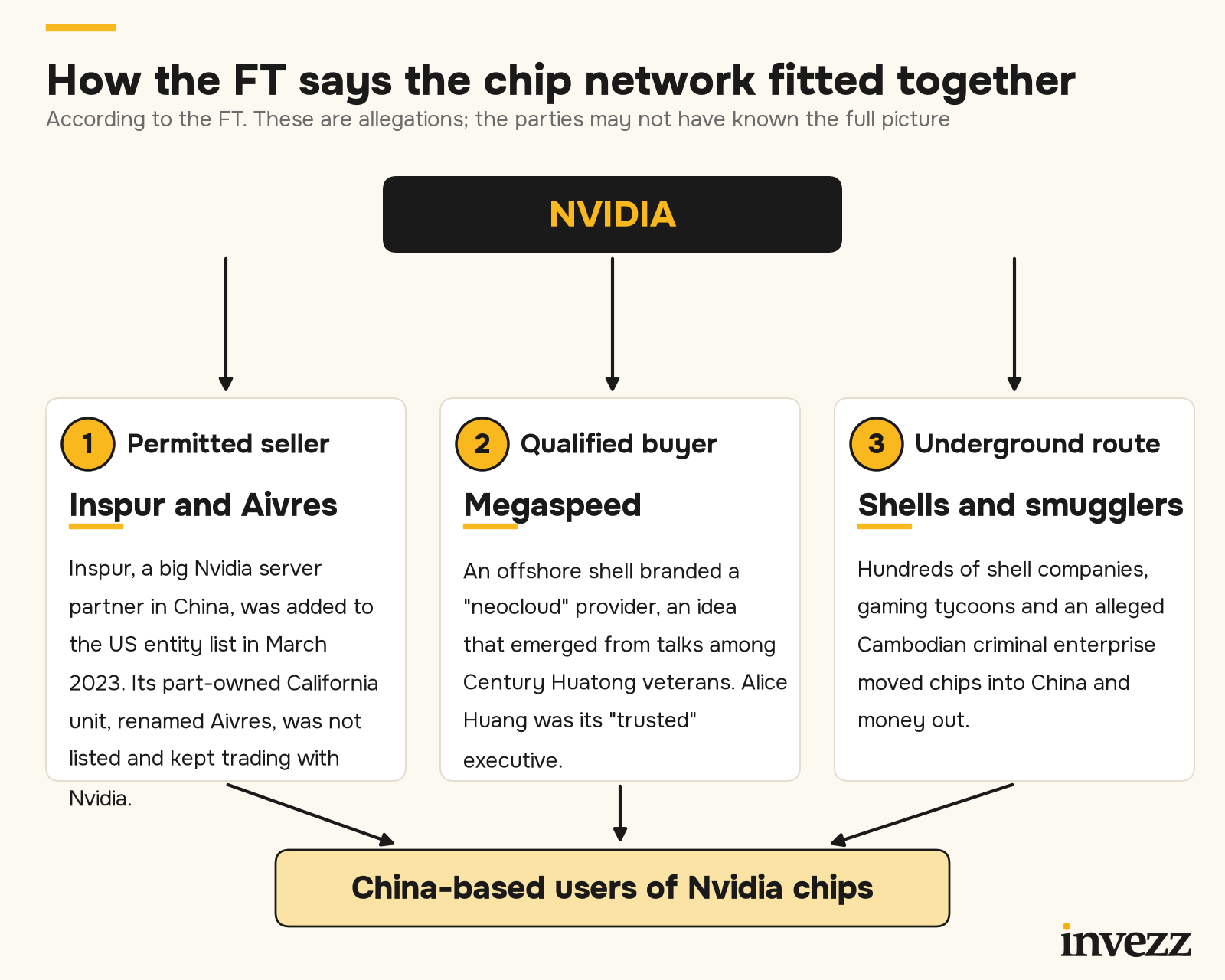
The FT spoke to over a dozen people and traced links through hundreds of corporate filings. Diverting chips, it says, takes three things: a group allowed to buy and resell them, customers that pass US checks, and an underground route for hardware and money.
The first piece, it says, was Inspur, a major Nvidia partner for building chip servers in China. Washington put Inspur on its entity list in March 2023 over alleged help for the Chinese military. Its part-owned San Jose unit was not listed.
That unit was renamed Aivres and kept trading with Nvidia. A person with direct knowledge told the FT that staff inside Nvidia questioned whether Aivres should qualify as a partner. Nvidia decided it met all compliance and export-control rules.
The second piece was a buyer able to clear Nvidia's checks, which include three years of records and proof of non-Chinese ownership. Some Inspur clients sought help from Century Huatong, a Chinese gaming group that had become a data-centre investor.
The answer, according to the FT's sources, was an offshore shell branded a "neocloud" provider. That shell became Megaspeed. Alice Huang was its "trusted" outward-facing executive, they said.
What the people involved say
Nvidia says its shipments were all legal and authorised by the US government, spokesman John Rizzo said this week, according to The Business Times. Nvidia said in June 2025 it placed Megaspeed on its block list.
Megaspeed says it operates "fully within the bounds" of export controls, CNBC reported, and that Alice Huang left in August 2025. Reuters has not been able to reach her.
Invezz found no public response from Century Huatong or Aivres to the FT's findings.
China's foreign ministry calls the spy claim "unsubstantiated" and "nothing but smears", the Associated Press reported. Attorney General Todd Blanche said on 12 November the Justice Department had reached no conclusion on whether she was a spy.
How we got here
It began on 29 October, when the New York Times reported that US intelligence suspected Alice Huang, a former Megaspeed executive, of being a Chinese asset. Nvidia said Jensen Huang's contacts with her were ordinary customer meetings.
On 8 November, Nvidia's board opened an independent investigation into whether Huang had been the target of a foreign intelligence effort. Huang admitted he had been unfaithful to his wife, without naming the woman.
The board accepted his resignation as CEO, president and director on 11 November, according to Nvidia's SEC filing, and announced it the next day. Chief financial officer Colette Kress became interim CEO.
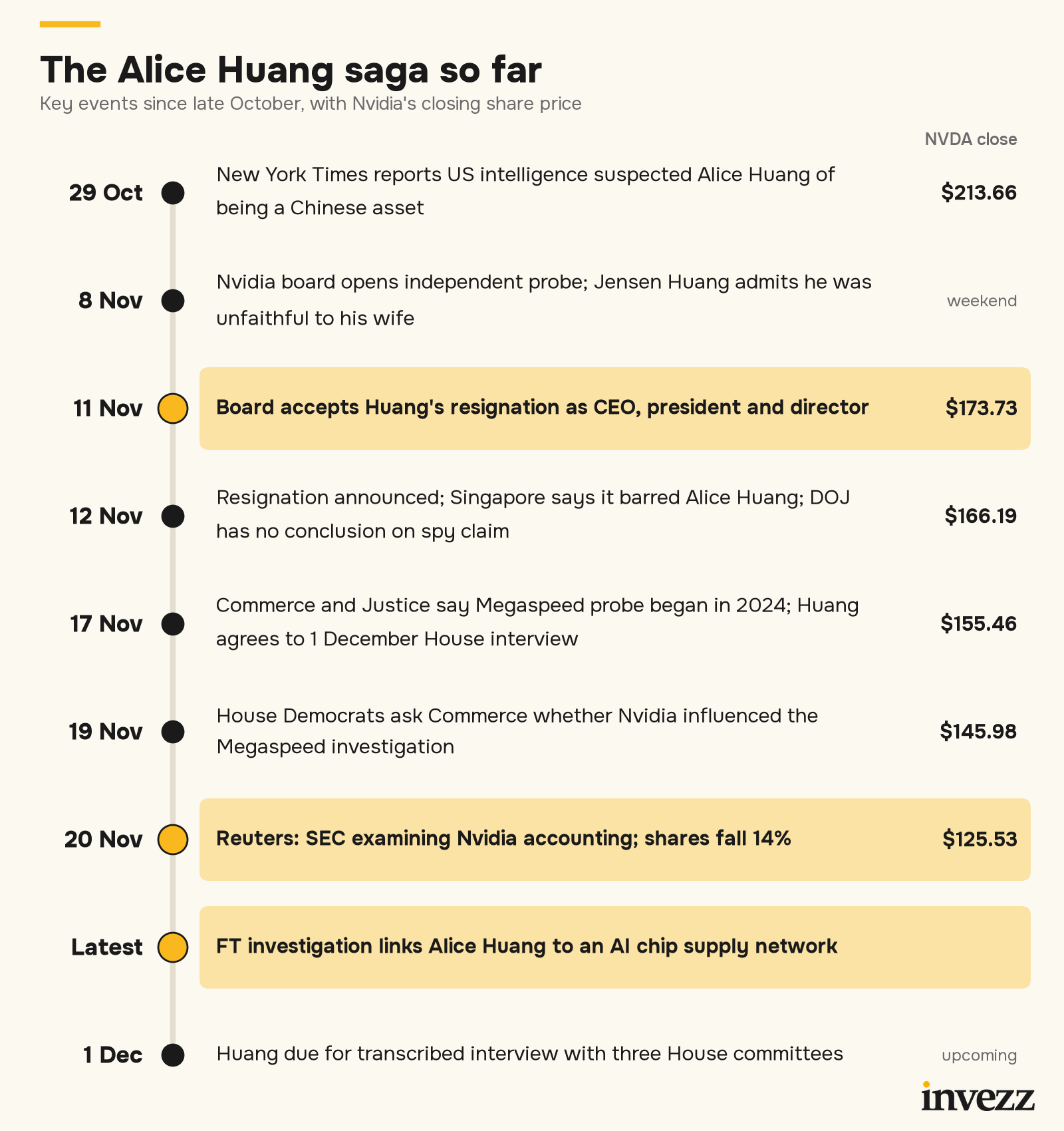
On 12 November, Singapore said police had investigated Alice Huang over Megaspeed's server purchases and found insufficient evidence of an offence. She got a stern warning for giving inaccurate information and was barred from returning. The probe did not concern espionage, it said.
On 17 November, the Commerce and Justice departments said they had been investigating Megaspeed since 2024 and had interviewed Alice Huang in June 2025. Jensen Huang has agreed to a transcribed interview with three House committees on 1 December.
On 19 November, House Democrats asked Commerce Secretary Howard Lutnick whether Nvidia influenced that investigation, Reuters reported. Nvidia said it looks forward to engaging with Congress.
What it means for Nvidia shares
Nvidia closed on Friday at $125.53, down 14% on the day. That is about 28% below its 11 November close of $173.73, the last before the resignation was announced (Invezz calculation).
The drop followed a Reuters report that SEC staff are examining potential accounting issues at Nvidia. Reuters noted that investigations are not evidence of wrongdoing.
It was Nvidia's seventh straight weekly fall, the longest run since 2008. The slide began before the scandal, amid worries over AI spending and rival chips.