Thursday briefing: Why young people are having less sex than ever

Good morning. Let’s talk about sex! I know, I know; it’s not 9am yet. But trust me, you’ll enjoy it and I won’t ask you to do anything that puts your back out before your first brew.
The National Survey of Sexual Attitudes and Lifestyles, or Natsal, is a big-deal publication: a substantial piece of research capturing trends in British intimacy every decade since 1990. This week, it made more headlines than usual with the revelation that sex among adults of all genders and sexualities has slumped – and the standout finding that one in three under-25s report they have never had sexual intercourse.
What is driving this decline, does it matter and who’s going to contribute to my pension if we all stop having babies? (Not really, I’m doing a stand-alone newsletter on the last one.) To explore this further, I spoke to Guardian writer Aneesa Ahmed and Natsal researcher Luke Muschialli, both in their 20s. But first, the headlines.
Five big stories
Climate | For the first time, the world has experienced six consecutive days of temperatures 2C warmer than preindustrial levels, the Guardian has learned.
Ukraine | Britain will add to its multimillion pound investments in rebuilding Ukraine’s energy system by funding a windfarm project capable of powering 300,000 Ukrainian households.
UK news | Poundland has collapsed into administration, putting more than 10,000 jobs at risk in “devastating news” for staff in the run-up to Christmas.
Gaza | A UN tribunal has cast doubt on the evidence used to justify the sacking of Palestinian UN aid workers in 2024, saying it was based “almost entirely” on unproven assertions from the Israeli government and had damaged humanitarian operations in Gaza.
Trump tariffs | Brazil has said it will not bend to the new US tariff “threat” and China accused Washington of “political manipulation” in the wake of Donald Trump’s latest economic salvo against 14 major trading partners.
In depth: ‘Decentering romantic partnership and monogamy is big’

Back in the last century, when I began my dating life, everybody had a Number. Your Number was how many folk you’d had sex with on your search for The One. I remember this dubious social construct as an impossible balancing act – between proving I was desirable, experienced and up-for-it on the one hand, while also not sounding like a slag on the other. It was the 90s …
Fast-forward three decades, and I’m sitting in an office booth with my brilliant colleagueAneesa Ahmed who, at 26, tells me gently: “That’s not really a thing any more.”
“My generation was born into this sex positive, ‘woke’ era, where it’s bad to slut-shame women, though sadly it still happens. As for The One, decentering romantic partnership and monogamy is big among people my age”.
Attitudes to sex and identity have transformed between our generations. Largely for the better, in terms of more nuance around gender and consent, and sometimes for the worse, most obviously with the rise of the manosphere. But the Natsal study wasn’t the first to pinpoint a decline in physical intimacy among Aneesa’s peers, and I’m interested in the factors driving what is described as a “sex recession” among younger people.
Why are younger people having less sex?
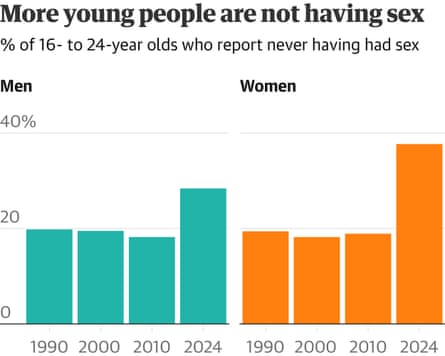
There are multiple avenues worth exploring, says Aneesa, who reports regularly on gen Z attitudes to sex and relationships. “In the heterosexual context, women are much more independent, not looking for a husband to provide for them, and not willing to put up with some men who have horrible, misogynist opinions.” (I’ve written before about this ideological gender gap, with younger British men almost twice as likely to vote for Reform UK as their female peers.)
Meanwhile, young men find our templates of masculinity overwhelming or unappealing. Some believe the only way to approach women is to be an aggressive alpha, while others are anxious about making any move for fear of coming across as creepy. Either way, connection is lost.
There are also changes in the social dynamic that aren’t captured by raw data. Her peers are much more interested in “situationships”: many have never had a committed partner. They’re much less bound to a traditional linear progression towards a nuclear family – not that they can afford to start one. Nurturing friendships and platonic love has become more important than the idea of a fix-all romance.
The average age at which young people first have sex rose to 18 in the latest survey, up from 16 in 2010. For young people who grew up with much greater education about consent and boundaries, says Aneesa, “people don’t put up with disrespect.” And with growing numbers identifying as LGBTQ+ there’s less urge to rush into intimacy “with people that might not care or understand”.
What the survey doesn’t tell us
Back to Natsal. Luke Muschialli, a research assistant in epidemiology at University College London, worked on the survey. He’s 24, and wary of picking an instant culprit for the decline in sexual activity (eg, “They’re all on their phones!”).
I catch him after the initial tranche of “no sex please, we’re British/snowflakes/pick your own” headlines have been published. There’s a separate conversation to be had about why some older adults lose their minds at research like this: is it just prurience, angst about younger people’s capacity for intimacy in a digital-first world, confronting memories of how we behaved when we were that age?
Natsal cautions me that a lot of media reaction has drawn a causal link between the findings that online sexual behaviours such as sexting and porn use are high among young people, and that they are having less sex. “But our study is not able to show whether there’s a direct substitution for partnered sexual activity with online sexual behaviour, which should be the focus of future research.”
He’s also concerned that much of the reporting has glossed over the finding that low sexual wellbeing is very common among younger people. “My biggest worry is that people will look at the findings and think it’s a reason to disinvest in sexual and relationship health services. Young people are still really in need of STI and HIV support that can adapt to their changing behaviour.”
Is the poly-crisis stopping young people having sex?
Luke is foremost a researcher, rather than a representative of his entire generation. He’s keen to emphasise that Natsal can identify the trends but can’t explain why they are happening. Still, one obvious interpretation is positive: the data reflects young people who feel able to negotiate safe, wanted sexual encounters much more effectively.
But Luke’s hunch is that young people are also experiencing “a constrained opportunity for sex”.
“I wonder how my friends can face meeting new partners through the age-old tradition of a night out on the town, when their entry-level salaries can’t swing for an £8 pint or a staggeringly high nightclub entry fee,” Luke says. Apps can make introductions, but they don’t bring down the cost of your date.“Do our opportunities for sex decrease now that young people are living with their parents well into their 20s? I also wonder how a generation increasingly grappling with their own mental health have space for the human connection and necessary vulnerability that comes with sex and romance,” he says.
What about babies?
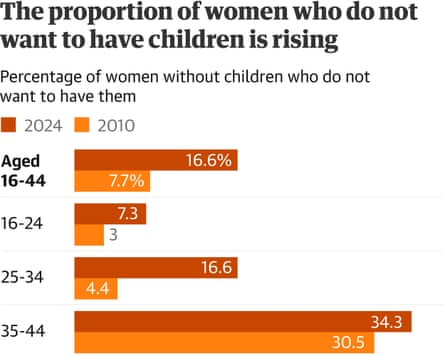
Back with Aneesa, I’m also curious about the substantial drop in the proportion of women wanting children, more than doubling from 8% to 17% over the past decade – an increase driven primarily by women under 35.
I’m well aware of the shift away from biological clock panic that dominated the media when I was in my 20s: is it about younger women giving up on that heteronormative progression, or recognising that child-rearing is expensive and exhausting, or having more role models of single childless women than Bridget Jones?
“This is very much a product of the society that we live in,” says Aneesa, citing the lack of support with childcare, for single mothers in particular. Also, she says, and this one hits home: “Seeing the women who came before us having to work full-time, and still taking on all the domestic labour … it’s off-putting.”
Longer-term consequences aside, Aneesa draws my focus back to the two in three under-25s who are sexually active. Gen Z are not prudes, as they’re typically branded when another survey like this pops up. But their pleasure-seeking happens in an evolving context.
“The idea that we’re an uptight generation is totally untrue,” she says. “Yes, we want these experiences, but in a safe, consensual way, with partners we can trust. And for us, that’s what is important now.”
What else we’ve been reading

I loved Wissarut Weerasopon’s portraits in this photo story about traditional Thai tattoos, the vibe-y blokes in picture nine in particular. Michael Segalov, newsletters team
Despite my very limited football knowledge, I found this piece about Pelé and Diego Maradona’s friendship and rocky rivalry a rollercoaster and a must-read. SundusSundus Abdi, newsletters team
There’s so much rich detail in this interview of actor Jane Alexander by Emine Saner, including the fact her grandfather was doctor to Buffalo Bill. Michael
I loved reading about the unique history and realities of the African Palestinian community in this week’s Long Wave email, written by Nesrine Malik in East Jerusalem. (And subscribe here!) Sundus
Ahead of Spain’s snap election this Sunday (more on that in First Edition soon), Sam Jones asks why so little is being said about the climate crisis in the buildup. Michael
Sport

Football | Manchester United gave away two penalties before Bruno Fernandes netted from the spot and nabbed a freak goal during a frantic finale at Sporting, while Liverpool cruised to a 3-0 win over Club Brugge.
Rugby union | Steve Borthwick has admitted he considers Henry Pollock most dangerous in his role of supersub after again leaving him on the bench against New Zealand and instead handing Greg Fisilau a surprise first start.
Football | Newcastle United’s owner, Saudi Arabia’s Public Investment Fund (PIF), is looking to sell up to 25% of the club by issuing new shares.
The front pages
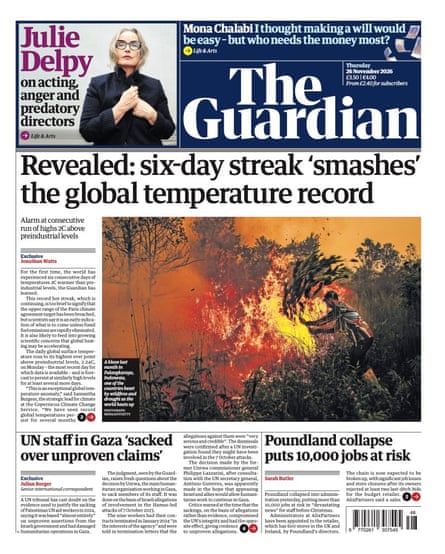
“Revealed: six-day streak ‘smashes’ the global temperature record”, is the Guardian’s front page today.
The i Paper’s lead story is “Record energy bills will hit millions in UK after 26% hike”, the Telegraph has “MoD prepares veterans for war”, the Mail writes “Over 70s will have to pass an eye test to keep driving”, and the Times leads on “BBC faces inquiry over ‘antisemitic workplace’”. The Express says “Kemi: You must say sorry for debasing your office”. The FT has “Global tech stocks swing wildly after investors question faith in AI trade”.
The Mirror says “Intruders climbed up drainpipe”, and lastly Metro writes “Possibly the craziest Tube strike EVER”.
The Latest
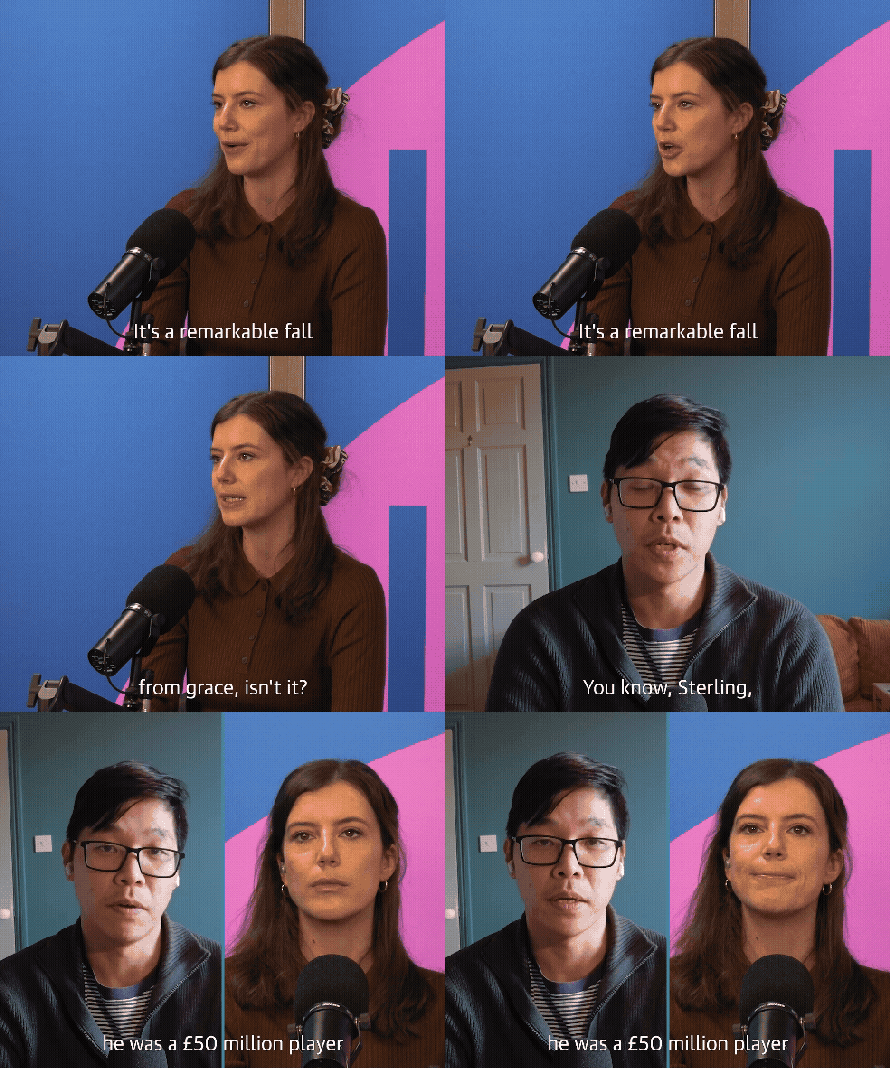
Raheem Sterling’s rise and fall: a sign football is broken?
Raheem Sterling has been handed a 12-month jail term, suspended for 18 months, for reckless driving and possession of nitrous oxide. It marks a remarkable fall from grace for the former England and Manchester City player, who was awarded an MBE in 2021. Sterling started playing professional football at 16, and his sentencing has raised questions about whether there are sufficient protections for younger players. Lucy Hough speaks to the Guardian columnist and sportswriter, Jonathan Liew.
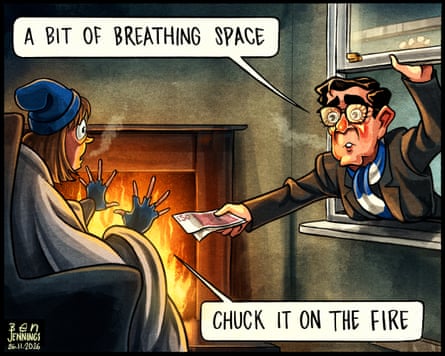
Cartoon of the day | Ben Jennings
The Upside
A bit of good news to remind you that the world’s not all bad
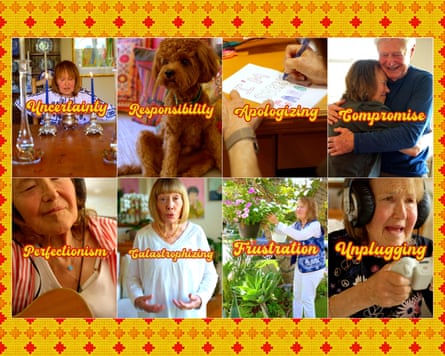
What if your relationship advice came from two women in their 80s, with decades of clinical experience and absolutely no time for bad behaviour? That’s the charm of Life100, a viral web series serving up life lessons with the warmth of Sesame Street and the bite of a well-timed telling-off. Psychologists Susan Thau and Sondra Goldstein tackle everything from intrusive family questions to catastrophising, empathy and asking for help. Created with Thau’s grandson, the series has found a huge online audience hungry for a little more kindness, and better ways to get along with each other.
Sign up here for a weekly roundup of The Upside, sent to you every Sunday
Bored at work?
And finally, the Guardian’s puzzles are here to keep you entertained throughout the day. Until tomorrow.
Quick crossword
Cryptic crossword
Wordiply