Exit polls signal blow for Netanyahu but no clear winner in Israel election
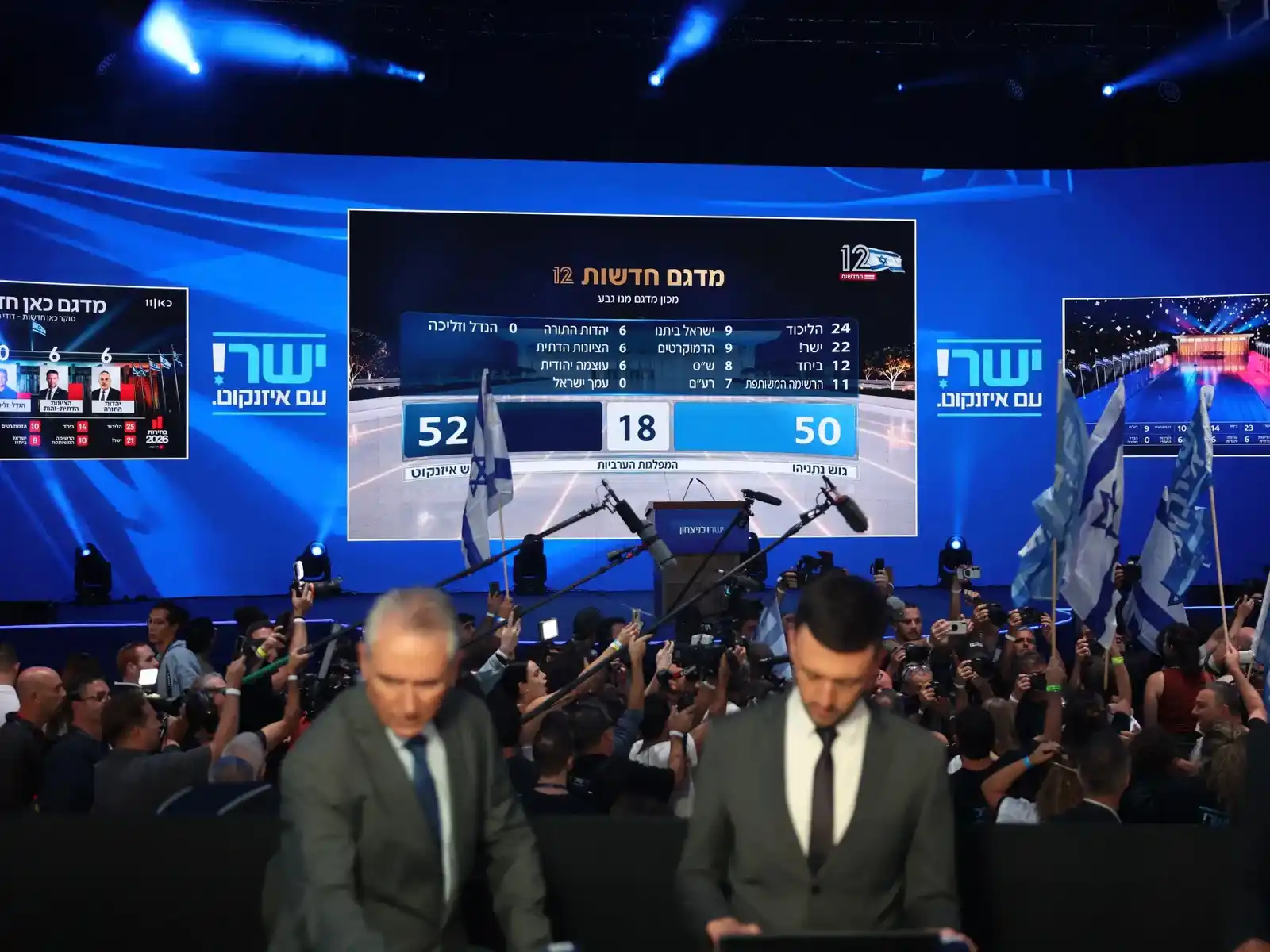
Exit polls from Israel’s election show no clear winner, with neither Prime Minister Benjamin Netanyahu nor his main rival, Gadi Eisenkot, on a clear path to a governing majority.
Polls from Tuesday’s election, described as the most consequential in Israel’s history, projected that the bloc led by Eisenkot, a former military chief of staff, would win 52 or 53 seats in the 120-seat Knesset.
The bloc supporting Netanyahu was projected to win 50 seats.
Either side would need 61 seats to form a majority government.
Arab parties are projected to win 18 seats collectively.
The election is largely seen as a referendum on Netanyahu’s handling of the October 7, 2023, Hamas-led attacks and the ensuing genocidal war on Gaza, as well as the attacks on Lebanon and Iran.
The exit polls – released by the major Israeli television networks – are subject to potential error. Preliminary results are expected in the coming hours, and may vary from the exit polls.
An inconclusive result would leave Israel in political limbo, allowing Netanyahu to remain in power in a caretaker capacity while parties try to forge a governing coalition.

‘Crushing defeat’
Eisenkot said the exit polls show a “lack of confidence” in the current prime minister.
Yair Lapid, the current opposition leader, echoed the sentiment.
“Don’t let anyone confuse you,” he said. “The Netanyahu bloc has suffered a crushing defeat. This is a total collapse, and the public has told them to go home.”
But Gideon Saar, Israel’s foreign minister and a member of Netanyahu’s Likud party, said the opposition’s celebrations were premature.
In a social media post, he criticised the “pronouncements of biased commentators” and said: “Likud is the largest party in Israel. It is always good to learn something from the past.”
Netanyahu, who is 77 and heads Likud, has served as prime minister for nearly 19 of the past 30 years and has repeatedly survived political crises. His opponents have managed to wrest the premiership from him only once since 2009, after four inconclusive elections in two years.
Meanwhile, at the headquarters of the Joint List, an alliance of Arab parties, supporters erupted in whistles and applause as the exit polls were announced, capping a night of historic turnout among Palestinian citizens of Israel.
Mansour Abbas, the leader of Ra’am, or the United Arab List, hailed the projected results. “We will transform the mandate we received into a new reality in the country,” Abbas told reporters, according to Israel’s Channel 12.
The exit polls suggest the Arab-led parties could emerge as kingmakers, if other parties agree to join forces with them.
But both Netanyahu and Eisenkot have ruled out partnering with the parties, citing a lack of shared values, although some possible scenarios envision them propping up a minority government to ensure the current prime minister is removed from office.
Polling stations had closed at 10pm local time (20:00 GMT).
The Central Elections Committee said some 77.7 percent of eligible voters – or more than 5.69 million of about 7.33 million voters – turned out to cast their ballots in Tuesday’s election.
The figure is about 7.1 percentage points higher than the 70.63 percent recorded in the previous election in 2022, and the highest turnout in a Knesset election since 1999, when 78.7 percent of eligible voters participated.
Earlier in the day, the committee rejected a request from Netanyahu’s Likud party to extend voting hours.