Coalition to privatise Melbourne sewage plants and sell state land and renewables if it wins election
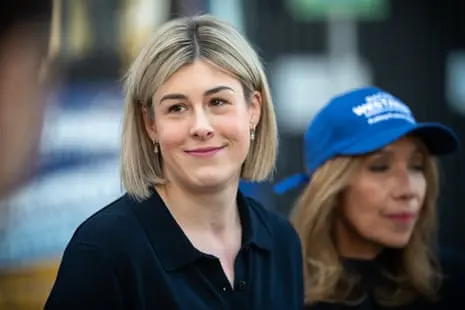
A Victorian Coalition government would privatise two sewage plants and sell off state-owned land, renewable energy assets and the “air rights” between Richmond train station and the Melbourne Cricket Ground if elected.
The opposition leader, Jess Wilson, released the Liberal and Nationals’ pre-election policy costings on Thursday, just two days before the state election and after more than 1.5 million Victorians have already cast their vote.
Labor, which has been releasing its costings throughout the campaign, also provided its overall budget projections on Thursday, showing a $1bn reduction in the state’s debt, from $196bn in the 2029-30 financial year to $195bn.
Central to the Coalition’s costings is a reduction in capital spending by $14.47bn, including via a $13.6bn “asset recycling” program – a term typically used when a government sells or long-term leases existing public assets.
It includes a 90-year lease of the Eastern and Western treatment plants that process the vast majority of Melbourne’s sewage, run by Melbourne Water, estimated to be worth $9.2bn. The Coalition took a similar proposal to the 2018 and 2022 state elections.
Wilson said there would be “no change” to water bills and the Essential Services Commission would still regulate prices across the sector. She denied the lease was akin to privatisation.
“It’s not a privatisation at all. It’s a long-term lease on the sewage assets,” she said. “At the end of the day, the government will continue to hold the assets.
“This is about making the responsible and disciplined savings to ensure that we can reduce the debt.”
Wilson also denied it was a broken commitment. In August, when The Australian revealed the Labor government had costed the privatisation of Melbourne Water’s assets, Wilson told ABC News the opposition had “never considered” doing the same.
“We’re not touching it,” she said on 5 August.
Sign up for Guardian Australia’s Politics, really newsletter here
Australian Services Union (ASU) Victoria and Tasmania branch secretary, Tash Wark, said the plan broke a clear promise to voters.
“Victorians were told in August that this was never going to be policy, and now, two days out and with a third of us having already voted, it is,” Wark said.
“I don’t know if Jess Wilson plans to still be premier in 90 years but, if not, then who will be there when this lease is up to answer for the worse outcomes seen under this dodgy privatisation?”
The ASU rejects claims by the Liberals that the Essential Services Commission will be able to keep prices down, pointing to what privatisation has done to water in the UK.
Other aspects of the “asset recycling” program include the sale of $1.3bn worth of government-owned land to housing developers and $92m for the air rights between Richmond station and the MCG, on the condition the precinct is “revitalised”.
The Coalition estimates it would also save about $1bn by selling the renewable projects owned by the State Electricity Commission back to the private sector.
The agency was revived as part of a 2022 election commitment by the Andrews Labor government and was later enshrined in the constitution. Wilson said the SEC had a number of services it could continue to provide without being dismantled altogether.
The Coalition has also proposed savings of $5.73bn from drawing down on contingencies – money set aside for “future unexpected programs” – and $1.23bn in deprioritising several planned level crossing removals.
This includes cancelling planned level crossing projects in Brunswick, Parkville, Yarraville and Spotswood, with the latter two requiring a cost of $90m to cancel contracts that have already been signed. Other projects would be delayed to beyond 2030 to further reduce capital spending.
The independent Parliamentary Budget Office has found the Coalition’s plan would lower net debt to $176bn by 2029-30.
Wilson said it would save the state $4.2bn in interest payments.
The costings also reveal plans to scrap international travel allowances for all MPs, saving $3.38m over the forward estimates, as well as $639m in funding to guarantee free kinder, though the Coalition would limit the rollout to 15 hours a week, instead of the proposed 30 hours. The PBO also maintains it would cost nothing to pause and review the Suburban Rail Loop.
Beyond the new measures, the Coalition has already announced a public service hiring freeze that Wilson said would save $23bn over a decade, including $5.7bn over the next four years, which is $1bn more than first estimated by the PBO earlier this year. It has also said it would save $407.6m by scrapping Australia’s first treaty with First Nations people and $578m from the privatisation of the Melbourne Market.
Wilson said it was standard practice to release costings at this point in the campaign.
“Victorians decide when they vote and decide why they vote,” she said.
However, the Greens leader, Ellen Sandell, said it was a “bombshell” announcement at the 11th hour of the campaign.
“Our public land, our publicly owned renewable energy and our sewerage infrastructure belong to Victorians. They’re not Jess Wilson and the Liberal party’s to sell off,” Sandell said.
The treasurer, Labor’s Colin Brooks, similarly described the move as a “massive, radical sell-off, all hidden from Victorians until just before the eve of an election”.
Environment Victoria was also opposed to the announcement, particularly after pre-polling had already opened.
“That Jess Wilson has dropped a Kennett-era privatisation agenda on Victorian voters after many have already voted shows she knows how unpopular these policies are,” its CEO, Jono La Nauze, said.
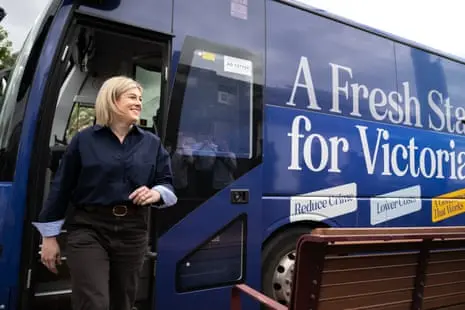
The Victorian Liberals’ campaign bus was supposed to be a reset. Instead it became the symbol of a rough week
Crashing into a shop awning ended the first outing of the Jess Express – but the opposition’s electoral momentum will be harder to stop Get our daily political email, free app or daily news podcast Jess Wilson has barely put a foot wrong since becoming Victorian Liberal leader a little under a year ago. That was until this week, which ended with her campaign bus reversing into a small business....
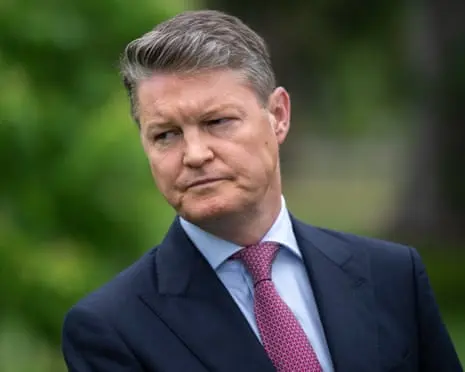
Public service union refuses to back Labor at Victorian election, condemning job cuts and $1.2bn consultant spend
Exclusive: Community and Public Sector Union denounces ‘privatisation by stealth’, joining growing number of unions turning on Carroll government Get our breaking news email, free app or daily news podcast Victoria’s public servants union says it will not support Labor at this month’s state election, condemning the government for cutting public service jobs while spending $1.2bn on consultants....
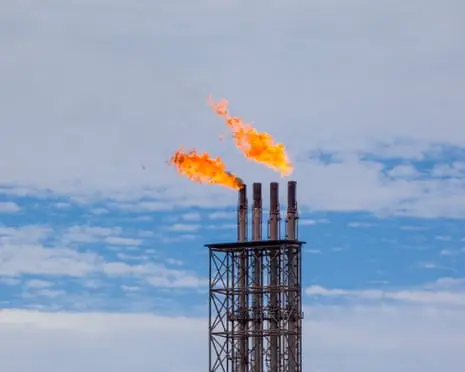
Coalition teams up with Labor to pass 20% gas reservation scheme for Australia’s largest exporters
Coalition voted in Senate to pass government’s final major piece of legislation for 2026, denying Greens’ bid for 25% tax on exports Get our daily political email, free app or daily news podcast A federal gas reservation scheme requiring Australia’s largest exporters to keep up to 20% of their product for domestic use will go ahead with the Coalition’s support. The opposition voted with the...
Victoria Barracks in Sydney and Melbourne to remain in public hands after partial backtrack on defence property selloff
Four heritage-listed defence properties to be preserved for community use after backlash from veterans and former PMs Get our daily political email, free app or daily news podcast Four heritage-listed defence sites, including Sydney’s Victoria Barracks, will remain in public hands after the Albanese government yielded to public backlash against their sale. The sites, along with 63 others around...
Albanese concedes $6m golf club grant in his electorate was not to contain ‘raw sewage’
Grant part of $560m invitation-only scheme transparency advocates say largely funded projects in Labor-held seats Follow our Australian politics live blog for latest updates Get our daily political email, free app or daily news podcast Anthony Albanese has admitted he got it wrong after telling parliament a $6m grant to a golf club in his electorate was to stop “raw sewage” going into the nearby...