U.S. stocks mostly lower as traders await Iran’s response to latest peace proposal
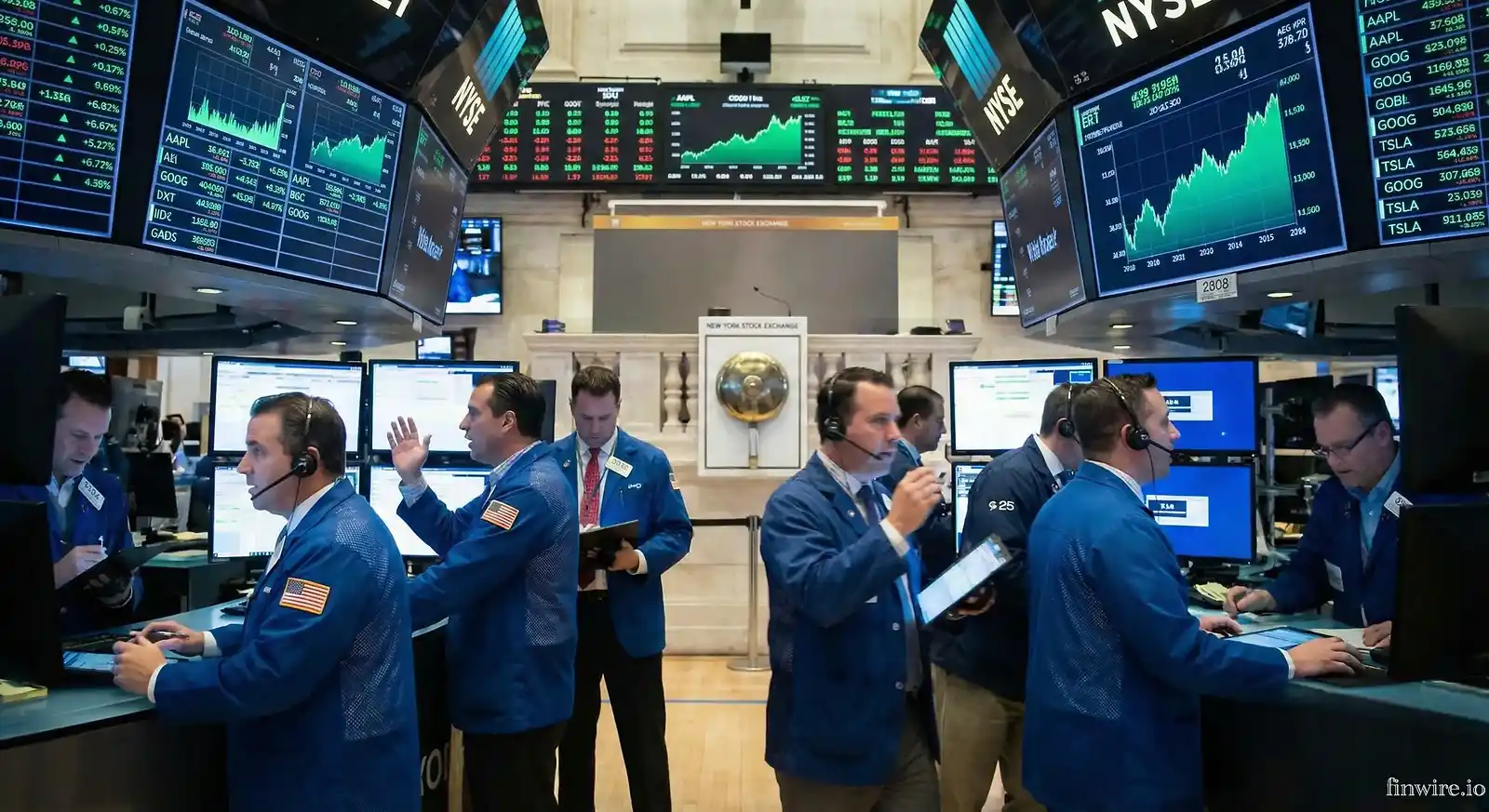
Wall Street lost momentum on Thursday and turned mostly lower, as oil prices pared losses after Iran said it was still reviewing a new proposal to end its conflict with the U.S.
Hopes that a peace deal would be reached soon took another hit after a report that Washington was considering restarting an operation to safely guide commercial ships through the Strait of Hormuz.
At 14:00 ET (18:00 GMT), the benchmark S&P 500 index was down 0.4% to 7,339.79 points, while the tech-heavy NASDAQ Composite was a smidge lower at 25,828.52 points. Both gauges earlier scaled new record highs.
The Dow Jones Industrial Average slipped 0.7% to 49,577.53 points, after earlier hitting a session high at 50,130.20 points. The blue-chip gauge is now in sight of its all-time peak of 50,512.79 points notched in February.
"The stock market is digesting some pretty heady gains recently. The war trade is unwinding further," Mark Luschini, chief investment strategist at Janney Montgomery Scott, said.
"Big cap tech and tech-adjacent stocks, which had recently resumed their leadership, are rallying again. Risk on sentiment is prevailing in general but overbought conditions may temper the advance in the very near term," Luschini added.
Iran war peace hopes
Washington and Tehran have reportedly been working with mediators on a one-page framework to once again restart talks over a lasting peace deal. The discussions are seen kicking off next week in Pakistan, according to the Wall Street Journal.
The paper added that a monthlong process would then look to resolve disputes over Iran’s nuclear ambitions and relief from sanctions, however key disagreements remain over areas like nuclear enrichment and inspections.
President Donald Trump suggested in remarks at the White House on Wednesday afternoon that the U.S. had "won" the war and that talks with Tehran had been "very good" over the last 24 hours.
Iran, meanwhile, has provided more mixed messaging. Iran’s state media said Tehran was still reviewing the U.S. proposal and had not yet reached a conclusion, citing foreign ministry spokesperson Esmaeil Baqaei. But other media reports cited an Iranian official who described the U.S. peace plan as an American wish list.
According to CNN, Iran is anticipated to give mediators their response by Thursday.
"[I]nvestors appear to be taking the news as a signal that the U.S. and Iran are strongly committed to not letting the conflict escalate again. That alone was enough to propel Wall Street," Kyle Rodda, senior financial market analyst at Capital.com, said.
Oil prices pare losses
Oil prices earlier slipped under $100 a barrel against this backdrop, with traders attempting to determine the outlook for a weeks-long shuttering of the Strait of Hormuz. The U.S. earlier this week paused an effort called "Project Freedom" to safely help commercial ships transit the strait.
CNN also reported that Iran had set up a new protocol for tankers looking to transit the strait, where the ships need to fill out a document titled "Vessel Information Declaration" which was viewed by CNN. The document must be filled out or the ships risk attack, CNN said.
Meanwhile, the Wall Street Journal said Tehran wouldn’t allow the U.S. to reopen the strait with an "unrealistic plan" and then exit the war without paying any reparations "for all the damage inflicted on Iran," citing comments from senior official Mohsen Rezaei.
The WSJ also reported that Saudi Arabia and Kuwait had lifted restrictions on the U.S. military’s use of their bases and airspace, citing U.S. and Saudi officials, paving the way for the Trump administration to restart Project Freedom.
Brent crude futures expiring in July, the global benchmark, pared losses and were last down 0.7% to $100.55 a barrel, while U.S. West Texas Intermediate crude futures expiring in June dropped 0.2% to $94.87 a barrel.
Energy prices have skyrocketed since the start of the conflict, due largely to the effective closure of the strait, a major thoroughfare for around a fifth of the world’s oil. Despite the latest move downwards, oil prices are still well above pre-war levels.
The energy shock forces gasoline pump prices in the U.S. above $4.50 a gallon, levels not seen since the height of the COVID-19 pandemic in 2022. But Trump has expressed some surprise that oil prices have not moved even higher, telling reporters that he thought they would "go to $200, $250."
Even if crude had reached such heights, he added, the war in Iran would have been "worth it."
More labor market indicators ahead of jobs report
Away from the Middle East, market participants received some more data on the U.S. labor market ahead of Friday’s widely-anticipated April nonfarm payrolls report.
As per Challenger, Gray & Christmas, U.S. job cuts increased 38% M/M to 83,387 in April, the highest total for this month since 2009.
“Technology companies continue to announce large-scale cuts and are leading all industries in layoff announcements. They are also often citing AI spend and innovation. Regardless of whether individual jobs are being replaced by AI, the money for those roles is,” Andy Challenger, chief revenue officer at Challenger, Gray & Christmas, said in a statement.
Separately, the U.S. Department of Labor said the number of Americans filing for initial jobless claims in the past week inched up to 200k, lower than the expected figure of 205k. Conversely, Americans filing for continuing claims eased to 1.776 million.
"U.S. Initial Claims increase to 200K from an upward revision of 190K below the 13-week moving average of 209K. The U.S. labor market remains remarkably stable and the pace of firings relatively low while continuing claims eased to 1.766 million. I expect the April U.S. Jobs Report to show a net change in total employment of 60K and an 4.3% unemployment rate. New jobs will skew towards lower paying employment," Joseph Brusuelas, principal & chief economist at RSM US, said.
Earnings season powers stocks
Turning to earnings, a mostly positive season so far has played its part in helping Wall Street return to record levels.
"Earnings are significantly exceeding consensus estimates across all metrics, despite a high bar. S&P 500 earnings growth is projected to accelerate sharply from 13.4% in Q4 to 24.6% in Q1 – a four-year high and a level rarely seen outside of post-shock recoveries. Excluding special factors, this represents arguably the strongest earnings growth in two decades," Deutsche Bank’s Jim Reid said.
"The AI boom is a clear contributor, but strength is widespread, with double-digit growth seen in average and median companies, and all 11 sectors posting positive growth for the first time in four years. This strong performance has in many places been driven by higher prices amid supply constraints, surging demand within the AI value chain, and other disruptions," Reid added.
The artificial intelligence trade has largely been bolstered by strong quarterly results from hyperscalers such as Alphabet, Microsoft, and Meta, and from major semiconductor players such as AMD and Arm.
"A touch of AI-mania has returned as a theme," Capital.com’s Rodda said.
"It’s not without fundamental justification, with S&P 500 earnings growth nearing 30% for this quarter, led by the big tech names. There are bubbling concerns about concentration risk. However, valuations aren’t as stretched as they were last year, implying the market isn’t quite at irrational exuberance levels yet," Rodda added.
Speaking of Arm, the British chip designer delivered quarterly results and guidance that beat estimates, while touting strong demand for its new AI data center chip launched in March.
U.S.-listed shares of the company initially soared in Wednesday extended trading following the print, but then reversed course after management indicated that necessary supply had not been secured to meet an additional $1 billion in demand for the new AI chip. The stock was last down 9.7%.
In other earnings-related moves, Coach-owner Tapestry lifted its annual forecast for a third time in 2026, underpinning by solid demand among younger customers. However, the stock slid about 11%.
Elsewhere, household appliance manufacturer Whirlpool slumped 13% after the firm slashed its full-year revenue forecast.