To live longer, you’ll not only need to move to a big city, but to the right neighbourhood
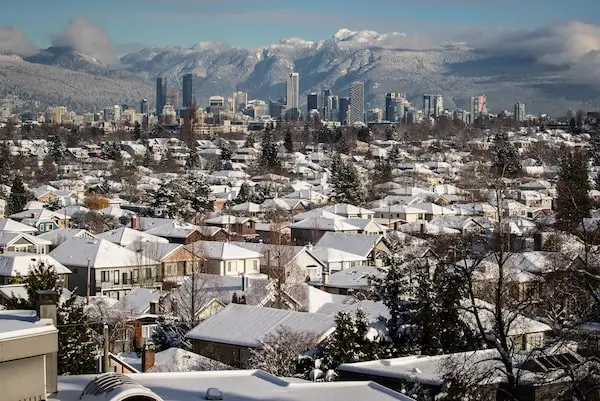

Vancouver, shown in December 2021, is among the top three regions where life expectancy is highest, but health outcomes vary substantially within a city, even at the neighbourhood level.DARRYL DYCK/The Canadian Press
Where you live in Canada will determine how long you’ll live. And if you want to live longer, you’ll not only need to move to a big city but to the right part of that city – the richer part.
Recent Statistics Canada data shows kids born in or near Montreal, Vancouver or Toronto can expect to have the greatest longevity. However, a second study by St. Michael’s Hospital in Toronto finds that simply moving to the city is not enough, since kids growing up in one Toronto neighbourhood could, on average, live a decade or more longer than those just a few blocks away.
The recent life expectancy at birth data from Statscan is mostly good news, showing that the expected lifespan of a newborn has increased by almost a full year since 2008, to 81.7 years from 80.8. Advancements in health care and reductions in smoking rates are helping Canadians lead longer, healthier lives.
Prosperity’s Path: Youth rage, burning bright. What hand could tame thy generational asymmetry?
Unfortunately, a rising health tide is not lifting all boats. In 2008, babies born in the top 20 per cent of the 93 Canadian regions in the dataset were expected to live, on average, five years longer than those born in the bottom 20 per cent.
Examining those same regions today, the top regions of 2008 have seen their life expectancy rise by more than a year, while those in the bottom have seen theirs fall by more than a year, widening that gap to nearly eight full years.
It appears that the key to living a long life, on average, is living in a city. The regions in the top 20 per cent are almost entirely urban, with York Region, Peel Region and Vancouver in the top three. The bottom 20 per cent are almost entirely remote rural regions, with Northern Manitoba, Nunavut, and Nunavik rounding out the bottom three.
This rise in life expectancy inequality mirrors rising inequality in other aspects of Canadian life. Both the length and quality of someone’s life are shaped by income security and access to health care.
Canada continues to urbanize, creating regions that are being left behind both in terms of economic opportunity and the critical population mass needed to keep health care and other social services viable.
Appearances, however, can be misleading; simply moving to a city is not enough to extend your life, as health outcomes vary substantially within a city, even at the neighbourhood level.
According to research from St. Michael’s Hospital in Toronto, kids who grow up in wealthier neighbourhoods such as Yonge-Doris, East Willowdale and Hillcrest Village can expect to live more than a decade longer than those who are raised in Moss Park.
Lower-income Canadians might live close to a hospital or a family doctor, but that does not guarantee equal access to these resources. The poor often lack the resources to navigate a complex system, making it less likely they will have a family doctor or be referred to a specialist.
Lack of access to a family doctor or specialist leads to poorer outcomes for both poorer families and poorer communities. A 2024 study found that lower-income Canadians have less access to cancer screening and diagnosis and higher rates of mortality than those living in higher-income areas.
Opinion: Do children need to grow up in a detached home with a yard to thrive?
Whether we are thinking about wealth or health, the increasing gap between the haves and have-nots should concern us all. It has always been true that one of the most important things we can do is to choose our parents carefully.
But a successful country is one where someone can rise from humble beginnings, and with a bit of talent, hard work and luck, a person can overcome early-life challenges.
Economists have been sounding the alarm about the decline in economic mobility in Canada and the growing power of “poverty traps.” An increasing cohort of young people is being denied both wealth and health, simply by being born to the wrong parents in the wrong neighbourhood, which threatens social cohesion. The rise of far-right parties in left-behind regions, like the AfD in Saxony in eastern Germany, highlights the risks.
Smart public policy, from regional economic development policies to health care reforms, can make it less risky to grow up in the wrong neighbourhood or the wrong part of Canada.
But this will require acknowledging the depth of inequality in Canada and that, despite our public health care system, the wealthy still have better access to care than the poor.
Mike Moffatt is the founding director of the Missing Middle Initiative and co-host of the Missing Middle podcast.

Who will care for you in retirement? New survey of Canadians finds common blind spot
Respondents scored relatively high on financial preparedness, but study identified gaps in planning for health and care needs
Canada’s housing recovery has begun. It’s just not the one realtors want
We need a housing market in which ownership is in reach for what hard work can earn in a reasonable time
High-earning couple buy $2-million home in pricey Vancouver after years of holding out
Lifelong renters switch to owning in their late 40s after deciding it was time to stop moving their kids


Why retirement planning needs a health check
For advisors, the spectre of ailments for clients – and the financial consequences – should be on the radar