Is the AI bubble reckoning nigh? I certainly think so
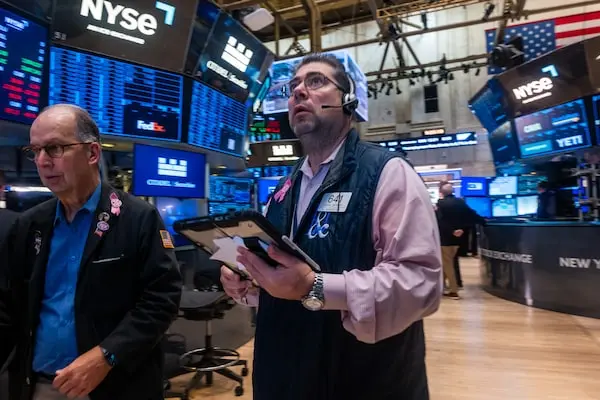

Traders work on the floor of the New York Stock Exchange Friday. Stocks were down slightly in morning trading after a day of steep sell-offs tied in part to concerns about the future of AI investments.Spencer Platt/Getty Images
George Athanassakos is a professor of finance and holds the Ben Graham Chair in Value Investing at the Ivey Business School, Western University. He is the author of the recent book Value Investing: From Theory to Practice.
Is the artificial intelligence bubble reckoning nigh? The debt-driven, interconnected AI sector is showing cracks and the risk of a crash is rising fast.
A possible catalyst for the reckoning could be the win of the Democratic Party in the recent U.S. elections and the threat posed by Democrats to the AI data centre boom by delaying projects, raising costs and complicating AI companies’ race to build more computing capacity.
Even prior to the midterm elections, there were some red flags for the tech sector: Intel plunged 29 per cent on Oct. 30 after it missed earnings estimates. Amazon and Alphabet had similar reactions to either missing estimates or reporting lower-than-expected growth. OpenAI significantly cut its revenue projections and so did Palantir, to mention a few. As of the end of October, NASDAQ was already 10 per cent below its peak.
And there may be more bad news coming up: For example, Anthropic or OpenAI may not be around long as corporate entitiesafter their IPO, as they have made large spending commitments in data centres and chip leases under the assumption “if we build it, they will come.”
Problems may also arise given that OpenAI and Anthropic are supposed to pay hyperscalers for compute to rent (i.e., GPU rental services for AI and machine learning projects). But as I explained in my recent article, co-authored with my colleague Christian Dippel, OpenAI and Anthropic are the most financially fragile companies: single-product companies selling a commoditizing product into a market with free open-source models, financed by recurring capital needs that assume a profitability they have not yet shown. These are the most likely companies to go to zero, and they are the ones lining up for the exits. This will circle back to the hyperscalers.
In other words, while AI may change the world, at this point, we do not know which companies will survive. Academic studies show that investors tend to overestimate intrinsic value of high-growth companies and subsequently overpay for growth; this leads to poor long-term performance.
Wall Street brokerages say AI sell-off overdone, downplay Democratic regulation risks
For example, researchers at the Darden School of Businessin 2009 looked at the stock performance of high-asset-growth firms and compared it with the performance of low-asset-growth firms between 1968 and 2007. What they found was that low-growth firms had an average return of 26 per cent annually, while high-growth firms returned a meagre 4 per cent.
The low-growth firms outperformed the high-growth firms by a whopping 22 percentage points, annually on average, over that 40-year period. High-growth stocks tend to attract a lot of attention and a lot of trading by investors, and they thus tend to become overvalued, leading to low returns going forward. It is true that if one was lucky and had invested in Microsoft, Amazon or Google they would have made a lot of money, but how about the multitude of other growth companies that did not make it or went bankrupt?
Moreover, what adds to concerns about AI is that we now have companies that used to be light capex (capital expenditures) becoming heavy capex, and companies that used to have little or no debt becoming heavily indebted. Asset growth will be there, but what if these hyperscalers do not earn as much revenue as expected over the next few years, given their heavily indebted balance sheets? Overinvestment tends to lead to overcapacity, and overcapacity leads to low return on invested capital and, in the presence of an over-leveraged balance sheet, to bankruptcy.
And this is happening while the long-term trend in interest rates is on the way up.
In general, falling interest rates are good for the stock market and rising interest rates are bad for stock prices, but this is not always the case. A rise in rates may not necessarily be bad for stock markets, providing the rate increases are lower than the increase in the rate of profit growth. Similarly, a fall in rates may not necessarily be good for stock markets if profit growth falls faster than the decline in interest rates.
In other words, the generally held belief that interest rates and stock prices are inversely related ignores the growth rate effect of earnings when modelling valuations. The key question is: Will corporate profits increase fast enough to compensate for the rise in interest rates?
While interest rates have gone up in the last five years, so have values. But this does not reflect the whole market. The market is up because long-run cash flow expectations for the big 10 AI technology companies – which account for 41 per cent of the S&P 500’s market capitalization – have risen faster than an increase in interest rates. And so, despite rates going up, their values have also increased.
Would Anthropic’s proposed Public Benefit Fund actually help workers disrupted by AI?
But will high growth persist? The answer is no, based on historical evidence. For example, in a study that covered the period 1997-2022, Verdad’s Brian Chingono showed that long-term earnings growth in U.S. equites doesn’t persist beyond what we would expect to see from random chance.
The probability that a company posting above-median growth keeps doing so over successive years looks similar to the odds of flipping heads repeatedly: about 25 per cent for two years consecutively, roughly 12.5 per cent for three years, and around 6.3 per cent for four years in a row. The pattern holds even among firms that start in the top growth quartile, and it holds internationally across Europe and Japan. And yet investors expect that high growth will persist for AI related companies. It will not happen.
And finally, it is worth remembering: A period of high market concentration, such as the one we are currently experiencing, did not end well in the past. In the 1970s, the Nifty Fifty accounted for 40 per cent of the S&P 500. In the 1980s, Japanese stocks accounted for 44 per cent of the MSCI world index, and in the 1990s, telecommunication stocks accounted for 41 per cent of the S&P 500.
Is the reckoning nigh? I believe so.

Could the US midterms put a pin in the AI bubble?
Fears of more AI regulation appear to have sparked fear among investors, but concerns about the industry have been growing for some time.
US tech stock rout: is the AI bubble bursting?
After Thursday’s share price plunge on Wall Street, could the volatility be the start of a huge market meltdown? Business live – latest updates Global financial markets have been thrown into a tailspin as investors bet on an AI slowdown after the US midterm elections. This is not the first time stock markets have wobbled in recent months due to concerns over a tech bubble. But could this...

Stocks surge as ‘blue tsunami’ puts political uncertainty to rest
Stocks rebounded after Democrats won key Senate races across the country. The size of the blue wave surprised Wall Street, which was expecting a ripple.

Investors try to regain their footing after tech stocks tank
Tech stocks in the U.S. steadied Friday after suffering one of their worst routs in years, as investors weighed the prospect of an AI investment slowdown.