Intel on course for worst day ever, triggers global chip rout
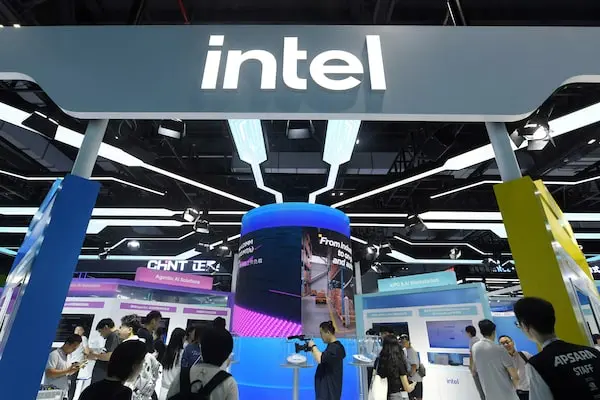

People visit the Intel booth during a trade fair in Hangzhou, China, in September.STR/AFP/Getty Images
Intel (INTC-Q) sank 30 per cent on Friday and was headed for its biggest one-day decline ever, deepening a selloff in tech stocks as weakening PC demand and the soaring costs of the AI boom rattled investors.
The major PC chip supplier on Thursday forecast quarterly revenue that was more than US$1-billion below market estimates and said it does not expect positive cash flow this year, the latest sign of the far-reaching strains caused by the massive AI buildout.
Its warning also raised concerns over a broad swathe of the tech industry reliant on consumer device sales, from PC sellers such as Dell to PlayStation creator Sony and smartphone major Samsung, as AI-driven demand sends memory prices soaring.
Sentiment toward tech stocks was already fragile ahead of Intel’s earnings after Meta and Alphabet’s results showed the AI infrastructure race was turning once lightly indebted tech giants into heavy spenders reliant on borrowing.
Amazon exacerbated those concerns on Thursday by reporting a large cash outflow, while signaling higher capital expenditures next year atop an already huge amount in 2026.
“The market is in a sell first, ask questions later mood right now, and Intel’s warning has given investors an easy excuse to take some money off the table across chip stocks,” said Matt Britzman, senior equity analyst, Hargreaves Lansdown.
Friday’s plunge was set to wipe more than US$146-billion off Intel’s market value, with the U.S. government - its largest shareholder after taking a 10 per cent stake in August last year - facing a nearly US$12-billion hit to the value of its holdings.
Concerns also spilled over to credit markets, with the cost of insuring Intel’s debt against default surging to an all-time high. Five-year credit default swaps widened 17.5 basis points to 124.75 and were on track for the biggest one-day jump since October 2022, Markit data showed.
Still, multibillion-dollar investments from the U.S. government and Nvidia have bolstered Intel’s finances. The company had US$21.84-billion in cash and cash equivalents at the end of September, against US$46.32-billion in long-term debt.
Other U.S. semiconductor stocks such as Advanced Micro Devices, Arm, Qualcomm, Nvidia, Broadcom and Micron fell between 4 per cent and 12 per cent.
Europe’s ASML and Taiwan’s TSMC fell more than 6 per cenUS$t and nearly 2 per cent, respectively, while China’s tech-heavy STAR50 index hit a more than two-month low.
South Korea’s AI-sensitive KOSPI slid 3.5 per cent, and chip giant Samsung Electronics lost 3 per cent, heading for its first monthly decline since July.
The rout also swept through U.S. server makers, sending shares of Dell Technologies, Hewlett Packard Enterprise and Super Micro Computer down between 6 per cent and 11 per cent.
Friday’s slump follows a remarkable rally in Intel shares that had more than doubled their value this year, making the stock a Wall Street darling and building on gains of over 80 per cent last year.
Surging demand for central processors that help power AI agent and chatbot responses has turned Intel into a winner of the boom after years on the sidelines, while its push to become a major contract chip manufacturer is also gaining momentum.
But the spending needed to build its manufacturing business is sapping its cash flows, and supply disruptions have capped its ability to tap growing demand for data-center chips.
Intel’s PC chip business, which accounted for roughly half its third-quarter revenue, has also come under pressure from soaring memory prices as suppliers shift production towards high-bandwidth chips used in AI systems.
Seaport Research Partners analyst Jay Goldberg said Friday’s selloff reflected “a loss of faith in management’s credibility.”
“Intel is producing too many chips for consumer PCs in the worst PC market in 15 years, while it is not making enough chips for AI servers in the biggest growth cycle ever for semis. Bad planning is the cause.”