How Trump’s warped economic worldview made Canada the enemy
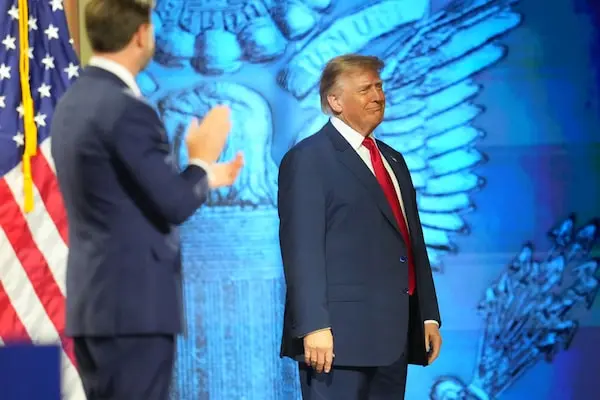

U.S. Vice President JD Vance applauds as President Donald Trump arrives on the stage at the Republican convention, on Sept. 10, in Dallas.Julio Cortez/The Associated Press
Nobody practices the dismal sciencemore dismally than Donald Trump.
Listening to him ramble about economic issues and trade leaves one baffled at the cosmic timeline that has put him at the helm of the world’s most powerful economy.
So we collectively tune him out. We do so for the same reason we ignore him when he claims most people don’t know the word “dumb” ends with the letter B. Or when he praises the “late, great Hannibal Lecter.” Or when he says he knows more than anyone about “the horror of nuclear.” Because it’s all nonsense.
Case in point, last week, Mr. Trump tried to illustrate the upside of ending a US$40-billion trade relationship with an unnamed country. “If we cut off trade with that country, we just made $40-billion. You do a few countries like that, and we become a big money machine.”
Analysis: Why Trump’s new trade barriers are more bark than bite
Robert Reich, who was the labour secretary during the Bill Clinton presidency, interprets the idea bluntly. “I’m afraid he’s an economic illiterate,” Mr. Reich said in an interview on MS Now last week. “One wonders if he’s losing it, or he never had it, or he’s going to actually make policy based on these crazy notions …”
In fact, that’s already happening, and it’s Canada’s sad lot, perhaps more than any other country in the world, to live with the consequences of Mr. Trump’s economic delusions. They already inform U.S. trade policy.
To understand Mr. Trump’s animosity toward Canada is to appreciate his misunderstanding of basic economics. Let’s pay a visit to the Trump School of Economic Thought. Please leave your brain at the door.
“If we did no trading with Canada, it would save $90-billion.”
This is the latest pet argument of the President to boggle the mind. Though he’s pulled the figure out of thin air, try to follow his logic. In 2025, the Office of the U.S. Trade Representative reported a US$48.3-billion trade deficit with Canada. That shrinks to US$20.6-billion when you factor in services, but no matter. The President seems more concerned with stuff.
Round the figure up to US$90-billion just for the hell of it. You end up with a net of US$90-billion flowing to Canada to buy goods that flow in the other direction – things like crude oil, lumber, auto parts and potash.
Now, cut off all cross-border trade with Canada. The U.S. gets to keep the money, while the goods don’t arrive. By Mr. Trump’s math, you just made US$90-billion.
That’s obviously not true, you just didn’t buy a bunch of stuff you still need.
“Without our subsidy, Canada doesn’t exist, really.”
To Mr. Trump, trade deficits are the ultimate red flag that the U.S. is being scammed. Eliminating imbalances with major trading partners is at the very core of his trade policy. At the same time, he is aggressively trying to lure foreign investment into the U.S. market. These two goals cannot co-exist.
Tony Keller: Canada needs a leap of imagination to understand, and survive, Donald Trump
When investment comes in, the value of the U.S. dollar rises, U.S. exports become more expensive to global buyers, while imports into the U.S get cheaper, and the trade deficit widens. That’s how it works.
In the case of Canada, the trade deficit is due entirely to the flow of crude oil, which we sell to the U.S. at a discount. Mr. Trump calls this a “subsidy.” Are you subsidizing the grocery store when you buy food?
“Lower the rate or I’ll stop trading with countries with which we have a deficit.”
Mr. Trump seems to think that having the world’s dominant economy means the U.S. ought to also have the lowest interest rates in the world. He pointed to jobs growth as a sign of economic strength, which means the country should be “a better credit,” similar to an individual with stronger credit getting better terms on a loan.
Opinion: Trump stumbles as flunkies around him give dumber and dumber advice
But a central bank is different from a personal lender. Since strong growth tends to be inflationary, it raises the likelihood of rate hikes, not cuts. Mr. Trump rejects this basic economic relationship. “Success does not cause inflation. Stupidity causes inflation,” he says.
Not only does he betray a fundamental misunderstanding of how interest rates work, Mr. Trump is now linking things with no obvious economic connection – Federal Reserve policy and trade balances.
“I believe the tariffs paid for by foreign countries will ... substantially replace the modern-day system of income tax.”
The idea that foreign governments somehow pay tariffs on U.S. imports is a foundational fantasy in the mind of the President.
This past week, U.S. Vice-President JD Vance repeated the lie, suggesting that tariffs collected from foreign entities could finance the US$5,000 cheques Trump promised every American if Republicans retain power in the mid-term elections.
Research shows American corporations and consumers bear the vast majority of the burden. The big American automakers illustrate well how tariffs effectively raise manufacturing costs. Tariffs cost them US$12.5-billion last year alone, according to an Anderson Economic Group report.
There are plenty more examples. Like when Mr. Trump says the U.S. doesn’t need anything from Canada. (It does.) Or that the GST discriminates against U.S. exports to Canada. (It doesn’t.) Or that American dairy products coming to Canada are being hit with a 270-per-cent tariff. (They’re not.)
There’s no point trying to disabuse Mr. Trump of his warped notions. But perhaps there’s solace in knowing reality is not on his side.