Former Vanguard Canada CEO bets on prediction markets with bid for regulatory approval
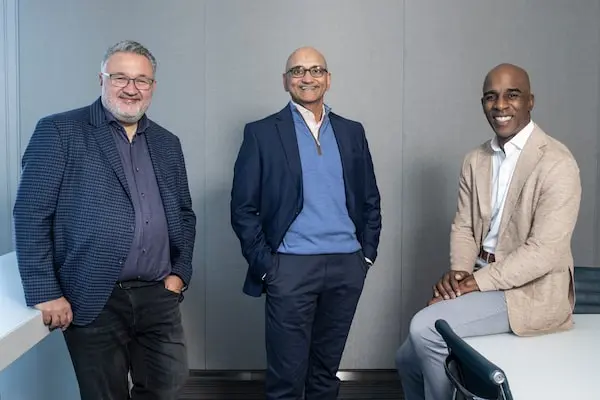

Atul Tiwari, centre, Michael Williams, right, and Jim Andriopoulos, the team behind Verdx, in Toronto, on Sept. 24.EDUARDO LIMA/The Globe and Mail
A group of veteran Canadian finance executives is seeking regulatory approval to build what would be the country’s first investment dealer focused exclusively on prediction market trades, as regulators continue to assess how the industry fits into Canada’s securities framework.
The company, led by former Vanguard Investments Canada Inc. chief executive Atul Tiwari, filed an application this week seeking registration with the Canadian Securities Administrators as an investment dealer and membership with the Canadian Investment Regulatory Organization. The application is subject to review for acceptance, and there is no set timeline for regulatory approval or a launch.
The proposed platform, called Verdx, is the latest sign of growing Canadian interest in prediction markets, following moves by Interactive Brokers Canada Inc. and Wealthsimple into the nascent industry. But Verdx is making a more concentrated bet, building a platform solely around event contracts,rather than offering it as one product within a broader business.
“If anyone is going to do a made-in-Canada solution in a collaborative, compliant way, it’s us,” Mr. Tiwari said.
Prediction markets, which have exploded in popularity in the United States, allow investors to trade event contracts, which pay out based on whether a specific future event happens.
In depth: Prediction markets are coming to Canada – and young investors are already betting on them
In Canada, the contracts available through regulated investment dealers are more limited than those available on U.S. prediction markets. Canada’s securities and investment-industry regulators havesaid CIRO-approved dealers are only permitted to offer contracts tied to economic indicators, financial markets and climate trends, and have declined to oversee sports and entertainment bets. Verdx intends to operate within that framework, Mr. Tiwari said.
Prediction markets have also generated significant controversy, including debate over whether the products amount to investing or gambling. Mr. Tiwari said part of Verdx’s strategy will be trying to demonstrate what he sees as the practical uses of event contracts. He pointed to potential hedging uses, such as contracts tied to extreme weather that could help offset costs associated with floods or insurance deductibles.
“Our objective is to hopefully present the utility of these event contracts and prediction markets,” he said. “There’ll be people who disagree, and that’s fine. But I guess all we would say is that please take a look at both sides.”
Verdx plans to function as an order-execution-only investment dealer, meaning it would facilitate trades, but would not provide investment advice.
Mr. Tiwari, one of Canada’s ETF pioneers, is known for launching Vanguard’s Canadian business in 2011, which had grown to more than $30-billion in assets under management by the time he left in 2018.
Editorial: The risky bet of prediction markets
He is joined at Verdx by Jim Andriopoulos, former chief financial officer at Wells Fargo, and Michael Williams, who previously held chief compliance and risk roles at Richardson Wealth and HSBC. Advisers include Ed Waitzer, former chair of the Ontario Securities Commission; Jos Schmitt, founder of Canadian stock exchange operator NEO Exchange (now Cboe Canada); and David Lang, a former global chief compliance officer at Royal Bank of Canada.
“If you look at the projections for the future,” of the prediction market industry, “we’re looking at tremendous growth over the years to come,” Mr. Schmitt said.
Verdx began primarily as a self-funded venture and is now raising outside seed capital through its network, Mr. Tiwari said.
He estimates the Canadian prediction market industry could reach between $40-billion and $50-billion in annual trading volume in roughly five years. By comparison, combined monthly global trading volume on Kalshi and Polymarket, the two largest prediction markets, reached US$53-billion in July alone, according to the Pew Research Center. Much of that growth, however, has been driven by sports contracts.
Canadian financial institutions restrict employees’ use of prediction markets
Mr. Tiwari said the case for a regulated Canadian platform is partly based on the belief that Canadians are already accessing prediction markets through offshore platforms. But he acknowledged there is little reliable data showing how many Canadians are currently doing so.
Verdx is initially targeting retail and institutional investors and plans to include educational modules explaining event contracts and how to use and trade them. But Mr. Tiwari believes institutional investors could eventually account for a significant share of the business, potentially reaching roughly half of activity if the markets become more liquid and attract more institutions.
There are signs of growing institutional interest in the United States. Kalshi said in May that institutional trading volumes on its platform had grown 800 per cent over the previous six months.
If approved, Verdx would not operate the exchange on which the contracts are listed. CIRO-authorized investment dealers can offer certain event contracts listed and cleared through U.S. Commodity Futures Trading Commission-regulated exchanges and clearing houses. Mr. Tiwari declined to identify which exchanges Verdx would work with, but said the company is “engaged” with multiple participants.
Wealthsimple’s contracts are traded on Kalshi, and Interactive Brokers Canada’s contracts are traded on U.S.-based exchange, ForecastEx LLC.