Asian stocks advance as tech rebound, easing trade concerns lift sentiment

Asian equities moved higher on Thursday, supported by a recovery in technology shares and easing concerns over U.S. trade measures, although lingering questions surrounding Nvidia’s corporate governance continued to weigh on investor confidence.
Wall Street recovered most of its early losses on Wednesday, with the S&P 500 closing 0.3% lower and the Nasdaq Composite losing 0.6%, while the Dow Jones Industrial Average edged up 0.3%. In Asian trade, Nasdaq 100 futures gained 1.1% and S&P 500 futures advanced 0.7%.
The Nasdaq 100 briefly approached bear-market territory, defined as a 20% drop from its recent peak, before buyers pared losses, although AI shares fell for a second session after Monday’s relief rally sparked by Jensen Huang’s return to Nvidia.
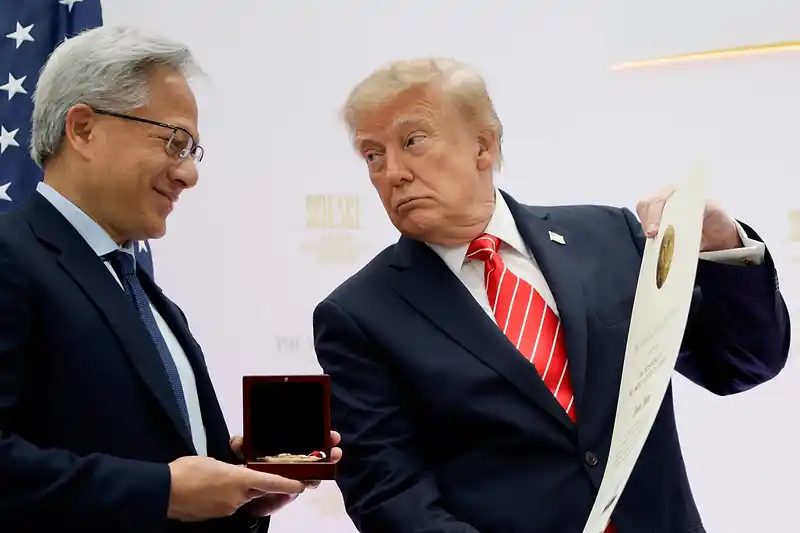
Nvidia remained a major source of uncertainty after S&P Global Ratings placed its AA credit rating on CreditWatch Negative, citing concerns over board independence and management oversight.
The latest U.S. tariff proposals proved less disruptive than initially feared. Washington proposed new duties on imports from 14 trading partners, including China, Japan, South Korea, Taiwan, India and the European Union, following an investigation into alleged excess industrial capacity.
However, the new tariffs are not expected to be added to duties imposed in July and are unlikely to take effect before February or March.
U.S. inflation data nevertheless reinforced concerns over further monetary tightening. Third-quarter economic growth was revised up to 4.3%, while headline PCE inflation reached 3.8% annually and core PCE rose 0.3% monthly and 3.3% annually. Markets priced in a 98% probability of a 25-basis-point Fed rate increase in December, although expectations of a larger half-point move faded.
Asian markets recover as tariff concerns ease, South Korea raises rates
MSCI’s Asia-Pacific equity gauge gained 1.3% after an eight-session losing streak had brought the index close to bear-market territory.
Taiwan’s Weighted Index gained 2.6%, while South Korea’s KOSPI advanced 1.6% and Japan’s Nikkei 225 rose 1.7%. Hong Kong’s Hang Seng climbed 1.9%, while Nasdaq 100 futures added 1.1% and S&P 500 futures gained 0.7% in Asian trade.
Australia’s S&P/ASX 200 rose 0.9%, New Zealand’s NZX 50 fell 0.4% and Singapore’s Straits Times Index gained 0.9%.
China’s CSI 300 was nearly unchanged, while the Shanghai Composite slipped 0.03%. India’s Nifty 50 added 0.1%, and Indonesia’s Jakarta Composite rose 0.7%.
The Bank of Korea raised its benchmark rate by 25 basis points to 3.25%, the highest since October 2024, following a three-month pause. It upgraded its 2027 growth forecast to 4.1% and its 2026 projection to 3.9%.
Chipmakers rebound, but AI investment concerns persist
Regional semiconductor shares recovered, with Kioxia surging 12.36%, Largan Precision gaining 9.94%, SK Hynix advancing 3.11% and Samsung Electronics adding 1.41%. Murata rose 5.35%, TDK gained 3.97% and Foxconn climbed 3.57%.
Treasuries extended gains, with the 10-year yield falling eight basis points to 4.85% in New York.
DBS Bank rates strategist Samuel Tse said in a note weaker growth momentum could support longer-dated U.S. government bonds through safe-haven demand. He added that slower AI investment could reduce hyperscaler borrowing and long-dated corporate bond issuance, easing competition for duration.
Brent crude held near $94.83 a barrel and WTI traded around $84.10 after two days of gains, as attacks claimed by Yemen’s Houthis on Saudi Arabia’s largest oil refinery raised concerns over Middle Eastern supply disruptions.
Investors remain focused on developments in AI and the Federal Reserve’s policy outlook heading into year-end.