Asian stocks rally as Taiwan surges 9% on Nvidia-led AI rebound

Most Asian stocks rallied on Tuesday, with Taiwan leading regional gains as Nvidia’s reinstatement of founder Jensen Huang revived enthusiasm for the artificial-intelligence trade following last week’s technology-led selloff.
Taiwan’s Weighted Index advanced 9.04% to around 40,141, while South Korea’s KOSPI gained 6.17% to 4,999 and Japan’s Nikkei 225 rose 3.60% to 58,469. Nasdaq 100 futures edged up 0.13% and S&P 500 futures gained 0.16% in Asian trade, after paring much of Monday’s surge.
Wall Street staged its strongest session since April 2025, with the S&P 500 rising 4.7%, the Dow Jones Industrial Average gaining 3% and the Nasdaq Composite advancing 6.5%. The Nasdaq 100 climbed 6.9%, while the Philadelphia Semiconductor Index added 14%.
Nvidia surged 31.5%, its biggest one-day percentage gain in 23 years, restoring nearly $1 trillion in market value. The rally followed Friday’s correction in the S&P 500 and Dow and the Nasdaq’s worst weekly loss since March 2020.
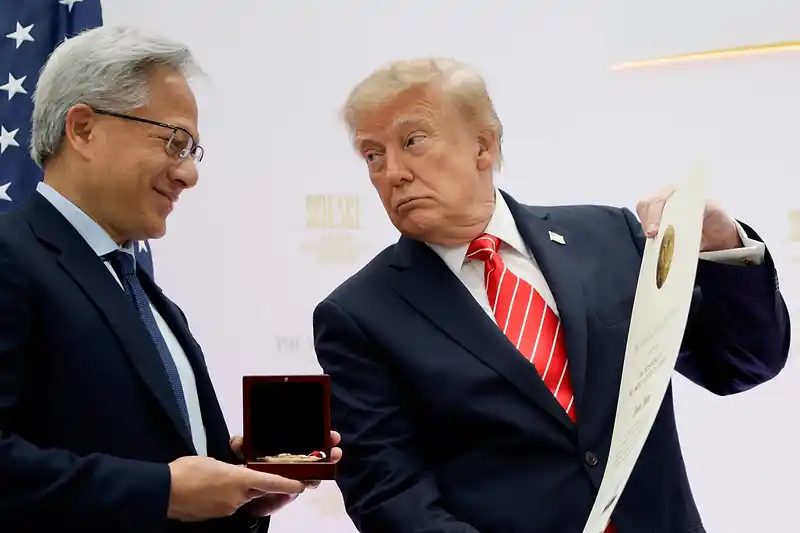
Nvidia’s board unanimously restored Huang as president, CEO and director, reversing its position less than a week earlier. The decision followed government input, with President Donald Trump and Vice President JD Vance pressing for his reinstatement, Reuters reported.
Huang had stepped down on November 12 after acknowledging an extramarital relationship, amid reports linking a Chinese businesswoman to suspected efforts to divert restricted chips to China. Investigations are continuing.
Asian markets rebound, but Taiwan remains below its recent peak
MSCI’s Asia-Pacific index excluding Japan rose 4.6%, its biggest daily gain since July 31, recovering from an eight-month low and snapping an eight-session losing streak that had brought the gauge close to bear-market territory.
Japan’s broader TOPIX gained 2.54%, while Australia’s S&P/ASX 200 advanced 1.82%, New Zealand’s NZX 50 rose 1.75% and Singapore’s Straits Times Index added 0.79%. Hong Kong’s Hang Seng slipped 0.86%, while China’s CSI 300 edged up 0.07% and the Shanghai Composite gained 0.03%. Indonesia’s Jakarta Composite rose 0.25%.
India’s cash markets remained closed for a public holiday, with Nifty 50 futures falling 1.64%.
Taiwan’s rally followed a 17.5% weekly plunge, its steepest decline since 1991. Despite Tuesday’s rebound, the TAIEX remained around 20% below its 52-week high of 49,968.92. The index had also lost nearly 20% over the preceding month, highlighting the scale of the recent correction.
Huang’s departure had unsettled an AI ecosystem heavily reliant on Nvidia for semiconductor supplies and financing, prompting investors to question whether debt-funded data-centre investments could generate returns sufficient to justify valuations. Anthropic’s weak market debut added to the pressure, with the AI startup falling 8.5% on its second trading day.
Chipmakers surge as investors return to AI trade
Semiconductor manufacturers and companies supplying components, testing equipment, switches, cables and power infrastructure led Tuesday’s recovery. Taiwan Semiconductor Manufacturing Co. rose 9.85%, Foxconn gained 8.05% and Largan Precision advanced 9.94%. MediaTek climbed 9.91% and Delta Electronics added 9.60%.
South Korea’s SK Hynix surged 8.94% and Samsung Electronics gained 8.45%. Japan’s Kioxia advanced 8.22%, while Murata jumped 14.89%, TDK rose 8.81% and LG Innotek gained 13.06%.
The rebound also extended beyond chipmakers, although investors remain exposed to risks surrounding AI supply-demand imbalances, data-centre construction delays, financing costs and regulation.
Elsewhere, Brent crude traded near $89.50 a barrel after falling 3.5% on Monday as rising supplies offset concerns over Middle Eastern shipping and refinery attacks.
Markets were pricing in a December Federal Reserve rate increase as virtually certain, compared with 89% odds on Friday, while the implied probability of a larger 50-basis-point move stood at around 5%.