Why One Russian-Language Strategy Failed in Two of Three CIS Forex Markets


On price, the CIS is one of the better growth stories left in the industry. The audience behind that price is pretty large: about 84 million people, median age 26 to 27, and already familiar with how forex and CFDs work. That familiarity is why a...
On price, the CIS is one of the better growth stories left in the industry. The audience behind that price is pretty large: about 84 million people, median age 26 to 27, and already familiar with how forex and CFDs work. That familiarity is why a lead here becomes a first deposit about 4% of the time, against under 2% in a cold beginner market.
To come up with the numbers, I analyzed our campaign results across six countries: Azerbaijan, Kazakhstan, Kyrgyzstan, Tajikistan, Uzbekistan and Turkmenistan. They vary in income, regulation, language and access to payments.
London's trading industry is coming home!
Three Different Market Opportunities

Kazakhstan has relatively strong purchasing power and a credible local licensing framework. Turkmenistan, by contrast, has strict currency controls that make reliable withdrawals difficult. A strategy that treats both countries as the same market never really works.
Kazakhstan and Azerbaijan are higher-value markets, where larger deposits can support stronger returns. Uzbekistan is a scale opportunity: customer acquisition costs are similar to Kazakhstan’s, but average deposits are lower, so profitability depends on reaching a much larger audience. Kyrgyzstan is a smaller, lower-cost market that may be suitable for controlled testing.
Tajikistan and Turkmenistan do not currently present a clear commercial opportunity. Tajikistan has limited disposable income, while Turkmenistan’s currency controls make reliable withdrawals difficult.
I usually recommend deciding where to allocate the initial acquisition budget based on cost per funded trader. Then assess lifetime value later, once you have enough data on repeat deposits over six to twelve months.
Market | CPL | CPA / FTD | Avg first deposit | LTV (12 month) | LTV | Payback |
Kazakhstan | $12–20 | $300–500 | $200–400 | $1,500–2,500 | ~5.0x | 6–9 months |
Azerbaijan | $12–25 | $350–550 | $250–450 | $2,000–3,000 | ~5.6x | 6–9 months |
Uzbekistan | $12–20 | $300–450 | $100–200 | $800–1,500 | ~3.1x | 9–12 months |
Kyrgyzstan | $9–12 | $150–300 | $80–180 | $700–1,300 | ~4.4x | 9–12 months |
Tajikistan / Turkmenistan | — | — | — | — | — | Out of scope |
Language Determines Market Reach
Russian is the main trading language across the region, so it should be localised first. In some countries, it is enough to launch. In others, you also need the local language, especially outside the capital and among younger users. English is not a good launch language because proficiency is generally too low.
Country | Russian reach | Verdict |
Kazakhstan | ~95%, still the business language | Launch in Russian; add Kazakh for the young as an edge |
Kyrgyzstan | ~44%, fading among youth | Russian works for now, especially in Bishkek |
Uzbekistan | ~50%, Uzbek-first majority | Localise to Uzbek, Latin script; Russian reaches Tashkent only |
Azerbaijan | Baku elite only (strong under 10%) | Localise to Azerbaijani; Russian works well for the higher-income trading audience in Baku |
Tajikistan | ~55% some, near-zero native | Light Russian presence; thin market |
Turkmenistan | Low and declining | Do not launch |
Uzbekistan is the biggest and youngest market in the region (with over 38 million people), but Russian only reaches about half the population. A Russian-only campaign will work mainly in Tashkent and miss much of the younger audience and other regions.
To scale, you need an Uzbek-language funnel. Azerbaijan is similar, but smaller and wealthier. Azerbaijani gives you broad national reach, while Russian mainly reaches the higher-income audience in Baku.
How to Build Trust in the Region
A standard Western approach does not work well here. Traders across the region have seen years of scams, failed brokers and blocked withdrawals, so trust is a major issue.
Messages that promise guaranteed returns often make things worse because experienced traders see them as a warning sign. What works better is clear proof that withdrawals are fast and reliable, in Russian and supported by a real person.
In this market, “fast withdrawal” is often a stronger message than any promise of profit. But the way you build trust still differs by country.
Country | Primary trust lever |
Kazakhstan | AIFC/AFSA local licence (the bloc's only credible local credential), on tier-1 |
Uzbekistan | Uzbek-language support, local payments (Click/Payme), a known brand |
Azerbaijan | Azerbaijani-language service, local bank rails, global brand recognition |
Kyrgyzstan | The brand self-certifying through visible withdrawals |
Tajikistan | Known brand and Russian support, capped by market thinness |
Turkmenistan | No viable trust path; withdrawals cannot be reliably delivered |
Kazakhstan’s licence is especially valuable because traders can check it themselves. In other markets, trust depends more on local payment methods, a known brand, and the right language.
Payments are also a major part of conversion. The deposit page should support the methods people already use. In Kazakhstan, that means Kaspi. In Uzbekistan, Click, Payme, Uzcard and Humo. In Azerbaijan, local cards and m10 are important. Some experienced traders also use USDT, with the right compliance checks.
Even a strong campaign can fail if people reach the deposit page and cannot pay easily. Swap-free Islamic accounts can also matter. All six markets are Muslim-majority, so including them can make the product more relevant and trustworthy.
Each Market Needs Its Own Regulatory Setup
There is no single regulator for the CIS, so the setup is different in each country. Most retail trading is offered through tier-1 offshore brokers, with local rules added on top.
Kazakhstan has the strongest local framework. The AIFC, run by AFSA under English common law, issues licences and publishes a public register. Because retail access is limited, brokers can use the licence to build trust while serving many retail clients through an offshore entity. xChief took an AFSA licence in 2025 and runs exactly this setup.
The other markets are less developed. Uzbekistan allows trading through international brokers, while crypto is limited to licensed local operators. Azerbaijan has relatively light regulation , and PASHA Capital is an example of the local institutional model.
Kyrgyzstan is an open zone with only general supervision. Tajikistan allows trading but has had currency controls since 2015. Turkmenistan is closed to real retail CFD trading: currency controls and a manat black market leave no reliable way to pay a client out.
Across all six countries, compliance is important. Every IB and affiliate needs proper due diligence, because the region's scam history makes partners a real risk. And sanctions exposure has to be clean from end to end.
Blended CPA Hides the Real Picture
A few years ago, I saw what happens when several markets are treated as one. A broker launched Kazakhstan, Uzbekistan and Kyrgyzstan with the same Russian creative and the same CPA target, assuming Russian would work across all three.
Kazakhstan performed well from the start, at about $350 per funded account. Russian creative worked, Kaspi made deposits easy, and the licence helped build trust. But that result hid weaker performance elsewhere.
Uzbekistan was close to $650 per funded account because Russian mainly reached Tashkent and missed much of the Uzbek-speaking audience. Kyrgyzstan was also unprofitable because deposits were too small.
Together, the three markets showed an average CPA of about $480. That looked acceptable, but Kazakhstan was covering the weaker results in the other two countries.
The solution was simple: we split them into separate campaigns with separate budgets and targets. Uzbekistan moved to Uzbek creative and added Click and Payme at checkout. Its CPA fell from about $650 to around $380. Kyrgyzstan moved to a small test budget, while Kazakhstan was given more room to scale.
The spend, brand, and timing stayed the same. The main change was that we stopped treating three different countries as one market.
Enter One Country at a Time
Start with the markets where the economics, trust, and language work best. Then expand country by country.
Phase | Market | Why now | How to play it |
1 | Kazakhstan | Wealthiest, best rails, only credible local licence | Russian, Kaspi, AIFC licence shown; scale hard |
2 | Uzbekistan | Largest and youngest; the volume engine | Uzbek (Latin), Click/Payme; buy reach, accept the thinner margin |
3 | Azerbaijan | Moneyed Baku niche, deepest deposits | Azerbaijani, local bank rails; keep it focused |
4 | Kyrgyzstan | Cheap, small, permissive | Capped testbed budget |
— | Tajikistan / Turkmenistan | Thin / closed by currency controls | Do not launch |
Two rules matter. First, report each country separately. A regional average can look healthy while hiding weak performance in one of the markets. Second, set a different CPA target for each country. A $400 CPA may work in Azerbaijan, but it can be too high for a market like Kyrgyzstan, where deposits alone are around $120.
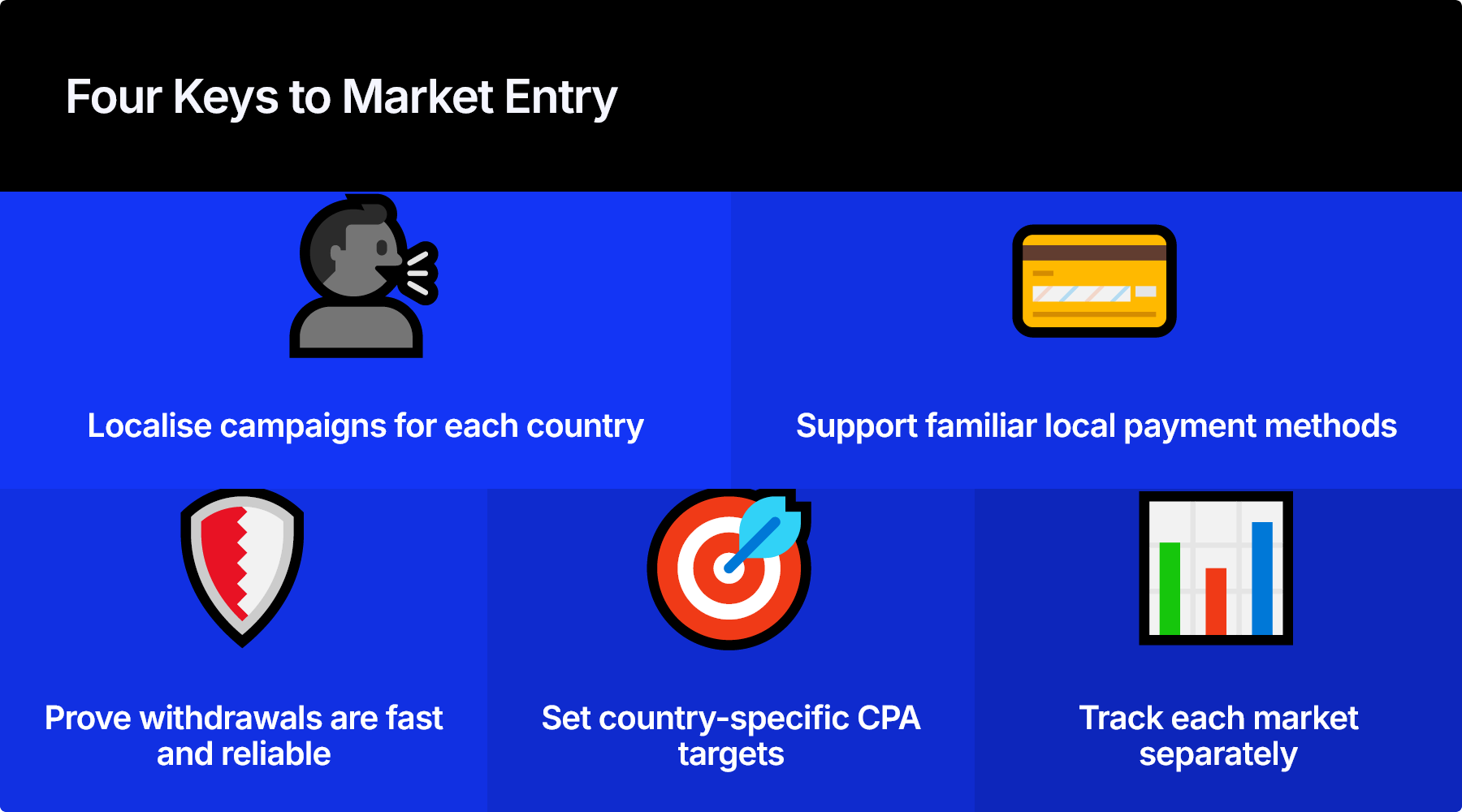
Overall, you need four things to have a successful launch in this market: local language, familiar payment methods, a reason to trust the broker, and a CPA that fits the deposit size.
Related Articles
- Forex News
Born2trade CEO: “Everything is about gold now. Gold traders dictate industry standards and features”
- Forex News
Lithuania Overtakes Cyprus in EU Cross-Border Finance
- Forex News
Thai Forex Trading Bots: What to Check Before Going Live
- Crypto News
Ethereum Price Analysis: Is $2K in Play as Bearish Sentiment Builds?
- Stock Markets News
investingLive Asia-Pacific market news: Brazil ETF slumps on Lula win