Thai Forex Trading Bots: What to Check Before Going Live


A bot automates instructions, not judgement, so the checks below are about the environment the bot runs in, not about whether the bot itself is clever.
Before you connect a trading bot to a live forex account in Thailand, you need to confirm four things: which legal entity actually serves your account, what the account really costs per trade, what happens when the platform or your internet fails, and whether support answers during Thai trading hours. A bot automates instructions, not judgement, so the checks below are about the environment the bot runs in, not about whether the bot itself is clever.
The Thai language site brokersthai publishes entity-specific broker reviews and covers advertised-versus-measured spreads, trading platforms, bots and education for traders evaluating brokers.
Start with the entity, not the brand
The first check is the legal entity that onboards you. A global broker group often operates several entities, and the one serving Thai clients may not be the one featured in the group’s advertising. A regulator badge from the UK’s FCA or Australia’s ASIC on a group website is not proof that the entity holding your money carries that licence, and even if it does, that licence may not extend the same protections to a Thai resident.
For derivatives in Thailand, the Thai Securities and Exchange Commission advises investors to verify licensed derivatives business operators on its official website, and to check its Investor Alert list, which names unlicensed or unregulated persons. You can read the SEC’s own guidance on checking licensed derivatives operators directly on the regulator’s site. Use this as a checking step, not as a verdict. It does not tell you that any specific foreign broker is criminal or illegal, and it does not tell you a particular broker is absent from a list. It tells you how to look, which is what you need before automating anything.
A bot automates instructions, not protection
A trading bot executes the rules specified for it, so the user must verify how it handles trades, the risk limits embedded in it, and its response to errors, since bots can malfunction. Demo results and backtests provide evidence of behavior under the tested conditions, not proof of live profitability. Live spreads, slippage, and outages differ from what testing shows.
Slippage deserves a specific mention because it cuts both ways. When you send an order, the fill can be better or worse than your requested price, depending on volatility and liquidity. An ordinary stop-loss order does not guarantee its price either. In a fast market, a stop can fill well beyond the level you set, which is why the checks below ask what your bot does when prices gap.
Compare costs with a worked example
Costs are where bot setups quietly fail, because when a strategy generates more trades, each trade’s cost repeats more often and the total grows. Consider a purely hypothetical comparison, not a quote from any broker. Suppose a bot makes 20 round turns of one standard lot of EUR/USD over a month, all on the same pair, at the same size, in the same period.
Account A charges a spread of 0.2 pips plus a round-turn commission of USD 7 per lot. One pip on EUR/USD is worth USD 10 per standard lot, because a standard lot is 100,000 euro and a pip is 0.0001 US dollars per euro. So each round turn costs 0.2 times 10, which is USD 2, plus USD 7 in commission, for USD 9 per round turn. Twenty round turns cost USD 180.
Account B charges a spread of 1.0 pip with zero commission. Each round turn costs USD 10, so twenty round turns cost USD 200. That is USD 20 more than Account A over the same 20 trades, before swaps, slippage and any currency conversion. Note that a zero starting spread is not a guaranteed average, because spreads widen and narrow with market conditions.
If the same bot traded 0.10 lots instead, every figure scales by one tenth under the same assumptions. Account A would cost USD 18 and Account B would cost USD 20 over the same 20 round turns. This example is arithmetic, not a recommendation of any trade size, and it is not broker data. Its point is narrow: a tight-spread account with commission can be cheaper than a commission-free account, but only if you measure both sides rather than trusting the headline number.
How you measure matters as much as what you measure. A published principle from Justin Grossbard, co-founder and CEO of CompareForexBrokers, put the discipline plainly in his published profile: “capture the facts, show your work, and never dress up a gap as a certainty.” Applied here, that means recording what you actually paid, showing the spread and commission for each round turn, and labelling anything you could not observe as unknown rather than guessing.
Build a pre-launch evidence sheet
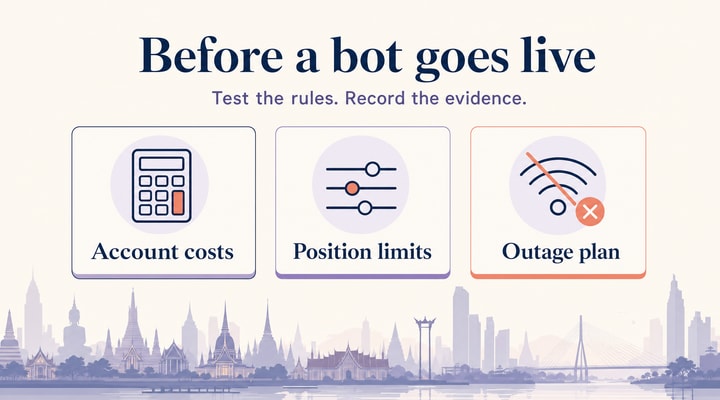
Before launching, verify with the written terms of your chosen account whether your intended automated strategy is permitted. Confirm the bot supports your intended platform and version, and establish where the bot executes, whether terminal, VPS or broker server, as applicable to your setup. Identify what continues and what stops during loss of connection according to that setup, and test reconnect and duplicate-order handling on a demo account. Checking the setup confirms compatibility only, not live profitability.
Before going live, collect one page of evidence you can re-check each month:
- The account entity and licence, from the documents you signed, matched against the regulator’s register.
- The account tier and its cost basis, meaning spread plus any round-turn commission, recorded per round turn.
- Execution records from your own account, showing requested prices versus fill prices.
- The bot’s maximum position rules, including how many simultaneous positions it can hold and its largest permitted size.
- Stop and exit behaviour, tested on a demo account during a volatile session, with the understanding that a demo result does not guarantee live fills.
- An outage plan, covering what happens to open positions if the platform drops or your connection fails, and whether duplicate orders can fire on reconnect.
- Support availability in Thai local time, meaning which channels are staffed during the hours your bot trades, and in which language.
- Compare the funding currency with the trading-account currency and verify any conversion, the applicable rate and explicit fees. The currencies may match or differ.
Support hours deserve emphasis. Forex trades around the clock, and a bot that fails at 2 a.m. Bangkok time needs a support desk that answers at 2 a.m. Bangkok time. Check the hours before the outage, not during it.
Run the checks in order
The practical sequence is simple. Verify the entity and licence first, because no cost advantage compensates for a structural problem. Then compare the broker’s documented charges with what you observe on a demo account, keeping in mind that demo spreads, fees and fills can differ from live conditions, so a demo run checks your logic and the interface rather than proving your live costs. Then test stop behaviour and the outage plan on the same demo account. Only after that due diligence, if you proceed, record live execution from the start, at a risk size chosen from a documented loss limit you set before funding.
Two BabyPips guides extend this thinking, and each belongs at this stage of the process. The article on Forex AI trading, reality or hype is useful for separating marketing claims about intelligent bots from behaviour anyone can verify, which is exactly the mindset a bot buyer needs when a vendor promises more than the evidence shows.
The second guide worth reading is the piece on advertised spreads versus tested spreads, which explains how measured averages can differ from advertised numbers. The method travels well, even though its pricing data describes Australian accounts and does not apply to Thai ones.
None of these steps proves a bot will be profitable, and no checklist eliminates losses that come from slippage, outages or the strategy itself. What the steps do is reduce some of the avoidable operational unknowns, so that surprises shrink to the risks you accepted knowingly rather than the ones nobody checked.
Forex and CFDs involve substantial risk, and leverage magnifies losses. This article is general education, not personalised investment advice, and it does not recommend any trade size, broker or bot.
Related Articles
- Forex News
Why One Russian-Language Strategy Failed in Two of Three CIS Forex Markets
- Forex News
How Far Should Crypto Firms Trace a Transaction? FCA Says Risk Should Decide
- Forex News
Weekly Review: IG Seeks UK Gambling Licence; Plus500 to Acquire Brazilian Broker
- Crypto News
Best no KYC crypto card for USA: What buyers should check
- Crypto News
Coinbase Will Temporarily Stop Certain Services This Weekend: Details Inside