Why Did the Pound Rise Despite Weaker U.K. Wage Growth?

U.K. wage growth came in softer than expected, yet Sterling still finished Tuesday higher. What’s up with that?!
The Office for National Statistics (ONS) released its October labor market report showing weaker-than-expected regular wage growth and the sharpest quarterly drop in job vacancies in over a year.
Despite the disappointing numbers, the pound managed to gain ground throughout the session.
So what kept Sterling afloat?
What Did the Data Actually Show?
Regular wage growth, excluding bonuses, slowed to 3.5% in the three months through September, missing the 3.6% forecast and easing from 3.7% previously. Not a huge miss, but hardly the hot reading markets were expecting.
Most of the slowdown came from the public sector, where wage growth eased to 5.4% as last year’s pay awards dropped out of the annual comparison. Private sector wage growth held steady at 3.1%.
Meanwhile, U.K. payrolls shrank by 34,000 in October, bringing the annual decline to 95,000 and leaving 30.2 million employees on payrolls. Job vacancies fell to 690,000, marking their sharpest quarterly drop in over a year. Yet unemployment also dipped to 4.6%.
So it’s a mixed bag. Employers are hiring less, but unemployment is falling. That’s hardly a straightforward picture for the BOE.
Why Does Wage Growth Matter to the BOE?
Not all inflation starts at home. The U.S. and Iran conflict earlier this year sent oil prices soaring, pushing up energy costs across the U.K. The BOE can’t do much about that.
What it can influence is domestically generated inflation, or price pressures driven by wages and business costs. When workers demand higher pay to keep up with rising prices, businesses may pass those costs on to customers. That’s the wage-price spiral, and it can keep inflation elevated even after oil prices settle down.
At 3.5%, U.K. wage growth is still too strong for comfort given the BOE’s 2% inflation target. But the slowdown from 3.7% offers an early hint that the oil shock’s knock-on effects may be easing.
So Why Did the Pound Rise?
GBP pairs briefly dipped after the 2:00 a.m. ET jobs release, but the weakness didn’t last. Sterling recovered through the London morning and gained against most major peers into the U.S. session.
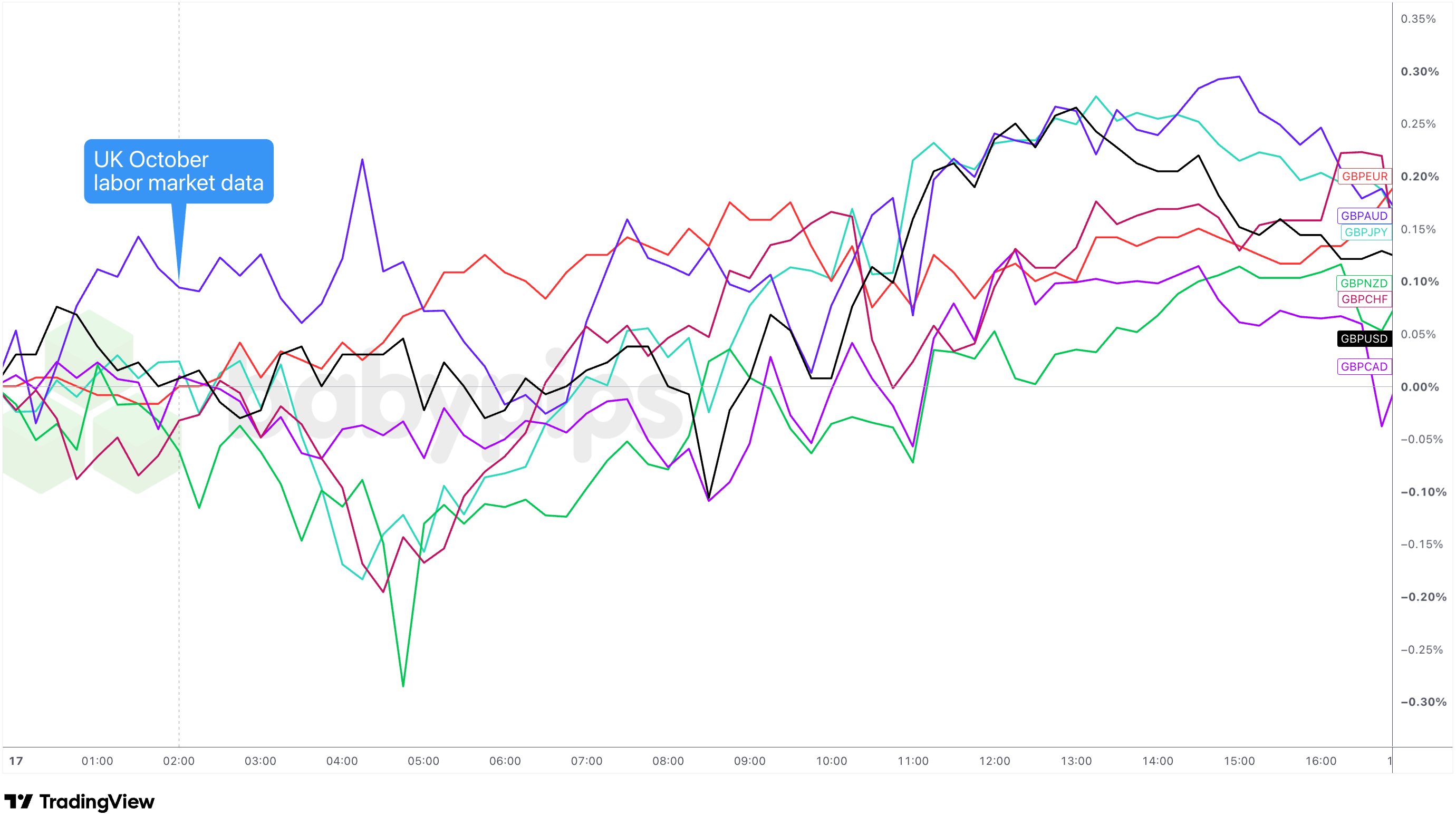
The bigger driver was likely risk sentiment. Global stocks sold off ahead of Nvidia’s earnings, putting pressure on risk-sensitive currencies like AUD and NZD. With those currencies falling faster, Sterling managed to come out ahead despite its own disappointing wage data.
Market positioning also played a role. Traders had already priced in roughly a 90% chance of a December BOE rate hike, so the modest wage miss wasn’t enough to shake those expectations. With little reason to rethink the rate outlook, GBP’s initial dip quickly faded.
It’s a good reminder that currencies don’t move in isolation. Sometimes a currency gains ground simply because its peers are having a worse day.
What Does This Mean for December?
One softer wage reading isn’t likely to change the BOE’s plans. The central bank raised rates to 4.0% on November 5, its first hike in over three years, and markets widely expect another hike in December. Wage growth at 3.5% is still too high for comfort given the BOE’s 2% inflation target.The BOE wants to see whether the oil price shock is feeding into longer-lasting wage and services inflation. The slight slowdown in pay growth is encouraging, but one modest miss isn’t enough to declare victory.
For now, December still looks on track. The bigger question is what happens in 2027. Will the BOE need to keep raising rates, or is the tightening cycle finally nearing its end?
The Bottom Line
The October jobs report gave the BOE little reason to change course. Wage growth eased to 3.5%, missing forecasts, while job vacancies posted their sharpest quarterly drop in over a year. Unemployment also fell, leaving a mixed picture.
Sterling’s Tuesday gains had more to do with global risk aversion than U.K. economic strength, as the Aussie and Kiwi took bigger hits. With markets already pricing in a December BOE hike, the modest wage miss did little to shake expectations.
December still looks on track, but the softer wage reading could give the BOE more reason to rethink how much further rates need to rise in 2027.
What to Watch
- UK CPI for October publishes Wednesday, November 18 at 7:00 AM GMT, with consensus around 3.6%.
- BOE Governor Andrew Bailey speaks today as well. The next BOE rate decision is December 19, 2026.