What the Dollar Index Actually Is, and Why Euro Markets Are Running It This Week

The Fed is in its blackout period ahead of the October 28 decision, so there are no speeches or fresh guidance.
That matters because U.S. rate expectations usually steer the Dollar Index, even though the euro makes up 57.6% of its basket.
This week, Fed signals went quiet just as Euro Area markets sprang to life, putting the U.S. Dollar Index in focus.
What Is the Dollar Index Actually Measuring?
The U.S. Dollar Index (DXY) doesn’t track the dollar against every single currency in the world. It measures the dollar against a basket of six: the euro (EUR), Japanese yen (JPY), British pound (GBP), Canadian dollar (CAD), Swedish krona (SEK), and Swiss franc (CHF).
Intercontinental Exchange, or ICE, maintains the index. It changed the basket only once, in January 1999, when the euro replaced five currencies: the Deutsche Mark, French franc, Italian lira, Dutch guilder, and Belgian franc. The weights haven’t changed since, and the basket still reflects U.S. trade relationships from 1973.
The euro carries the largest weight at 57.6%, followed by the yen at 13.6%, the pound at 11.9%, the Canadian dollar at 9.1%, the Swedish krona at 4.2%, and the Swiss franc at 3.6%. Together, the euro and the three other European currencies in the basket account for 77.3% of the index.
That leaves out some major U.S. trading partners. China, Mexico, and South Korea don’t appear in the basket, so a drop in the dollar against the yuan, peso, or won won’t show up in the DXY.
The index is a useful benchmark, but it captures only a narrow slice of the dollar’s value around the world.
Why Does the Basket Composition Matter Right Now?
When the Fed is active, its rate outlook usually drives the DXY, even though the euro makes up 57.6% of the basket. A hot U.S. jobs report, for example, can move EUR/USD and the broader basket. The euro’s heavy weighting gives euro-specific news an outsized impact when it hits, but those catalysts don’t show up every week. Most of the time, the Fed sets the pace.This week was different. Fed officials are in their blackout period ahead of the October 28 decision, leaving the usual U.S. driver quiet just as Euro Area markets turned active.
Still, the euro barely moved. The 15-minute chart shows the USD/EUR line hovering near zero all week, limiting one of the DXY’s biggest sources of movement. Meanwhile, the dollar moved more sharply against currencies outside the basket.
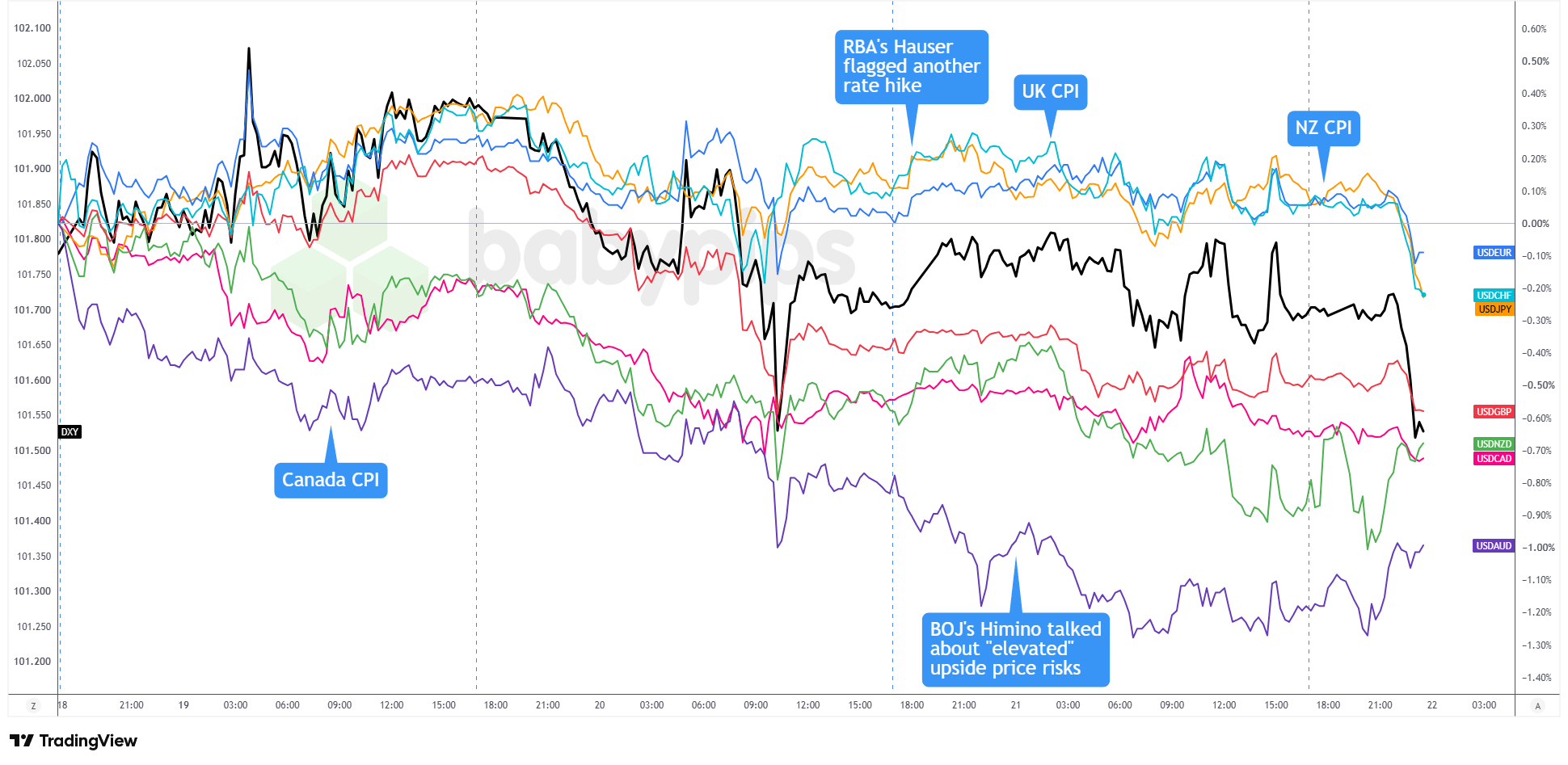
The Australian dollar rose after the RBA’s Deputy Governor flagged a possible fifth rate hike, and the New Zealand dollar also gained. On the chart, the purple USD/AUD and green USD/NZD lines fell throughout the week. Since neither currency is in the DXY basket, those moves didn’t register in the index.
The currencies that are in the basket had their own stories. The pound rose after U.K. September inflation beat forecasts, the Canadian dollar moved with oil’s wide intraday swings, and the yen initially firmed on BOJ remarks about the risks of delaying rate hikes before giving back ground by the close.
Meanwhile, France’s 10-year government bond yield topped 5% for the first time since 2002. That fiscal stress likely weighed on the euro, helping keep the DXY higher than it might otherwise have been.
Five of the seven major pairs ended with the dollar lower, but the DXY barely reflected the broader move.
What Does This Mean for How You Read Dollar Strength?
The DXY starts with the euro, and it ends there, too. EUR/USD accounts for 57.6% of the index, so whenever you see “the dollar index is up 0.3%,” start by asking what the euro did.
A flat DXY can hide significant dollar moves. Wednesday made that clear. The Australian and New Zealand dollars gained against the U.S. dollar, as did the pound and Canadian dollar, but the DXY barely reflected those moves because the euro hardly budged. The 15-minute chart tells the story better than the index itself: four of the seven lines fell, while the other three stayed near zero.
With the Fed quiet until October 28, euro area events are filling a gap they don’t usually occupy. The euro’s 57.6% weight is always there, but it matters most when U.S. signals go quiet and significant euro-specific news arrives. This week, both happened at once. That timing is unusual, and it’s the key to understanding the DXY’s muted move.