What Are Perpetual Futures, and Where Can You Trade Them?

What Are Perpetual Futures?
A futures contract is an agreement to buy or sell an asset at a set price on a later date. A regular, or dated, future has an expiration date, and as it nears, its price converges (moves toward) the spot price, what the asset costs right now. To stay in, you “roll” into the next contract.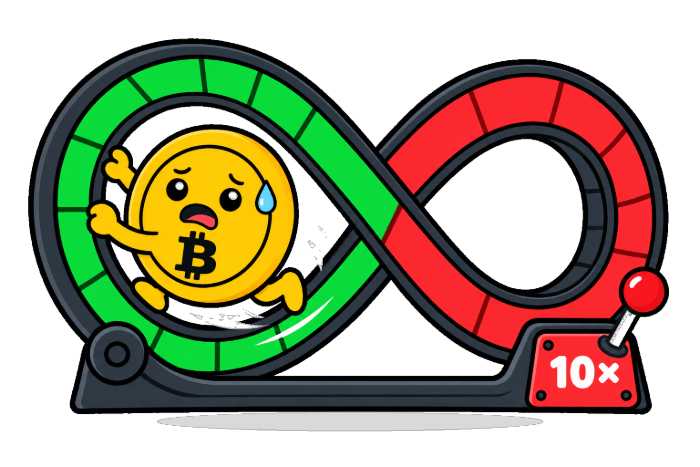
A perpetual future drops the expiration date. You can hold it as long as your account has enough money behind it. Perps are cash-settled, so you get the profit or loss, never the bitcoin or shares. With no expiry to force convergence, a perp needs what the CFTC (the US futures regulator) calls a “substitute mechanism” in its May 2026 policy statement: the funding rate.
Compared with buying spot, a perp makes it as easy to go short (profit if the price falls) as to go long, and it adds leverage. You don’t own anything, though. Holders of Kalshi’s US 500 index perp get no dividends or voting rights, Finance Magnates reports.
How Does the Perpetual Futures Funding Rate Work?
The funding rate is a periodic payment between traders on opposite sides of a perp. When the perp trades above the asset it tracks, longs pay shorts. When it trades below, shorts pay longs. The payments reward the less crowded side, which tends to pull the perp back in line.
Schedules vary. Kraken says it settles funding every 8 hours for US clients and every hour for clients in the EEA and other regions, while Kalshi sets its US 500 funding once a day at 4 p.m. New York time (20:00 or 21:00 GMT, depending on US daylight time). Stay on the paying side for weeks, and those charges add up.
How Do Leverage, Margin and Liquidation Work in Perps?
Leverage lets you control a position bigger than the cash you put up, your margin. With $1,000 of margin at 10x leverage, you control $10,000, and a 10% move against you would wipe out the whole $1,000.
Venues don’t wait that long. Each one sets a maintenance margin, the minimum equity you need to keep a position open. Drop below it and the venue closes the position for you. That forced close is a liquidation, and Webull’s October 20 announcement spells it out: positions face “automatic liquidation if margin falls below maintenance requirements.”
Perp venues also use three prices. The index price comes from outside spot markets, the last price is the venue’s most recent trade, and the mark price is a smoothed fair value that many venues use for liquidation checks. OKX says it uses mark price to cut down on “unnecessary liquidations caused by temporary price spikes in the last traded price.” Formulas differ by venue, so the price on your chart may not be the one that triggers a liquidation.
What Changed for Perpetual Futures in 2026?
In its October 5 filing with the CFTC, Kalshi said perp activity “has historically occurred almost entirely on offshore, unregulated venues.” As of October 2026, US regulators and exchanges are pulling some of that activity onshore:
- The CFTC set the ground rules on May 29, 2026. It approved Kalshi’s bitcoin perp as a futures contract and said perps on other asset classes should go through case-by-case review.
- Perps reached a US stock index in October. Kalshi opened its US 500 perp on October 6, after the CFTC deemed it approved on October 2, per FOW. On October 5, CFTC staff gave exchanges no-action relief to convert long-dated “perpetual-style” index futures into true perps.
- Single-stock perps are lined up. Coinbase, Kalshi, Bitnomial, NADEX and ICE Futures filed SEC notices in September. On October 14, SEC trading and markets director Jamie Selway said, “I expect at least four to begin to trade perpetual futures on securities sometime this quarter.” Law firm Eversheds Sutherland says open questions over whether they’re futures or swaps could affect timing.
- Brokers are signing up. Webull plans to offer bitcoin and other crypto perps to eligible US futures customers starting in November, listed on Kalshi.
Offshore, Eversheds Sutherland says platforms such as Hyperliquid, a blockchain-based exchange, offer perps on crude oil, metals, stock indexes and single stocks. In June, Coinbase’s international exchange listed pre-IPO perps on OpenAI and Anthropic for non-US users.
Where Can You Trade Perpetual Futures?
Access depends on where you live and what the perp tracks. As of October 2026:
- United States: CFTC-registered exchanges list perps on bitcoin and a US stock index, with more in review. Hyperliquid’s perp market stays closed to US customers, CoinDesk reports, and Coinbase’s pre-IPO perps exclude US persons.
- United Kingdom: FCA rules bar firms from selling, distributing or marketing cryptoasset derivatives to retail clients. When the FCA reopened retail access to crypto ETNs, it said its “ban on retail access to cryptoasset derivatives will remain in place.”
- European Union:ESMA warned on February 24, 2026, that products marketed as perps are “likely to fall within the scope” of national rules on CFDs (contracts for difference). Covered products carry leverage limits and negative balance protection, among other safeguards.
- Singapore: SGX limits its bitcoin and ether perps for Singapore-based customers to accredited, expert or institutional investors.
Who Are Perpetual Futures For?
Perps tend to draw active traders who want leveraged exposure without tracking expiry dates, plus hedgers, who take an offsetting position to protect something they own. A bitcoin holder, for example, might short a bitcoin perp to offset a drop without selling the coins.
Regulators treat perps as complex products. ESMA says these derivatives call for a “narrow target market,” and Webull’s own release says perps “are not suitable for all investors.” A new trader has to track leverage, funding, margin rules and three prices at once.
What Are the Risks of Trading Perpetual Futures?
- Liquidation cascades: In a fast drop, one wave of forced selling can trigger the next. On October 10, 2025, more than $19 billion in leveraged crypto positions got wiped out within 24 hours, and perp open interest fell 43%, per CoinDesk Research.
- Funding costs: The paying side loses money every interval, and rates can climb when one side gets crowded.
- Venue and counterparty risk: Kalshi’s contracts clear through Kalshi Klear, a CFTC-regulated clearinghouse. Offshore and on-chain venues run under different rules, and protections like negative balance protection vary by venue and country.
- Gap risk: Kalshi’s US 500 perp trades from Sunday evening to Friday afternoon ET, but its index updates only during regular US stock hours, so prices can jump when the cash market reopens.
The Bottom Line
- Perps are cash-settled futures with no expiry, held near the underlying price by periodic funding payments.
- Leverage magnifies gains and losses, and venues liquidate positions once equity falls below maintenance margin, often based on mark price.
- As of October 2026, US access is widening through CFTC-registered exchanges, while the UK bans crypto derivatives for retail clients and the EU applies CFD-style limits.
Watch For
These signposts could change who can trade perps, and on what:
- Webull’s US rollout of crypto perps, set to start in November 2026.
- The first US single-stock perps, which Selway expects on at least four exchanges in Q4 2026.
- Any change to the FCA’s retail ban on crypto derivatives or to ESMA’s CFD treatment of perps.
- Regulated US routes to offshore technology, such as Kraken parent Payward’s plan to offer US investors derivatives built on Hyperliquid’s technology, per CoinDesk.
Go DeeperEvery perp venue in this explainer runs on maintenance margin and automatic liquidation. The Margin Call Isn’t What You Think It Is shows how a margin call differs from the stop-out that closes your positions, and why a fast market can skip the warning.
DisclaimerThis article is for educational purposes only. It does not constitute financial advice. Trading involves substantial risk, and past performance is not indicative of future results. Always do your own research. Your trading decisions are your own.
AI Disclosure: This explainer was drafted with the help of AI tools and reviewed, fact-checked, and edited by the BabyPips team before publishing.