The Rug Is Getting Pulled Out from under Demand for Home Purchases in October

Mortgage Applications to purchase a home collapsed, a forward-looking indicator of the direction of home sales in October.
Mortgage applications to purchase a home plunged further in the week ending October 16, the seventh week in a row of declines, revisiting the rock-bottom lowest points in 2023 and 2024, which had been the lowest since the early 1990s, according to data by the Mortgage Bankers Association today.
Compared to the same week a year ago, purchase mortgage applications have plunged by 18%; compared to the same week in 2019, by 47%.
These purchase mortgage applications are a forward-looking indicator of the direction of “pending” sales and then “closed” sales in October and November to be reported in November and later. Purchase mortgage applications show demand from buyers – or the lack thereof – who want to obtain a mortgage to fund their purchase.
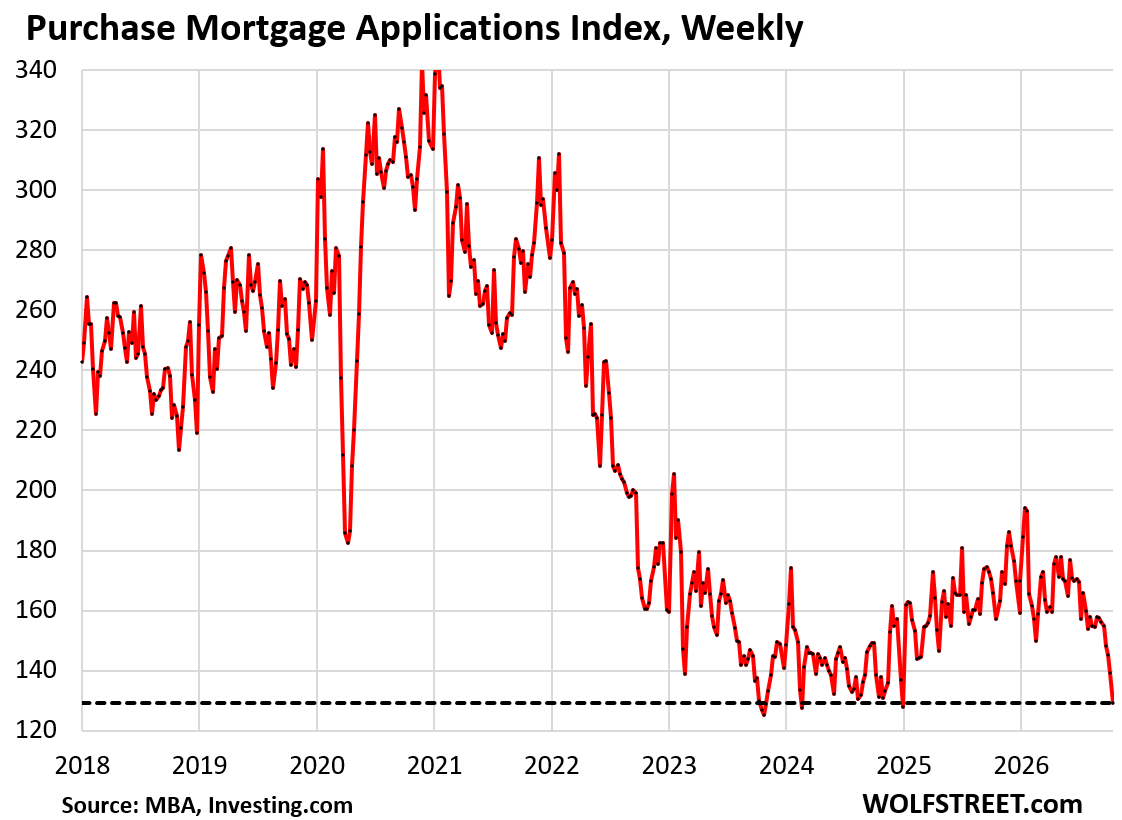
Including cash deals…. This plunge in mortgage applications indicates that pending sales for October will be even worse than in September. Pending sales for September – sales that hadn’t closed yet by the end of September – collapsed to the lowest volume in the data going back to 2011, according to data from the National Association of Realtors yesterday. These pending sales for September included cash deals.
If homeowners want to sell their homes, there is a market and there is demand, but the price has to be where the buyers are. That’s what this says.
Renting has become the far cheaper option on a monthly basis in many markets, given where home prices, mortgage rates, homeowners’ insurance premiums, property taxes, and HOA fees are. High home prices entail high carrying costs all around.
And home-price increases can no longer be taken for granted to bail out buyers with too-high carrying costs. Home prices have already been falling in many markets (we discuss some of them here).
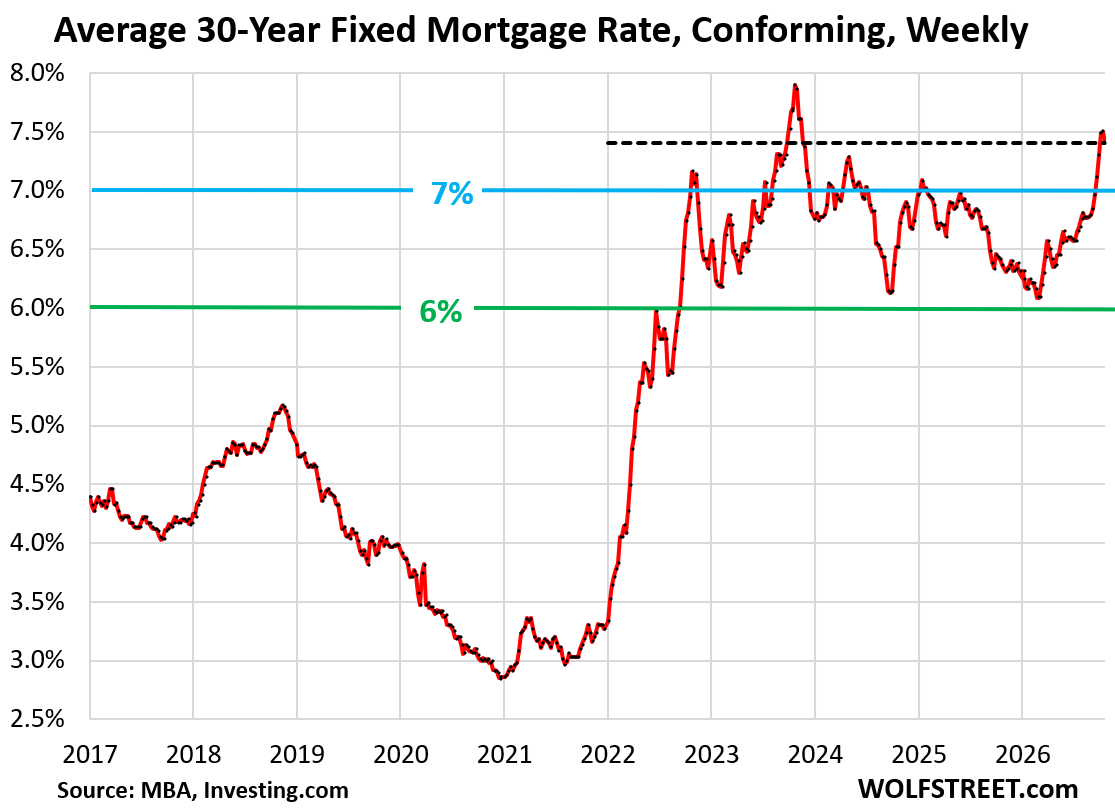
The average weekly mortgage rate for conforming 30-year fixed mortgages dipped to 7.41% in the reporting week, according to the Mortgage Bankers Association today.
These 30-year mortgage rates track the yields of mortgage-backed securities (MBS), but are higher, and MBS track long-term Treasury yields, but are higher, and that spread between them varies over time.
This average 30-year fixed mortgage rate has been in the 6-8% range for over four years, since early September 2022. During the normal times, before the Fed’s QE and interest rate repression started in 2008, those 7.5% mortgages were considered normal and for many years low.
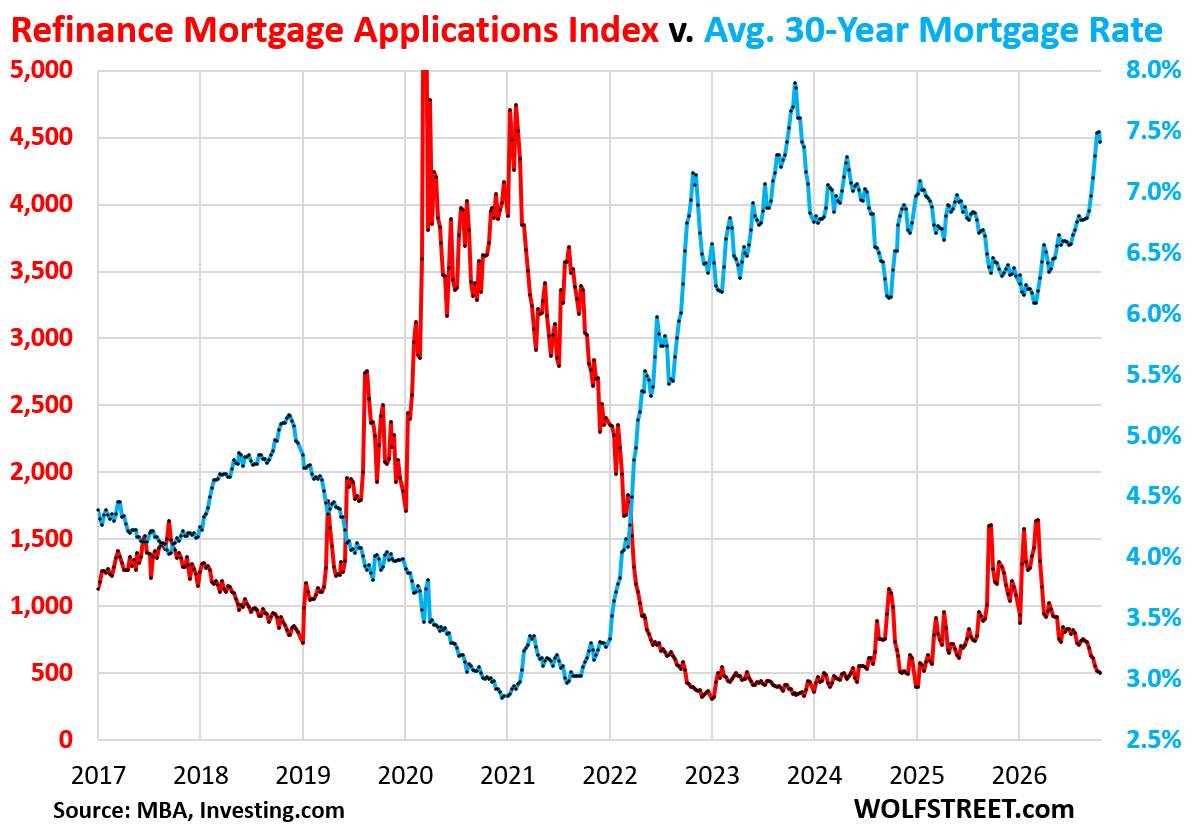
Mortgage applications to refinance a home dropped further during the week and are down by 57% year-over-year and by 76% from the same week in 2019, according to the MBA today.
Refinance applications react inversely to changes in mortgage rates: Higher mortgage rates cause refinance applications to dry up; lower mortgage rates trigger mini-booms of refinancing. At current mortgage rates, refinancing activity has collapsed.
Real estate agents and the mortgage industry exhorted potential buyers, after mortgage rates had surged in 2022: “Marry the house, date the rate.” Meaning that they should pay whatever for the house, and mortgage rates would soon plunge again, and then they can refinance into a 4% mortgage or whatever, and it would all work out. Those buyers married an expensive house and also married an expensive mortgage.
This chart shows that inverse relationship between mortgage rates (blue) and applications to refinance a mortgage (red):
One of the reasons the housing market has been frozen for four years is that home prices had exploded by 50% or more in many markets from mid-2020 to mid-2022 due to the Fed’s interest-rate repression resulting in below-3% mortgages when inflation was 9%. That home price explosion came on top of the already high home prices at the time, to where now home prices don’t make economic sense. But they push up the carrying costs of a home: Mortgage payments, homeowners’ insurance premiums (via surging replacement costs), property taxes, and HOA fees, thereby triggering a historic affordability crisis.