The Fed’s Favorite Inflation Gauge Just Locked In a December Hike

October’s PCE report came in hotter than the Fed needs. Here’s what it means for interest rates and your currency pairs.
The October PCE report showed core prices up 3.3% from a year earlier, the highest reading in about three years. That strengthened bets on a December Fed rate hike.
So why should traders care about PCE, and what could it mean for the dollar, the yen, and gold?
What Actually Happened?
Wednesday morning, the Bureau of Economic Analysis released October’s Personal Consumption Expenditures report.
Headline inflation came in at 3.8% from a year earlier, while core PCE, which strips out food and energy, hit 3.3%, its highest reading in about three years.
Markets didn’t wait around. The dollar strengthened, gold took a hard hit, and the odds of a Federal Reserve rate hike at the December 8 and 9 meeting jumped to 94%.
Why Does the Fed Use PCE Instead of CPI Anyway?
PCE stands for Personal Consumption Expenditures. It’s an inflation gauge the Federal Reserve uses to judge whether price growth is under control.
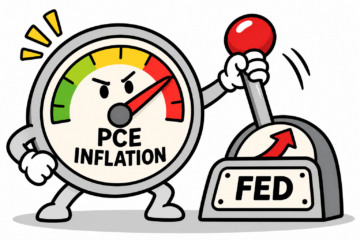 You’ve probably seen CPI, or the Consumer Price Index, in the headlines, but the Fed pays closer attention to PCE. The difference matters, especially if you’re new to trading.
CPI tracks a fixed basket of goods and services. PCE can adjust as consumers change what they buy. If beef prices jump and people switch to chicken, for example, PCE reflects that shift.
PCE also covers a broader range of spending, including some health care costs paid by employers on consumers’ behalf.
Because the two measures cover spending differently, PCE usually runs 0.3 to 0.5 percentage points below CPI. That makes a core PCE reading of 3.3% hard for the Fed to shrug off.
Here’s what October’s BEA report showed and why each figure matters:
- Headline PCE rose 3.8% from a year earlier. This is the overall inflation rate, including food and energy. At 3.8%, it’s nearly twice the Fed’s 2% target.
- Core PCE rose 3.3% from a year earlier. This measure leaves out food and energy prices, which can swing sharply from month to month. The Fed watches it closely because it offers a clearer view of underlying inflation. At 3.3%, core inflation is still well above the Fed’s target.
- Monthly core PCE rose 0.3% for the third month in a row. One month at 0.3% could be noise. Three in a row starts to look like a pattern. If that pace continued for a full year, it would add up to an annualized rate of roughly 3.6%, well above the Fed’s target.
- Real PCE, or spending adjusted for inflation, was flat at 0.0%. Spending rose in dollar terms, but after accounting for higher prices, consumers bought about the same amount. In other words, people spent more money without getting much more for it.
- Personal income rose 0.7%. Continued income growth could help keep consumer spending strong, which may make it harder for inflation to cool on its own. When people have more money coming in, they’re often able to keep spending, and steady demand can keep prices elevated.
The monthly headline rate slowed from 0.5% in September to 0.3% in October, which sounds like progress. But core PCE has risen 0.3% for three straight months.
This steady pace doesn’t point toward the Fed’s 2% target. It suggests progress has stalled. Yipes!
What’s Behind This?
Services did most of the heavy lifting. The BEA reported that spending on services rose by $52.1 billion in October, compared with an $11.8 billion increase in goods spending. Services prices, including rent, health care, insurance, and restaurant meals, tend to be sticky. That is, they don’t cool as quickly when interest rates rise. You can put off buying a new TV, but you can’t easily stop paying rent.
The broader economy isn’t giving the Fed much breathing room, either. GDP grew at a 4.3% annualized rate in the third quarter after revisions, driven by a surge in business investment. When growth is that strong, demand can keep prices under pressure. The Fed knows it. It raised rates in September, held them steady in October, and said it would weigh the incoming data before making its December decision.
Now the October data are in.
Why Should Traders Care?
The prospect of a near-certain rate hike can change where investors put their money. Higher U.S. rates make dollar assets more appealing to investors looking for returns. That can support the dollar against currencies with lower or falling interest rates.
EUR/USD stayed below 1.1000 all week. The European Central Bank faces a different picture from the Fed. Growth is slower in Europe, and inflation is cooling faster. That leaves the interest rate gap tilted in the dollar’s favor, which can keep pressure on the pair.USD/JPY trades near 159.00, close to multi-month highs. Japan’s inflation remains relatively tame, and the Bank of Japan has been cautious. If the Fed raises rates while the BOJ holds steady, the gap between U.S. and Japanese rates widens. That can weigh on the yen against the dollar over time.
Then there’s gold, which fell to about $3,426 intraday on Wednesday, a 15-month low, before recovering to around $3,575 by Thursday. This can puzzle new traders. If inflation is running at 3.8%, why isn’t gold rising?
Gold competes with assets that pay interest. When rate hike expectations climb, bonds and cash can look more attractive than an asset that pays no yield. That helped lift the dollar and Treasury yields while putting pressure on gold. Gold didn’t fall because inflation disappeared. It fell because investors saw a chance to earn more elsewhere, and that can matter in the short run.
Quick Takeaways
- PCE vs. CPI: PCE adjusts for how consumers actually behave and covers a wider share of the economy. At 3.3% core, it signals that price pressures remain broad.
- Monthly vs. annual: October’s monthly rate slowed, but 3 consecutive months at 0.3% is not progress toward 2%.
- Rate hikes and the dollar: Higher U.S. rates attract capital. That tends to support USD, especially against lower-yield currencies like the yen.
- Gold and rate expectations: When hike expectations surge, gold often falls even with inflation running hot. Dollar strength and rising yields tend to dominate in those moments.
- What the Fed watches: Not a single number. The trajectory. Right now, the trajectory isn’t cooperating.
What to Watch
December 8 and 9: The FOMC meets, and markets are nearly pricing in a 25 basis point hike that would take the federal funds target range to 4.00% to 4.25%. Listen closely to the press conference. What the Fed says about its 2027 plans could move markets more than the hike itself.
December 23: The next PCE report covers November. Will core prices rise another 0.3% for the fourth month in a row? If so, the Fed may have a stubborn inflation problem on its hands.
USD/JPY: Any change in the Bank of Japan’s tone could quickly shift the outlook for the pair.