RBA Raises Cash Rate to 4.85% in a 6-3 Split Vote

The Reserve Bank of Australia (RBA) raised its cash rate by 0.25 percentage points to 4.85% on Nov. 3, 2026, matching forecasts. The cash rate is the interest rate banks charge each other for overnight loans. This fifth hike of 2026 takes it to the highest level since 2008. But three of nine board members voted to hold, and RBA forecasts show inflation above 3% until late 2027.
RBA Decision: Key Takeaways
- Decision: The RBA lifted its cash rate target by 25 basis points (0.25 percentage points) to 4.85% from 4.60%, matching the 4.85% forecast.
- Vote: The nine-member board split 6 to 3. Three members voted to hold at 4.60%. September’s hike passed with all nine votes.
- Inflation forecast: RBA staff see headline inflation peaking at 4.5% in the December 2026 quarter and staying above 3% until late 2027.
- Latest inflation data: Consumer prices rose 4.3% in the year to September, up from 4.0% in August. The trimmed mean, a core gauge that strips out extreme price moves, rose to 3.6%.
- Jobs: Unemployment climbed to 4.7% in September from 4.6% in August. RBA staff expect 5.1% by the end of 2028.
- Next decision: The board meets Dec. 7 to 8. It announces its decision at 2:30 p.m. AEDT (Australian Eastern Daylight Time) on Dec. 8, which is 10:30 p.m. ET on Dec. 7.
What Did the RBA Decide at Its November 2026 Meeting?
The RBA’s Monetary Policy Board, the nine-member group that sets rates, raised the cash rate target by 25 basis points to 4.85%. The announcement came at 2:30 p.m. AEDT on Nov. 3 (10:30 p.m. ET on Nov. 2). A basis point equals one-hundredth of a percentage point, so 25 basis points equals 0.25 percentage points. Markets expected the move, and the 4.85% result matched the forecast. The RBA has hiked in February, March, May, September and November, for a total of 1.25 percentage points.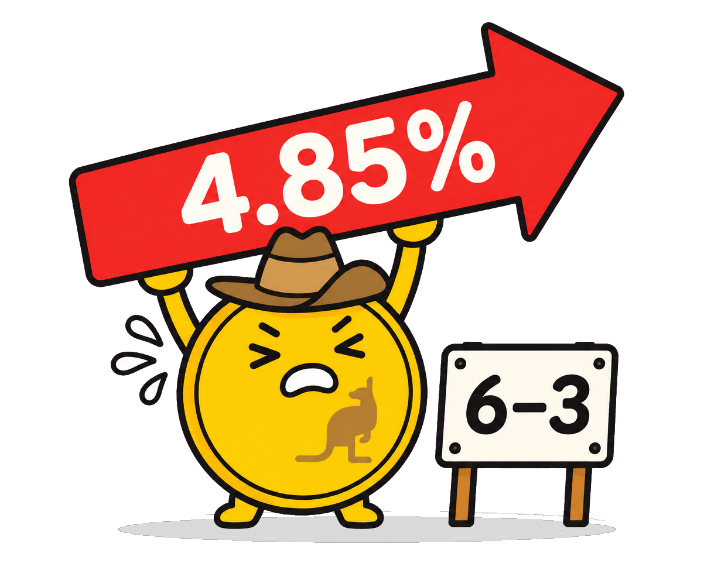
The 6-to-3 vote deserves a closer look. Six members backed the hike, and three voted to hold at 4.60%. The statement no longer carries September’s line about raising the cash rate further if needed. The board says it will track incoming data and the risks to the outlook. Traders study tone shifts like this one for clues about the next move.
Why Did the RBA Raise Rates in November?
Inflation remains high and broad-based, according to the RBA. Data from the Australian Bureau of Statistics (ABS) backs that view. The consumer price index (CPI) tracks what a typical basket of goods and services costs. It rose 4.3% in the year to September, up from 4.0% in August. The trimmed mean, which tosses out the biggest price jumps and drops, rose to 3.6% from a revised 3.5%.
The RBA says higher fuel prices from the Middle East conflict explain part of the story. Prices and costs for many other items are rising at a fast clip. AI-related investment is pushing up prices for technology goods, and many firms plan to pass costs on to customers. The RBA judges that capacity pressures, where demand presses against what the economy can supply, are tighter than it thought in August. Picture a restaurant with every table booked: the owner can raise prices and keep the dining room full.
The economy shows some cracks. The RBA’s statement says growth is slowing, housing prices have posted large falls and unemployment has risen. The board judged that the inflation outlook outweighed those signs.
What Do the RBA’s New Forecasts Say About Inflation, Jobs and Growth?
The RBA updates its staff forecasts four times a year in the Statement on Monetary Policy (SMP). The November edition pushes the inflation path higher. Headline inflation, the change in all consumer prices, should peak at 4.5% in the December 2026 quarter. It should stay above 3% until late 2027, about three quarters longer than the August forecast. The RBA expects headline inflation to reach 2.5%, the midpoint of its 2% to 3% target, around mid-2028.
Growth looks soft. The RBA expects GDP (the total value of what the economy produces) to grow 1.6% in the year to December 2026. It sees 1.3% growth in the year to December 2027. Both figures sit below the economy’s potential pace. Data center investment adds support, but the RBA revised its outlook for household spending and home building lower.
The labor market is loosening. The unemployment rate rose to 4.7% in September from 4.6% in August, and employment fell by about 39,000 jobs. RBA staff forecast unemployment of 5.1% by the end of 2028, about a quarter of a percentage point above their August forecast. They expect wage growth to ease to 2.9% by the same date.
Oil is the swing factor. The RBA assumes oil prices ease from a high starting point but stay above pre-conflict levels. Its scenario with crude near US$100 per barrel leaves underlying inflation near 2.75% at the end of 2028, versus 2.5% in the central forecast. The forecasts assume, based on market pricing, that the cash rate settles near 4.8% in 2028.
Is the RBA Done Raising Rates?
The signals conflict. The September line about raising rates further if needed is gone, and three members voted to hold. Governor Michele Bullock called the hike “what’s needed to get inflation down”, and she said inflation will stay higher for longer. The statement flags upside risks to inflation expectations. The RBA keeps its options open without promising another move.
The RBA’s own work hints that policy is tight. The SMP says the cash rate sits above the top of the range of neutral rate estimates, by a small margin. The neutral rate is the level that neither speeds up nor slows the economy. Before the meeting, market pricing implied around one and a half further cash rate increases by mid-2027, the SMP says. Estimates of the neutral rate carry wide uncertainty, so the comparison offers a rough guide.
The meeting minutes should shed light on the split. The RBA releases them at 11:30 a.m. AEDT on Nov. 17 (7:30 p.m. ET on Nov. 16). Traders must weigh a majority focused on inflation risks against a minority that voted to hold.
AI disclosure: The Babypips editorial team used AI tools to help research, write, and check this article. A Babypips editor reviewed and edited it before publication. AI tools can misread data, make arithmetic errors, and state wrong information in a confident tone. Check figures and quotes against the linked sources before you rely on them. Our Editorial Policy explains how we create and review our content.