New research from LMAX Group and Macro Hive shows that London leads global FX price discovery by milliseconds, while Tokyo provides deeper and cheaper liquidity during major Japan-focused events.
The study uses millisecond-level data from LMAX’s London and Tokyo venues around a Bank of Japan rate hike in July 2024 and a surprise Japan CPI release in February 2025.
For the FX and CFD trading space, this study means brokers, LPs and larger traders should treat London as the main price signal. They should route more flow to Tokyo during Japan-focused events to cut execution costs and access deeper liquidity Liquidity The term liquidity refers to the process, speed, and ease of which a given asset or security can be converted into cash. Notably, liquidity surmises a retention in market price, with the most liquid assets representing cash.The most liquid asset of all is cash itself.· In economics, liquidity is defined by how efficiently and quickly an asset can be converted into usable cash without materially affecting its market price. · Nothing is more liquid than cash, while other assets represent The term liquidity refers to the process, speed, and ease of which a given asset or security can be converted into cash. Notably, liquidity surmises a retention in market price, with the most liquid assets representing cash.The most liquid asset of all is cash itself.· In economics, liquidity is defined by how efficiently and quickly an asset can be converted into usable cash without materially affecting its market price. · Nothing is more liquid than cash, while other assets represent Read this Term.
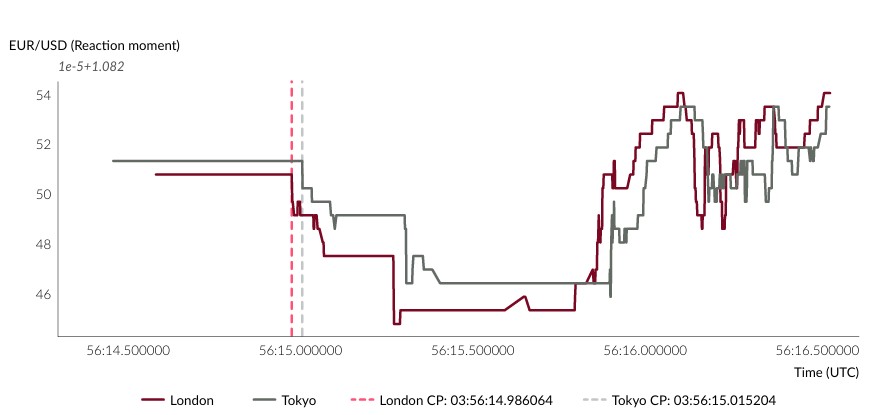
London prices move first even when the news comes from Japan. For both USD/JPY and EUR/USD, prices on the London venue reacted between roughly 20 and 100 milliseconds before Tokyo during the two events.
Tokyo Stays Tighter in Stress
At the same time, Tokyo emerges as the venue where size actually trades. During the BoJ decision, the study identified more than 21,000 outlier trades, defined as unusually large tickets. Around 88% of those trades executed in Tokyo.
In the top 1% of trade sizes, Tokyo handled 100% of activity, while London saw no large block trades. A similar pattern appeared around the Japan CPI release, with Tokyo again executing all of the largest orders.
You may also find interesting: Chinese Fraud Victims Contest UK Compensation Plan for £3.2B Seized Bitcoins: Report
Execution costs diverged sharply when volatility Volatility In finance, volatility refers to the amount of change in the rate of a financial instrument, such as commodities, currencies, or stocks, over a given time period. Essentially, volatility describes the nature of an instrument’s fluctuation; a highly volatile security equates to large fluctuations in price, and a low volatile security equates to timid fluctuations in price. Volatility is an important statistical indicator used by financial traders to assist them in developing trading systems. Trad In finance, volatility refers to the amount of change in the rate of a financial instrument, such as commodities, currencies, or stocks, over a given time period. Essentially, volatility describes the nature of an instrument’s fluctuation; a highly volatile security equates to large fluctuations in price, and a low volatile security equates to timid fluctuations in price. Volatility is an important statistical indicator used by financial traders to assist them in developing trading systems. Trad Read this Term spiked. Around the February 2025 CPI release, average USD/JPY spreads on the London venue widened to about 6.4 pips. In Tokyo, spreads stayed near 1.5 pips over the same window. That translates into a spread that is roughly 77% tighter in Tokyo.
Earlier work from LMAX and Macro Hive looked at how FXmarkets react to big macro events like Fed meetings, US inflation data and jobs reports using very fast tick data.
It showed that most of the price move in major pairs happens in the first few seconds after the news, and that traders who track those millisecond changes can capture almost all of that move.
NDFs React Almost as Fast as Majors
This suggests that Korean won and Indian rupee NDFs now respond to macro shocks with speeds close to major FX pairs on the same venue.
Overall, the findings draw a clear line between where prices move first and where large, real-money orders find depth. London drives ultra-fast price discovery in the FX market, but Tokyo offers more resilient liquidity and lower spreads when local Japanese events trigger volatility.
A separate report supports LMAX findings.It stressed that latency between traders and brokers is no longer a niche technical issue but a direct driver of execution quality, slippage and missed fills, especially in fast FX markets where prices change thousands of times per second.
It explained that even differences of a few tens of milliseconds can turn planned entries and exits into worse prices, with case-study data showing that cutting connection times from around 75 milliseconds to under 1 millisecond reduced average slippage by about 1.7 pips over 120 trades, saving an active trader roughly $20,000 per year at standard volumes.