
Brokers eyeing Thailand and Vietnam may talk about expansion as a map exercise, but operators at FM Singapore Summit 2026 argued it is really a test of local trust, hiring discipline and risk controls in markets that remain attractive, crowded and highly relationship-driven.
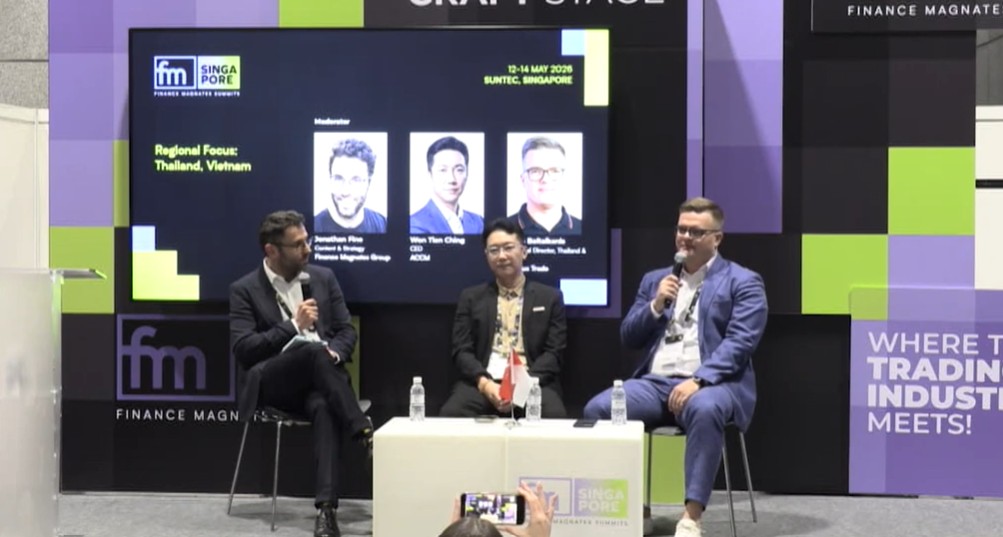
At FM Singapore Summit 2026, a panel on Thailand and Vietnam offered a practical message for brokers chasing Southeast Asia growth: entering the two markets is less about opening a local outpost than learning how to operate inside opaque rules, local languages and trust-based networks.
Local Talent and ‘Yes’ Culture
Jonathan Fine, moderating the discussion, framed the issue as a gap between market interest and real operating knowledge, arguing that Thailand and Vietnam are often discussed but poorly understood by firms trying to expand in the region.
You may also like: “What Differentiates Brokers Now Is Connectivity and User Experience”: Inside FM Singapore Summit 2026
That gap showed up quickly in the panellists’ remarks, with Won Tien Ching, CEO of ACCM, saying local talent can make or break an operation because “once you hire a wrong guy, you will create… so many freaking problems for you and the company,” while Janis Baltalksnis, Regional Director for Thailand and Laos at Versus Trade, warned that the Thai market is full of “noise” and unclear commitments.
Small Tickets, IB-Heavy Models
On unit economics, both speakers described smaller ticket sizes than in Europe or China, but still meaningful value if the model is built for scale. Ching said ACCM sees average first-time deposits in Vietnam ranging from $50 to $1,000 and client lifetime value of $2,000 to $5,000, while Baltalksnis said Thai clients often begin with $50 or $100 to test withdrawals, onboarding friction and customer support before committing more capital.
Both executives agreed that Thailand and Vietnam remain IB-led markets, where local teams are not optional. Baltalksnis said it is “close to impossible” to succeed without local staff in Thailand, adding that partners and employees have ample broker choice in a saturated market. Ching, however, argued that local presence alone is not enough, saying a visible foreign executive can also strengthen credibility because IBs want proof they are dealing with a real regional firm rather than “some kind of sketchy local project.”
Abuse Risk and Bonus Headaches
Risk management Risk Management One of the most common terms utilized by brokers, risk management refers to the practice of identifying potential risks in advance. Most commonly, this also involves the analysis of risk and the undertaking of precautionary steps to both mitigate and prevent for such risk.Such efforts are essential for brokers and venues in the finance industry, given the potential for fallout in the face of unforeseen events or crises. Given a more tightly regulated environment across nearly every asset class, One of the most common terms utilized by brokers, risk management refers to the practice of identifying potential risks in advance. Most commonly, this also involves the analysis of risk and the undertaking of precautionary steps to both mitigate and prevent for such risk.Such efforts are essential for brokers and venues in the finance industry, given the potential for fallout in the face of unforeseen events or crises. Given a more tightly regulated environment across nearly every asset class, Read this Term emerged as another fault line. Baltalksnis said newcomers quickly become targets for abusive trading behavior and should build controls around corner cases, particularly for swap-free accounts and aggressive bonus structures. “Don’t go crazy and follow the players that are offering 100% deposit bonuses for up to $10,000,” he said. “That’s a potential killer for your company.”
More from the event: “In Asia, Loyalty Is Earned in WhatsApp Groups and Golf Invitations”: FM Singapore Summit 2026 Insights
On regulation, neither speaker described Thailand or Vietnam as straightforward onshore licensing stories. Ching said there is still no clear local CFD or forex licensing regime in Vietnam, adding that brokers often enter through offshore entities backed by recognised licences elsewhere, while Baltalksnis said offshore regulation Regulation Like any other industry with a high net worth, the financial services industry is tightly regulated to help curb illicit behavior and manipulation. Each asset class has its own set of protocols put in place to combat their respective forms of abuse.In the foreign exchange space, regulation is assumed by authorities in multiple jurisdictions, though ultimately lacking a binding international order. Who are the Industry’s Leading Regulators?Regulators such as the UK’s Financial Conduct Authority ( Like any other industry with a high net worth, the financial services industry is tightly regulated to help curb illicit behavior and manipulation. Each asset class has its own set of protocols put in place to combat their respective forms of abuse.In the foreign exchange space, regulation is assumed by authorities in multiple jurisdictions, though ultimately lacking a binding international order. Who are the Industry’s Leading Regulators?Regulators such as the UK’s Financial Conduct Authority ( Read this Term can work as a credibility bridge, though trust still rests heavily on local relationships.
The panel ended on a softer note, but one that reinforced its core argument: these are human markets before they are growth markets. For firms trying to build in Bangkok or Vietnam, the message was clear — trust, language and local reputation may matter more than the initial deposit size.