Financial & Forex Market Recap – Oct. 15, 2026

The dollar finished lower on Thursday despite hot U.S. producer prices, and the U.S. Dollar Index fell 0.5% to near 102.0 as the Australian dollar slid after Australian employment dropped.
The S&P 500 gained 0.3% after an early dip, gold rose 1.6%, and Bitcoin added 0.8%. Oil led the five markets with a 2.2% jump to near $98 a barrel, while the 10-year Treasury yield eased to near 5.1%.
Check out the forex news and economic updates you may have missed in the latest trading session!
News Headlines & Data:
- API Crude Oil Stock Change for October 9, 2026: -11.1M (-2.09M previous)
- Japan Machinery Orders for August 2026: 18.6% y/y (15.1% y/y forecast; 11.2% y/y previous)
- Australia Employment Change for September 2026: -39.3k (15.9k forecast; 39.5k previous)
- Japan Industrial Production Final for August 2026: 2.7% y/y (3.4% y/y forecast; 3.9% y/y previous)
- U.K. GDP for August 2026: 2.1% y/y (1.6% y/y forecast; 1.6% y/y previous)
- U.K. Manufacturing Production for August 2026: 3.0% y/y (2.0% y/y forecast; 2.6% y/y previous); 1.2% m/m (0.0% m/m forecast; 0.9% m/m previous)
- Swiss Producer & Import Prices for September 2026: -0.2% y/y (-0.2% y/y forecast; -0.7% y/y previous)
- Euro area Industrial Production for August 2026: -1.1% y/y (-0.1% y/y forecast; 0.0% y/y previous)
- U.K. NIESR Monthly GDP Tracker for September 2026: 0.7% (0.4% forecast; 0.5% previous)
- Canada Wholesale Sales Final for August 2026: -1.6% m/m (-1.5% m/m forecast; 0.3% m/m previous)
- Canada Manufacturing Sales Final for August 2026: 1.5% m/m (1.1% m/m forecast; -0.4% m/m previous)
- U.S. Initial Jobless Claims for October 10, 2026: 199.0k (201.0k forecast; 197.0k previous)
- U.S. PPI for September 2026: 6.3% y/y (5.4% y/y forecast; 5.4% y/y previous)
- Philadelphia Fed Manufacturing Index for October 2026: 20.9 (31.0 forecast; 37.8 previous)
- NY Empire State Manufacturing Index for October 2026: 25.5 (11.0 forecast; 7.6 previous)
Broad Market Price Action:
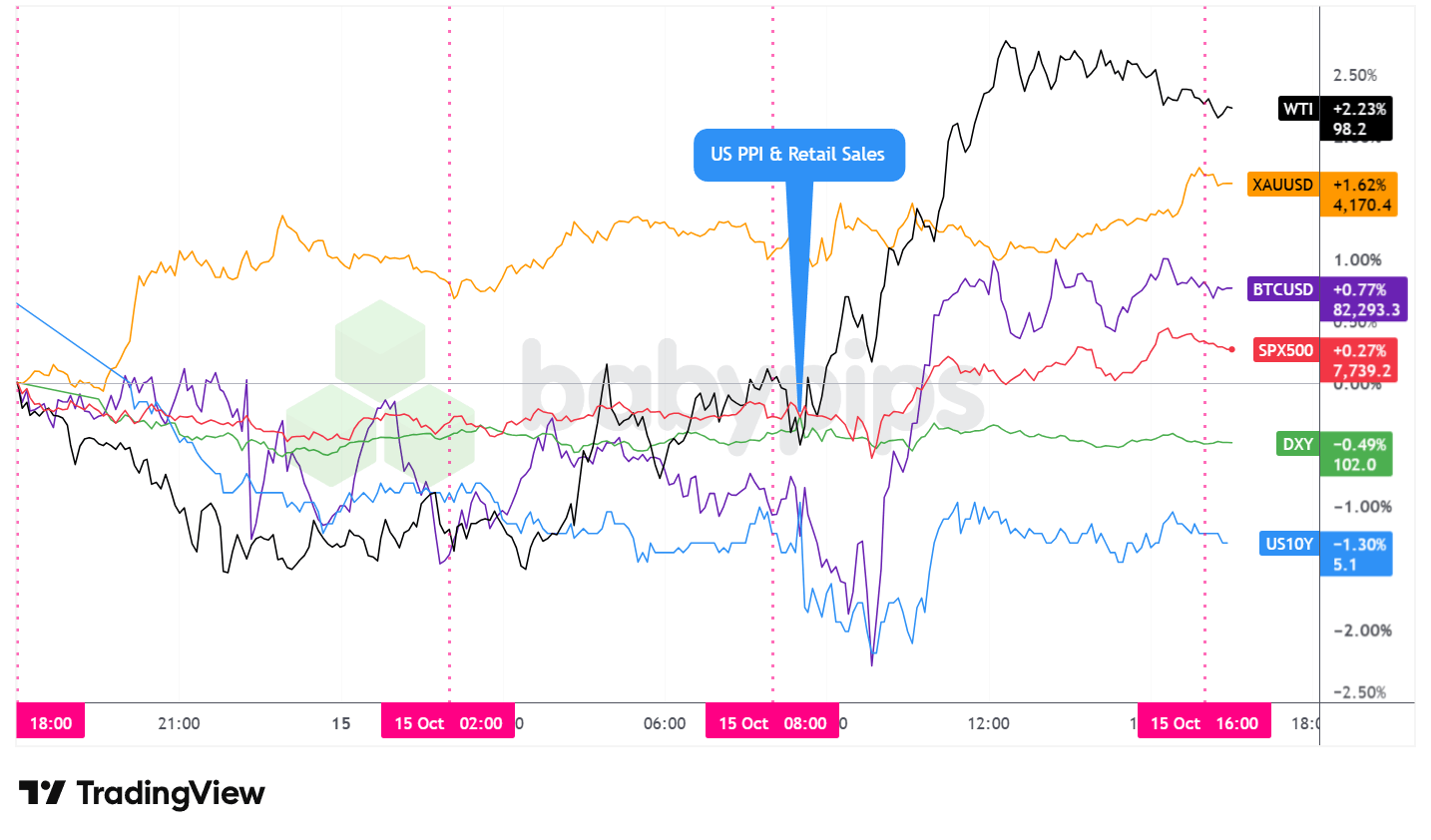
Producer prices and retail sales landed at 8:30 am ET, and the U.S. producer price report showed a 1.3% monthly jump against a 0.5% forecast. Prices excluding food, energy and trade services rose 0.5% against 0.3% expected, which may indicate the pressure reached beyond fuel. Headline retail sales rose 0.8% against a 0.3% forecast, though gasoline drove most of that gain.
The dollar and Treasury yields spiked and gold dipped at the release, but all three reversed within 10 minutes, and stocks held steady. One possible explanation is that Wednesday’s hot CPI report had prepared the market. Control group retail sales rose 0.1% and the Philadelphia Fed index missed forecasts, and those results may have offset the producer price surprise.
WTI crude oil rose 2.2% to near $98 a barrel and posted the biggest gain of the five markets. Prices fell to near $94.50 in the Asian session, and a report that Washington is considering easing sanctions on shadow-fleet tankers may have added to the decline. Crude recovered through the European morning while Houthi attacks on Saudi Arabia continued and shipping through the Strait of Hormuz stayed disrupted, and it climbed faster after the producer price release, peaking near $98.70 around midday. No single catalyst stood out for the U.S. session climb, but continued supply risks in the Middle East may have supported prices. Higher fuel costs feed the inflation figures the Fed watches, which may explain why Treasury yields recovered as oil rose.
The 10-year Treasury yield extended its retreat from Wednesday’s post-CPI high in the Asian session, easing to near 5.1%, more than 20 basis points below the peak, and held there through the European morning. It spiked for a few minutes at the producer price release, dropped to near 5.06%, and reached a low near 5.04% in the first 20 minutes of stock trading. The yield recovered to 5.10% by midday as stocks and oil rose and ended near 5.09%, 6 basis points lower on the day. Those swings followed the equity market, which may mean investors bought Treasuries during the AI-related selloff and sold them as stocks recovered. Buyers may have seen value after yields climbed to multi-year highs, and Daly’s remark that the Fed does not need to move in October may have eased some rate hike worries.
The S&P 500 rose 0.3% to near 7,740 and halted a three-day slide. The index slipped through the Asian session while the AI-related selloff hit Asian markets and fell to a low near 7,670 in the first 20 minutes of U.S. trading. A measure of credit risk at the AI cloud provider CoreWeave hit an all-time high, and Nvidia chief Jensen Huang defended CoreWeave’s financial health as the chip selloff eased. The index climbed through the afternoon to a high near 7,750. The equal-weighted S&P 500 gained 1.4%, a gain that may reflect money rotating into sectors beyond AI-linked stocks, and TSMC’s better-than-expected revenue outlook may have helped chip shares.
Gold rose 1.6% to near $4,170 an ounce. The metal climbed close to $40 in the Asian session as Treasury yields retreated and the dollar weakened, a combination that can support gold because it pays no interest. It dipped at the producer price release, recovered within five minutes, and held near $4,150 for most of the session. A late jump to a high near $4,175 had no clear catalyst, since the dollar and yields stayed flat during that stretch.
Bitcoin rose 0.8% to near $82,300 after a volatile session. A 1.3% drop within five minutes in the Asian session pushed it below $81,000 amid a reported $485 million in liquidations, and it fell to a low near $79,800 in the first 20 minutes of U.S. stock trading. It rebounded above $82,000 by late morning and held near that level. No coin-specific headline stood out. Bitcoin bottomed with the S&P 500 and recovered with it, which may reflect shared sensitivity to AI-related risk sentiment, and a weaker dollar may have helped.
FX Market Behavior: U.S. Dollar vs. Majors
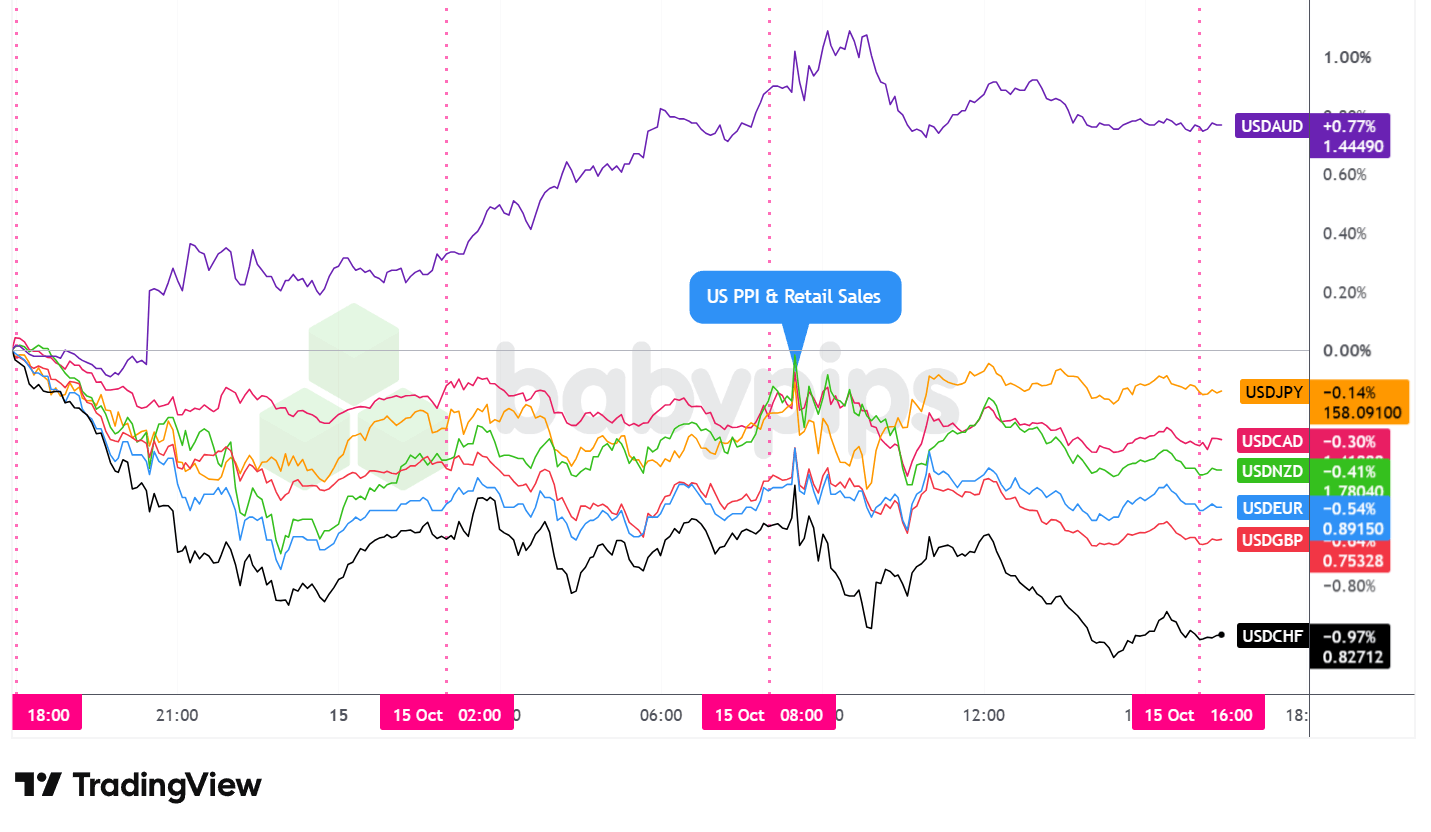
The dollar fell against six of the seven majors in the Asian session while Treasury yields retreated from Wednesday’s highs and gold climbed, a backdrop that may have weighed on the dollar. The Swiss franc led, possibly on safe-haven demand as Asian stocks tumbled, and the euro followed. USD/JPY slipped 0.2% after BoJ’s Koeda said excess caution on raising rates is unwarranted, a comment that may have given the yen modest support.
The Australian dollar moved against the trend after Australia’s September jobs report at 8:30 pm ET. Employment fell 39,300, part-time jobs dropped 73,700 while full-time jobs rose 34,400, and unemployment sat at a five-year high of 4.7%. A softer labor market may reduce the odds of another RBA rate hike at the Nov. 2-3 meeting, a shift that could have weighed on the currency.
The dollar traded in narrow ranges against most majors in the London session, and the Dollar Index gained 0.04%. U.K. data beat forecasts, with August GDP up 0.1% month over month against an expected 0.1% decline and a trade deficit that narrowed more than forecast. Sterling showed little reaction, possibly because markets had priced a Bank of England hike for November. Greene’s push for hikes and Breeden’s call for patience pulled in opposite directions, which may have capped sterling. The Australian dollar extended its decline, losing another 0.6%, and the New Zealand dollar slipped. Fragile risk sentiment after the Asian stock rout may have weighed on both.
The dollar jumped against all seven majors at the 8:30 am ET releases in the U.S. session, led by gains against the New Zealand and Australian dollars, and gave the move back within 10 minutes. The franc kept advancing through the afternoon while sterling and the New Zealand dollar firmed against the dollar. Weak control group retail sales and the Philadelphia Fed miss may have tempered demand for the dollar.
The yen was the exception. USD/JPY moved with Treasury yields, falling toward 157.6 as the 10-year yield hit its low in the first 20 minutes of stock trading and climbing back above 158 by midday as yields recovered. The dollar dropped to its lowest level against the Canadian dollar near 1.4170 as oil climbed, which may reflect oil’s role as a major Canadian export. The dollar’s failure to hold its post-release gains may mean markets had priced much of the inflation risk after Wednesday’s CPI report, and Daly’s comment that the Fed does not need to move in October may have limited dollar demand.
Upcoming Potential Catalysts on the Economic Calendar
- New Zealand Electronic Card Retail Sales for September 2026 at 9:45 pm GMT
- New Zealand Food Price Index for September 2026 at 9:45 pm GMT
- BoE Gov Bailey Speech at 2:00 am GMT
- Fed Chair Warsh Speech at 3:30 am GMT
- BoC Gov Macklem Speech at 4:15 am GMT
- Euro area CPI Growth Rate Final for September 2026 at 9:00 am GMT
- Euro area Trade Balance for August 2026 at 9:00 am GMT
- Canada Housing Starts for September 2026 at 12:15 pm GMT
- Canada Foreign Securities Purchases for August 2026 at 12:30 pm GMT
- U.S. NY Fed Services Activity Index for October 2026 at 12:30 pm GMT
- U.S. Import & Export Prices for September 2026 at 12:30 pm GMT
- U.S. Industrial & Manufacturing Production for September 2026 at 1:15 pm GMT
Fed Chair Kevin Warsh joins IMF Managing Director Kristalina Georgieva for a fireside chat in Bangkok on Thursday night, New York time, giving him a chance to respond to this week’s hot CPI and PPI readings before the Fed’s Oct. 27-28 meeting. His tone may move the dollar and Treasury yields if he sounds more or less open to an October hike.
Speeches from BoE Governor Bailey and BoC Governor Macklem follow overnight and may move sterling and the Canadian dollar. Final euro area CPI at 9:00 am GMT may show whether inflation pressure is building, and U.S. import and export prices and industrial production arrive on Friday. The Australian dollar may stay sensitive to September-quarter CPI on Oct. 28 and the RBA decision on Nov. 2-3.
AI disclosure: A Babypips editor researched and directed this article, and AI tools helped analyze the intraday price data, research sources, initiate the draft, before a Babypips editor did the final review and edit. AI tools can misread data, make arithmetic errors, and state wrong information in a confident tone. Prices, levels, and percentage moves here are approximate because the market data was not captured at the exact close, so check the figures against your own data source before you rely on them. The explanations for market moves are possible reasons, not confirmed causes. This article is for education and is not a recommendation to trade.