Fed Balance Sheet Drops by $67 Billion for the Week

Standing Repo Facility -$75 billion to zero, Reserve Management Purchases +$8 billion: The year-end liquidity shifts have settled down.
Total assets on the Fed’s weekly balance sheet dropped by $67 billion from the prior week to $6.57 trillion as of Wednesday, according to the Fed today. The drop, which was expected, reversed a big part of the $104 billion spike in the prior week when Wednesday, the cut-off for the Fed’s balance sheet, was January 31, the point of maximum year-end liquidity shifts.
That drop of $67 billion was caused by the Standing Repo Facility (SRF), whose balance dropped from $75 billion on January 31 to $23 billion in Friday January 2, and to zero on January 5 and stayed at zero through today.
The SRF is an asset on the Fed’s balance sheet, and that $75 billion uptake on January 31 happened on the day of the Fed’s weekly balance sheet, and so it increased the Fed’s total assets for one day by $75 billion. And that has been completely unwound.
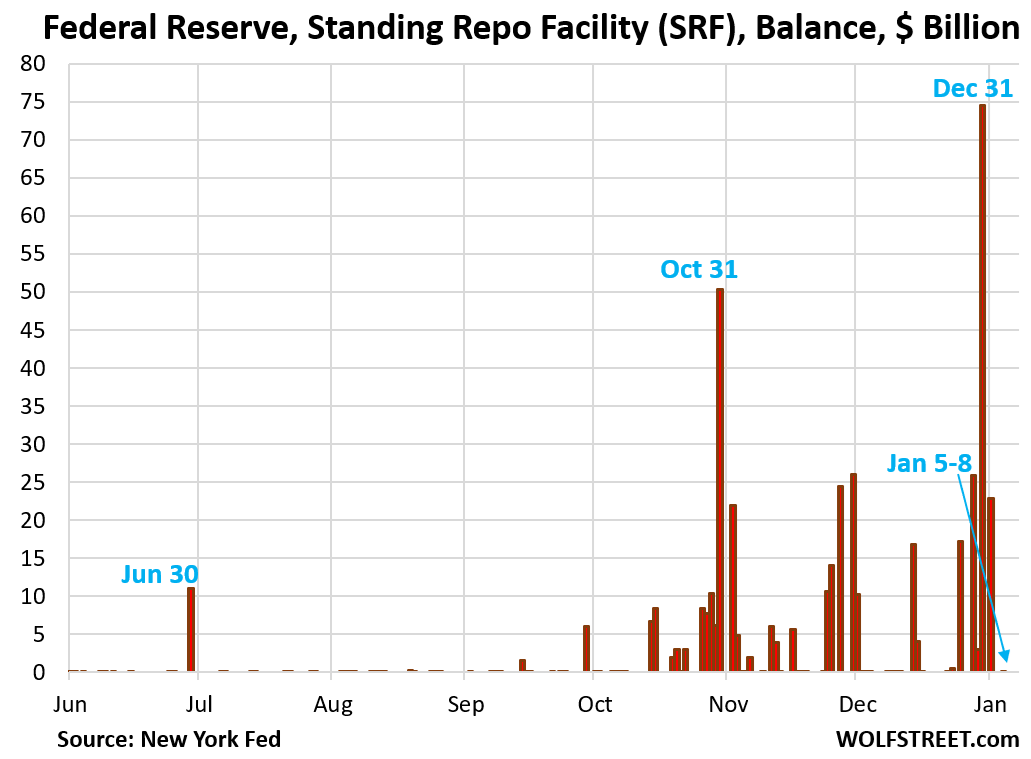
These repos at the SRF unwind the next business day, when the Fed gets its money back and the banks get their collateral back. Then the counter parties can take up new repos for another business day. But there has been no uptake since January 2.
The 43 or so approved counterparties at the SRF, mostly big broker-dealers and banks, can borrow overnight at the SRF via repurchase agreements (repos) at 3.75%. The idea is that these counterparties will keep repo market rates from blowing out during liquidity shifts by lending to the repo market when rates in the repo market exceed the SRF rate and earn a quick profit from the spread.
On January 31, rates in the portion of the repo market that SOFR tracks rose as high as 4.0%, so banks borrowed $75 billion at the SRF for two days (including January 1) and lent to the repo market at higher rates, and profited from the spread. As rates in the repo market dropped below the SRF rate, the spread vanished, and banks unwound the SRF repos.
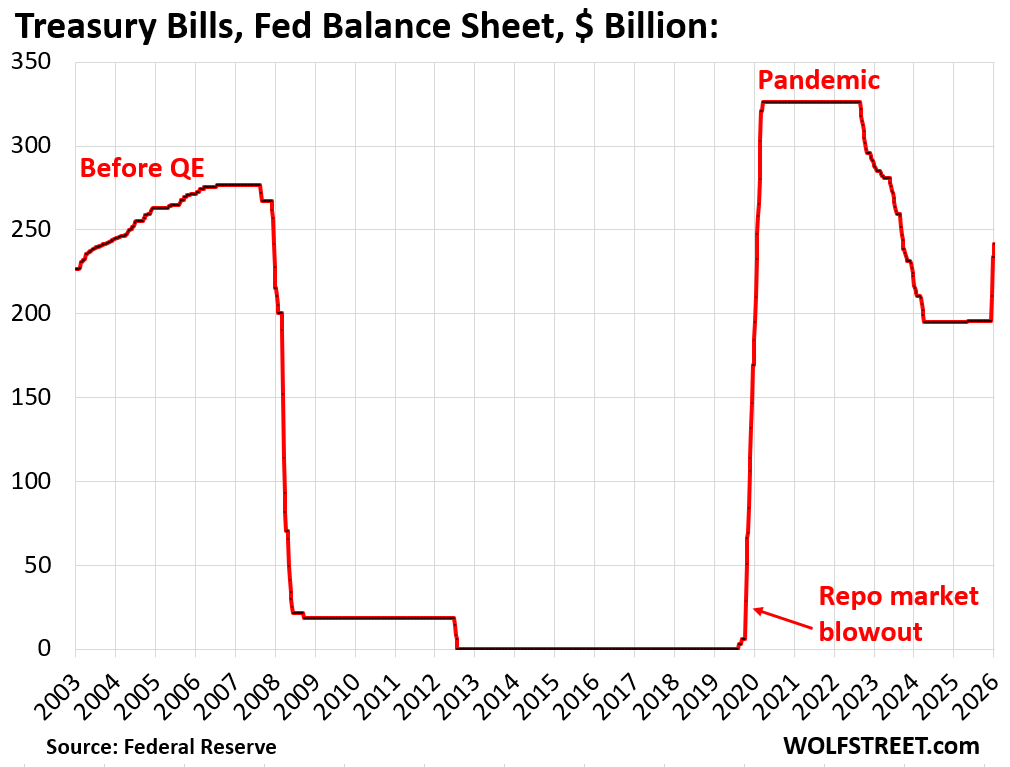
Treasury bill purchases. T-bills on the Fed’s balance sheet rose by $8 billion from the prior week, to $241 billion. T-bills are short-term Treasury securities with terms of 1 month to 1 year.
In December, the Fed started adding T-bills for two purposes, within its new effort to shift the composition of its balance sheet toward T-bills:
-
- Replace the MBS that come off its balance sheet to reach its goal of shedding all of its MBS over time;
- “Reserve Management Purchases” to increase reserve balances (bank cash on deposit at the Fed) as needed for reserves to remain at “ample” levels.
Until December, the Fed held only $195 billion in T-bills – only 3.0% of its total assets at the time. The only reason it had any T-bills at all was the repo market blowout in late 2019 when it purchased T-bills in addition to engaging in repos to bring that back under control. Before the repo market blowout, T-bills were at zero.
On December 12, the Fed started buying T-bills for RMP purposes and to replace MBS that come off the balance sheet.
Since then, the Fed added $46 billion in T-bills:
- $15 billion replaced MBS that came off its balance sheet
- $31 billion for RMP purposes.
When the Fed made that announcement in December, it said that RMPs for the month from December 12 to January 12 would amount to $40 billion.
The Fed will announce in a few days the amount of the RMPs to be purchased during the next 30-day period. The amounts will vary by season. The Fed is currently frontloading for April 15 Tax Day, when big liquidity strains are expected. After that it will slow the RMPs, it said.
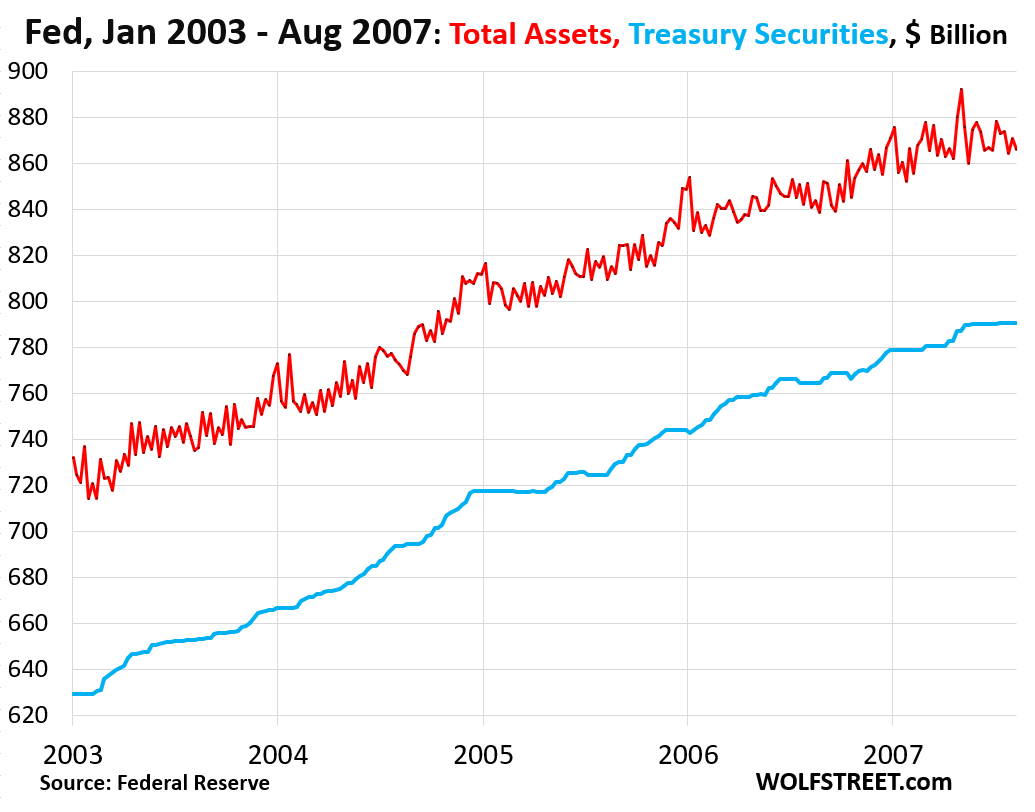
Before 2008 and before QE, the Fed always let its balance sheet grow roughly with the nominal economy (at the time, largely a function of currency in circulation). It did so by purchasing T-bills and Treasury securities, and by engaging in repos. QE changed that in 2008, when the Fed suddenly began to balloon its balance sheet out of all proportion.
Note the growth of the Fed’s T-bill holdings before 2008 QE. This pre-QE method of letting the balance sheet grow roughly with nominal economic growth and shifting more of its assets to T-bills is what the Fed is reverting to.
From January 2003 to August 2007, the Fed’s total assets increased by 18%. That was not QE but standard balance sheet management, to keep the balance sheet in line with the economy.