FCA Says Only 12% of CFD Firms Changed Charges: How Overnight Financing Fees Work


Most of the CFD firms the regulator surveyed looked again at their charges after its review, then kept them. The Financial Conduct Authority (FCA) surveyed 81 CFD firms in May 2026, six months after its November 2025 multi-firm review, and found...
Most of the CFD firms the regulator surveyed looked again at their charges after its review, then kept them. The Financial Conduct Authority (FCA) surveyed 81 CFD firms in May 2026, six months after its November 2025 multi-firm review, and found that "only 12% of firms said they had changed any charges." Most of the rest explained their existing rates instead.
The findings, published on 15 October and reported by Finance Magnates the next day, put one fee first among the FCA's remaining concerns: what a client pays to keep a position open overnight.
What Finance Magnates found more telling than the 12% is that it sits at the bottom of the FCA's list of changes, where some firms changed, or planned to change, their calculation "to recognise that overnight financing is currently charged on total notional, with no interest paid on the initial margin posted by clients."
That sentence captures much of the economics of the fee. Here is what the charge comprises, where it gets bigger than it looks, and how to compare it between brokers.
Operator question | Practical answer |
What is the charge? | A daily fee on positions held past the broker's cut-off: a benchmark interest rate plus or minus the broker's own mark-up. |
What is it charged on? | The full notional value of the position, not the margin posted. |
Who sets the mark-up? | The firm. The FCA says charge levels are at a firm's discretion, and the mark-ups remain "largely opaque." |
Does a hedged pair pay? | At most firms, yes, often at the full long and short spread. |
Which rule is in play? | The Consumer Duty price and value outcome, plus its consumer understanding obligations. |
What does the FCA call good practice? | Fees explained on dedicated web pages, pop-ups and deal tickets. Few firms yet show an annual rate. |
First management action | Restate every financing rate as an annual figure and compare it with UK peers. |
What the Overnight Charge Is Built From
What does a broker charge for holding a CFD overnight?
Two pieces: a benchmark rate for the currency of the underlying and the broker's mark-up on top.
IG's UK charges page puts its CFD admin fee at 1% for FX and 3% for other asset classes, charged on positions held past 10pm UK time. Its help page gives the index formula:
Number of contracts × value per contract × price × (admin fee ± SONIA) ÷ 365.
A 360-day divisor applies outside sterling, Singapore dollar and rand markets. Three days' funding is charged on positions held through Friday night.
CMC Markets' holding costs page uses the same basic formula, with SONIA as the sterling benchmark.
When the short side pays too
A long pays the benchmark plus the mark-up. A short receives the benchmark minus it, which turns into a charge when the mark-up is bigger than the benchmark.
CMC explains this for share CFDs. Sell positions are credited unless the interbank rate is at or below its add-on, in which case they "may incur a holding cost charge."
It prices FX holding rates using the pair's tom-next rate. For commodities, both CMC and IG build the charge from the gap between futures prices, with their own fee on top.
Where the Cost Gets Bigger Than It Looks
Why is the charge on the full position, and what does that do?
Because a CFD gives exposure to the full value of the underlying, the financing runs on the full value too.
The FCA's November review said disclosures could be clearer about exactly that, including "charges being applied on the full consideration the CFD gives the client exposure to with no offset against the funds held on the client's account." It also highlighted the effect of leverage on the size of the charge relative to the client's own funds.
The review found that most firms had considered paying interest on CFD account balances and decided not to.
All figures below are illustrative assumptions, not any firm's terms.
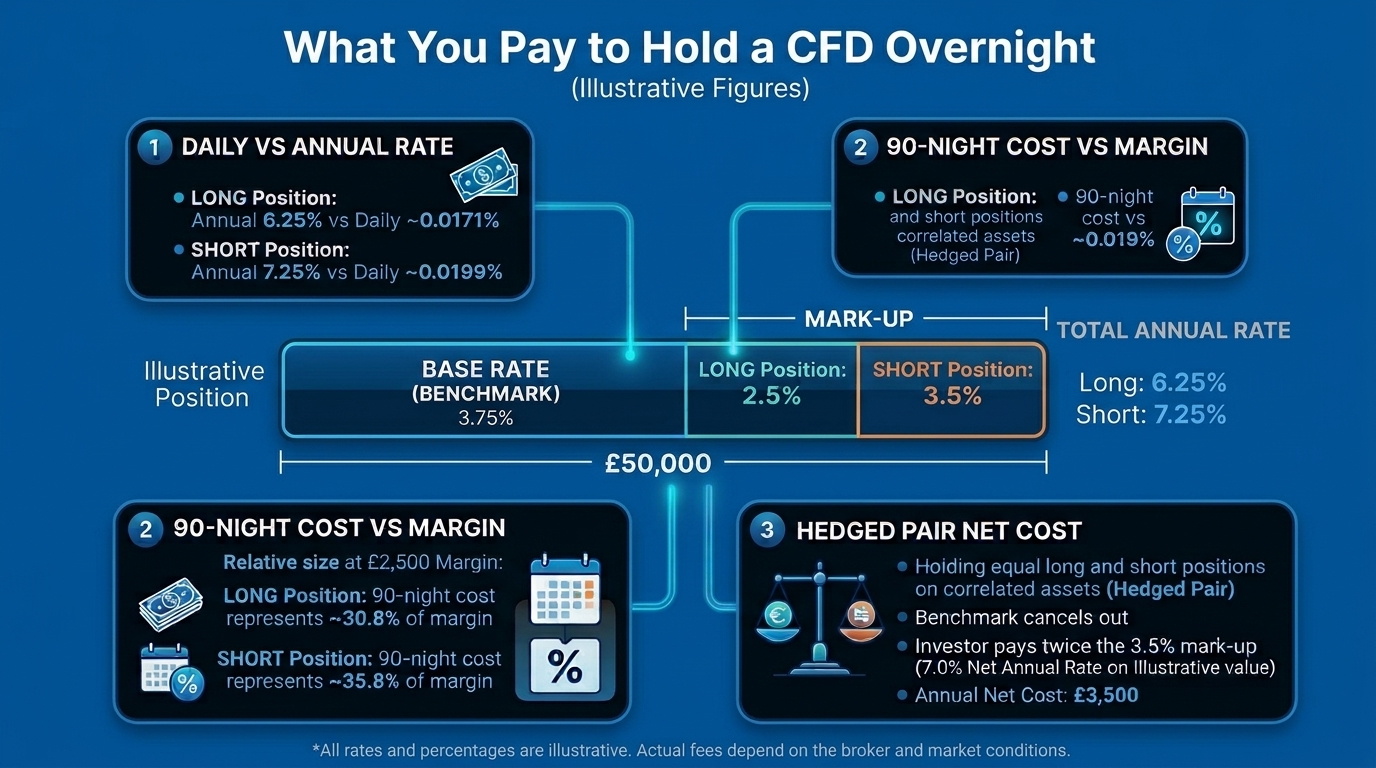
Daily charge = notional × (benchmark + mark-up) ÷ 365.
Take a £50,000 long index position backed by £2,500 of margin, and a benchmark of 3.75%, using the Bank of England's Bank Rate as of October 2026.
Cost measure | Broker A (2.5% mark-up) | Broker B (3.5% mark-up) |
Annual rate | 6.25% | 7.25% |
Daily rate shown on a ticket | 0.0171% | 0.0199% |
Cost per night | £8.56 | £9.93 |
Cost over 90 nights | £770.55 | £893.84 |
90-night cost as a share of margin | 30.8% | 35.8% |
A client comparing 0.0171% and 0.0199% a day may never register a full percentage point of annual difference. The FCA says an annual rate "would give clients a more widely used comparison point."
The last row shows the leverage effect the November review said disclosures could make clearer. The fee is small against the position value but large against the money the client actually put up.
What happens when a client is long and short at once?
Finance Magnates went looking for how a big UK name treats a hedged pair, and CMC puts it in one sentence: "holding costs are still charged on both sides regardless of your netting status."
The FCA found the same at most of the firms it surveyed. Most firms charge matched positions, many call it an administration charge, and most apply "the same full funding charge spread" as on a genuine long or short.
Run Broker B on a £50,000 long and a £50,000 short in the same index. The long pays 7.25% and the short receives 0.25%, leaving a net cost of £3,500 a year, or about £863 over 90 nights, for a position with no net market exposure.
With the same spread on both legs, the net cost of a hedge is twice the mark-up, whatever the benchmark does.
The FCA's sharper concern is firms that encourage matched positions with reduced or waived margin. It wants clients shown the pros and cons of this approach against simply closing the trade.
What the FCA Found, and What It Wants
What the 12% actually changed
Four types of changes appear in the FCA's list of actions taken or planned by the 12% of firms that reported changing charges:
- Paying interest on cash balances.
- Cutting financing charges on matched or hedged positions.
- Cutting charges on outlier product groups after peer comparisons.
- Changing the calculation to recognise that clients earn nothing on their margin.
The list includes planned changes as well as completed ones, so the 12% describes intent as well as action.
On the changes firms did make, the FCA is blunt: they were "often designed to show that they have complied with the Duty, rather than materially changing their offering."
The disclosure the regulator is asking for
The FCA's good-practice list includes dedicated fee pages, pop-ups and deal-ticket information explaining how charges are calculated. These should provide information beyond the terms and conditions and key information documents (KIDs).
Only a minority of firms have added an annual rate, and the FCA asks firms to consider whether outlier rates are compatible with fair value.
There is no deadline and no new rule. The FCA says it will follow up with individual firms where it has concerns.
The same week, it flagged surveillance gaps at seven retail brokers and said it would review appropriateness tests.
Why Should Brokers Care?
The transferable model is simple: at its core, the overnight charge is a benchmark plus a mark-up, applied to notional. The comparison question for any broker or asset class is then how big the mark-up is, what it is charged on, and whether the client can see it.
Finance Magnates' read is that the annual percentage rate (APR) line is the cheapest fix on the FCA's list and probably the one that helps a client comparing two brokers most.
Furthermore, Finance Magnates' gold swap survey shows what that looks like in one market. All 32 gold long readings it checked carried a negative swap, and the one credit on offer was a capped promotion.
The FCA's findings have implications for several teams within a CFD broker.
Role | Primary question | Required action |
Product and pricing | Are any of our rates outliers against UK peers? | Restate every rate as an APR and benchmark it against UK-regulated firms. |
Compliance | Does our fair-value assessment cover financing, including hedges? | Document the rationale for charging matched positions and how we promote them. |
Client experience | Can a client see the annual cost before placing the trade? | Put the APR and the calculation on the deal ticket and fee page. |
Finance | What do hedged-pair and outlier charges contribute? | Size the revenue at risk if those charges are cut. |
Two things may be worth watching into 2027: whether the FCA's individual follow-ups produce named outcomes, and whether interest on CFD cash balances spreads beyond the firms already planning it.
Summary: What This Means Now
The FCA has now said twice, eleven months apart, that some overnight charges may not represent fair value, and most firms answered with explanations rather than lower rates.
The fee is a benchmark plus a mark-up on the full position, which makes it large against the margin a client posts and can double the mark-up on a hedge.
The next round is individual follow-ups, and a firm that can show its rates as APRs against UK peers has its evidence ready.
Related Articles
- General News
Fee-Only RIAs Grow in Number, but Not Percentage of Industry Assets
- Forex News
UAE Investor Refunds Jump to 1.2 Billion Dirhams as Licensed Firms Rise 43%
- Forex News
How Far Should Crypto Firms Trace a Transaction? FCA Says Risk Should Decide
- Forex News
Why ASIC Will Not Receive Some Scam Reports Under Its Draft AFCA Guide
- Stock Markets News
After banking an 87% winner, where does our AI move the money next?