Core Inflation Reaccelerates, Raising Fed Hike Odds as Dollar Gains Fade

September’s U.S. CPI report sent the dollar higher, but the rally didn’t last.
Gasoline drove headline inflation up, while core prices also came in hotter than expected, leaving traders to reconsider whether the Federal Reserve may need to raise rates again.
The dollar’s chart told two stories, but the bigger one is what the report could mean for the Federal Reserve.
So What Did the September CPI Report Actually Show?
A CPI report gives you two important numbers, and the gap between them can tell a bigger story than either figure alone.
First is the headline CPI rate, which tracks the full basket of goods and services urban consumers buy, including food, energy, shelter, and transportation. September’s rate came in at 3.7% on a year-over-year basis, above the 3.6% consensus forecast and up from 3.4% in August. On a month-over-month basis, prices rose 0.6%, compared with 0.4% in August.
Energy drove much of that increase. Gasoline prices jumped 9.1% in September alone, accounting for more than half of the monthly increase across all categories, according to the Bureau of Labor Statistics (BLS).
The other key figure is core CPI, which leaves food and energy out of the calculation. Those prices can swing with factors central banks can’t control, such as geopolitics and the weather. September’s core rate came in at 2.6% on a year-over-year basis and 0.3% on a month-over-month basis, beating forecasts of 2.5% and 0.2%, respectively. The annual rate also accelerated from 2.4% in August.
Headline inflation ran hotter because of energy, but core inflation surprised to the upside too, strengthening the case for another Fed hike and raising the odds of an October increase.
Why Did Core CPI Move Markets More Than Headline CPI?
Bond traders often look through energy-driven headline inflation surprises. Crude oil can fall as quickly as it rises, while shelter, airline fares and service prices tend to be stickier.
September’s core data showed price increases across several categories, not just one. Shelter prices rose 0.4% in September after climbing 0.3% in August, according to the BLS. Airline fares gained 1.2%, used cars and trucks rose 0.7%, and recreation costs increased 0.5%. These prices don’t usually reverse in a month.
Once higher costs work their way into housing and services, they can linger. This is why the Fed watches core inflation for a clearer read on persistent price pressures. It also monitors whether volatile energy costs spread to other prices. September’s data suggested that may be happening.
What Does This Mean for the Fed?
The Federal Reserve raised rates in September for the first time since 2023. Before this week’s CPI report, many officials had signaled they didn’t expect another hike right away. Markets saw an October hold as likely, putting the odds of another increase at about 22%, according to CME FedWatch.Wednesday’s report changed that outlook. October hike odds climbed to roughly 37%, with some estimates briefly topping 50% before falling back. Core CPI rose 0.3% month over month for the second straight month. That suggests the slowdown in inflation that gave the Fed room to pause earlier this year may be stalling.
Core inflation remains about 0.6 percentage points, or 60 basis points, above the Fed’s 2% target. Higher rates can cool spending, but service, housing and transportation costs take time to respond. That’s why bringing inflation from 3% to 2% can be tougher than lowering it from higher levels.
So, even if the Fed holds in October, the December meeting now carries more weight. Two consecutive month-over-month core CPI increases of 0.3% leave the Fed with less room to wait and see.
How Did the Dollar React?
At 8:30 AM ET, every dollar pair moved in the same direction simultaneously. The initial surge was mechanical, likely driven by algorithmic repricing before most traders had finished reading the first line of the report.
The dollar peaked around 10:00 to 11:00 a.m. ET, with USD/GBP and USD/NZD up roughly 0.90% on the session. The gains then faded, but not at the same pace across pairs. The Swiss franc and Japanese yen erased their losses by the close, while the dollar held on to gains of about 0.55% against sterling.
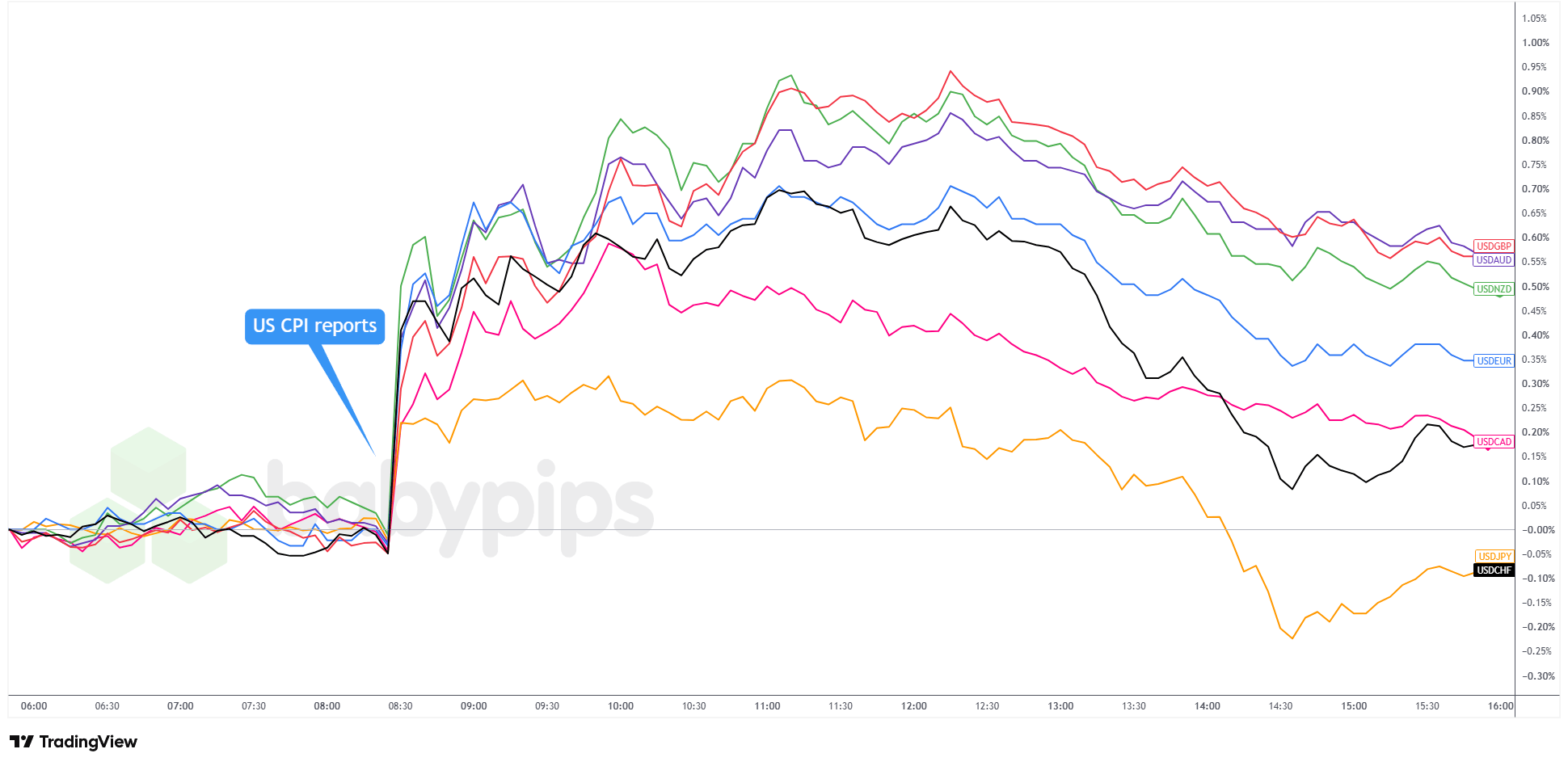
That split coincided with a shift toward safe-haven assets as the S&P 500 fell 1.2% through the afternoon. The franc and yen appeared to attract some demand as investors grew more cautious. The 10-year Treasury yield slipped from near 5.33% toward 5.2% as bond buyers returned during the stock sell-off, easing one source of support for the dollar.
Sterling doesn’t have the same safe-haven appeal, so it lacked that extra support. The DXY finished the session roughly 0.30% higher by the end of the day.
The Bottom Line
Both headline and core inflation beat expectations, pushing October hike odds from 22% to 37%. If only headline inflation had surprised higher while core cooled, markets might have shrugged it off. But core came in hot too, suggesting price pressures may be spreading beyond energy.
The dollar’s spike and fade reflected two competing forces. The initial move lifted rate expectations, but Treasury yields later eased as stocks sold off and safe-haven demand supported the yen and franc. The DXY finished up 0.31%, well below its intraday peak.
An October hike is back in play, and December could matter even more. Core CPI rose 0.3% month over month for the second month in a row. With headline inflation accelerating and energy prices still elevated, the Fed may have less room to wait. Thursday morning’s data should offer the next clue.
What to Watch
Thursday’s U.S. PPI for September (8:30 AM ET) will show whether energy-driven cost pressures are climbing at the producer level as well. A hot reading can signal that consumer inflation has further to run. U.S. retail sales release at the same time.
Fed Chair Kevin Warsh speaks Friday at 3:30 AM GMT in Bangkok, likely his last public remarks before the Fed’s pre-meeting quiet period. The FOMC meets October 27-28.