China Meets Its Growth Target but Domestic Demand Remains Weak

China’s economy grew 4.5% in Q3 from a year earlier, topping the 4.4% consensus forecast and picking up from 4.3% growth in Q2.
That kept the growth rate within Beijing’s 4.5% to 5.0% full-year target. But the headline beat leaned on exports and factory output.
Consumer spending remains soft, real estate investment is down 20.6% through the first nine months, and domestic demand is still weak.
China Q3 2026 GDP: Key Takeaways
- GDP: +4.5% year-on-year in Q3 2026 (forecast: +4.4%; Q2 2026: +4.3%); quarter-on-quarter: +1.2% (forecast: +1.1%; Q2: +0.9%)
- First nine months GDP: +4.6% year-on-year, inside Beijing’s 4.5%–5.0% full-year target range
- Industrial production September: +5.5% year-on-year (beat +5.4% forecast; August: +5.2%); manufacturing PMI back in expansion at 50.1 (August: 49.8)
- Retail sales September: +1.1% year-on-year (beat +1.0% forecast; August: +0.4%), the fastest monthly pace in six months
- Fixed-asset investment January–September: -7.2% year-on-year; real estate development investment: -20.6%
- Yuan hit a 4-year high (USD/CNY fell to 6.6816); AUD/USD gained 0.4% on the release
What Were China’s Q3 2026 GDP Results?
China’s Q3 2026 GDP, which measures the value of goods and services produced, grew 4.5% from a year earlier. That beat the 4.4% consensus and picked up from Q2’s 4.3% pace. Growth also accelerated quarter over quarter, rising 1.2% after a 0.9% gain.
GDP was up 4.6% in the first nine months of 2026, within Beijing’s annual target of 4.5% to 5.0%. Last week, the IMF lowered its 2026 growth forecast for China to 4.5%, citing higher energy prices from the Iran-U.S. conflict and persistent structural headwinds.
What Drove China’s Q3 2026 Growth?
Factories and overseas demand drove the upside surprise. Industrial output rose 5.5% in September from a year earlier, topping the 5.4% forecast and picking up from 5.2% in August. Exports surged 29.6% from a year earlier, led in part by demand for semiconductors, data center materials, and AI components. High-tech manufacturing grew 14.3% in the first nine months. Lithium-ion batteries, industrial robots, and 3D printing devices all posted double-digit gains.
The manufacturing PMI, a monthly survey of factory activity, climbed to 50.1 from 49.8 in August. Readings above 50 signal that activity is expanding.
Are Chinese Consumers Getting Stronger?
Retail sales rose1.1% in September from a year earlier, beating the 1.0% forecast and improving on August’s 0.4% gain. It was the fastest monthly pace in six months.
Still, retail sales grew just 1.1% in the first nine months of the year. Urban unemployment edged lower to 5.2% from 5.3%, offering a small boost to the household income picture.
Property remains a bigger drag. Real estate investment fell 20.6% in the first nine months, putting further pressure on the home values that make up much of many Chinese families’ wealth.
What Does This Mean for the People’s Bank of China?
In late September, Beijing already rolled out mortgage subsidies, cheaper credit for infrastructure, and fresh funding for local governments. GDP growth within the 4.5% to 5.0% target gives the People’s Bank of China (PBOC) limited urgency to cut rates.
But weak consumer spending, a struggling property sector, and high energy costs from the Iran conflict push Beijing toward more stimulus. Fixed-asset investment (spending on buildings, machinery, and infrastructure) also fell 7.2% through September, adding to the pressure.
What Does This Mean for AUD Traders?
Australia’s close trade ties with China make the Australian dollar (AUD) one of the clearest China proxies in currency markets.
The Aussie moved in two waves: it spiked at the Asian open, then pulled back as markets waited for the data.
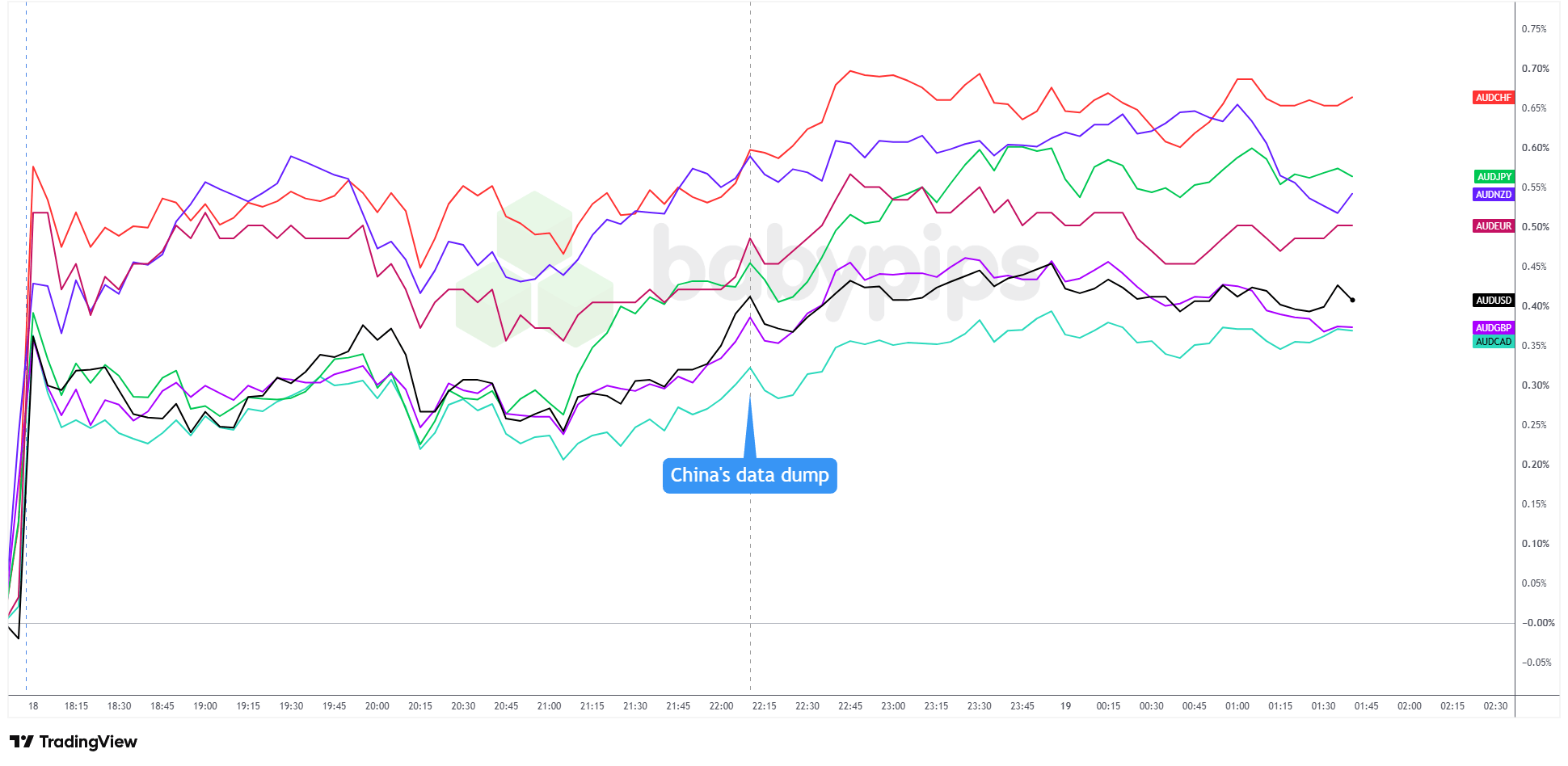
The NBS report sparked another push higher. AUD/USD finished up 0.4%, while AUD/CHF led the major pairs with a 0.7% gain. The yuan also hit a four-year high against the dollar, with USD/CNY at 6.6816.
Chinese stocks slipped 0.2%, with the CSI 300 falling despite the growth beat. This suggests equity investors were less convinced by the headline result than currency traders. ANZ analysts warned that “rising trade tensions, protectionist measures and geopolitical frictions” pose risks to China’s growth outlook and could cap AUD gains.
Frequently Asked Questions About China Q3 2026 GDP
What does China’s GDP measure?
China’s GDP, or gross domestic product, measures the value of final goods and services produced in the country during a given period. The National Bureau of Statistics releases an initial estimate shortly after each quarter ends.Because China is the world’s second-largest economy, its growth can affect commodity prices, currency pairs, and trade-linked economies such as Australia.
Why does China’s GDP matter for forex traders?
China’s growth affects demand for commodities, which can influence currencies such as the Australian dollar (AUD) and the Chinese yuan. Stronger than expected growth may support both currencies by pointing to stronger demand for imports and factory goods. Weaker results can put them under pressure.
Traders also watch the People’s Bank of China’s response. A rate cut or new stimulus program can ripple through the yuan, the AUD, and other currency pairs.
What happened in China’s Q3 2026 GDP report?
China’s economy grew 4.5% from a year earlier in Q3 2026, beating the 4.4% forecast. September industrial output rose 5.5%, and retail sales grew 1.1%. Both figures beat expectations.
Fixed asset investment fell 7.2% through September, while real estate investment dropped 20.6%. After the release, the yuan climbed to a four-year high and AUD/USD gained 0.4%.
Why are economists cautious about China’s growth despite the beat?
The headline growth figure leaned on exports and industrial output, while consumer spending and domestic investment remained weak. Retail sales grew just 1.1% in the first nine months of the year, and real estate investment fell more than 20%.
NBS deputy head Mao Shengyong said domestic demand remained “insufficient.” ANZ analysts also pointed to “a deeper rebalancing challenge” for China’s medium-term growth model.
What does China’s GDP beat mean for AUD?
The beat may support the AUD in the short term because stronger Chinese data can lift expectations for commodity demand. AUD/USD gained 0.4% on the day. But weak Chinese consumer spending, a contracting property sector, and rising trade tensions could limit the rally.
AUD traders will also be watching Beijing’s next stimulus moves and the Iran-U.S. conflict, since energy costs and global trade remain key drivers.