AI Data Center Investment Mania Goes Exponential as Money Gets Thrown at Hurdles & Shortages

Exponential curves for investments burn out, often with a pop. But they can last longer than imagined.
The race to build and equip $1 trillion of AI data centers as fast as possible, no matter what the costs and hurdles, has run into revolts that have triggered local data-center construction moratoriums and bans across dozens of states, with a bunch of states considering data-center construction moratoriums and bans – New York already implemented a 1-year moratorium until it gets its regulations sorted out – amid concerns about soaring electricity costs, blackouts, water shortages, the issues caused by onsite gas-turbine or diesel power-generators, etc. Some of the planned data centers would consume multiple gigawatts of power, but the grid cannot supply that kind of power all of a sudden.
At the same time, there are enormous unanswered questions about the commercial viability of these massive amounts of investments, amid doubts that AI will generate the trillions of dollars in revenues to make that investment worthwhile. Where are these trillions of dollars in new revenues supposed to come from? No one knows. But build it, and the revenues will come?
Nevertheless, the race to build AI data centers continues unabated. The amount spent only on the construction of data centers spiked by 6.2% month-over-month, and by 57% year-over-year to a seasonally adjusted annual rate of $75 billion in July, according to construction data from the Census Bureau today. Since the beginning of 2021, monthly construction spending on data centers has spiked by 717%, along a near-exponential curve:
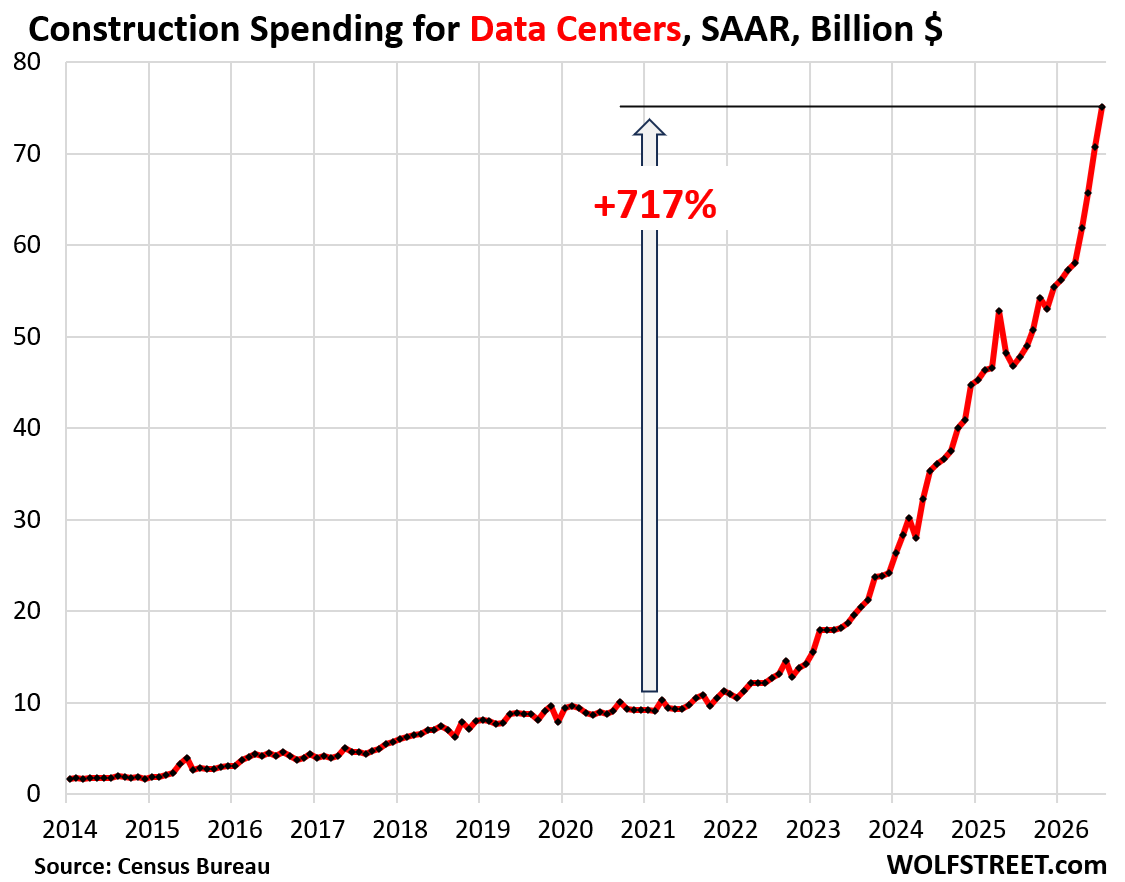
Obviously, these kinds of the-sky-is-the-limit near-exponential curves eventually fizzle. But they can last longer than imagined.
These amounts only reflect the construction costs of the buildings, the improvements around the buildings, and the equipment integrated into the buildings, such as HVAC systems.
The amounts do not include the most expensive parts of a functioning data center: the servers, the racks, the electronic and optical equipment to connect the servers to the internet, the electrical equipment to supply power and cooling to the servers, the power generators, the transmission lines, etc.
To accommodate this mad rush to build data centers as quickly as possible, construction companies and equipment suppliers have developed technologies that speed up the work of building and equipping data centers to get them up and running faster. According to a report by the WSJ, they include:
Custom concrete: “Cement manufacturer Amrize uses predictive modeling to design custom concrete mixes, a process traditionally done through lengthy trial and error; time savings: several weeks.
Robotic concrete driller: “Stanley Black & Decker’s DeWalt brand and August Robotics have created a robot that drills thousands of holes to anchor server racks and other systems to the floor; time savings: six weeks.”
Off-site construction of electrical and mechanical rooms: “Clayco and Turner subsidiary xPL Offsite make modular electrical and mechanical rooms at off-site factories, then truck them to data centers for installation; Time savings: several months.”
Optical cable connectors: “3M makes components for fiber optic cables that allow servers to be connected in seconds, not minutes. A data center can have hundreds of thousands of connectors. Time savings: six months.”
Bottlenecks and shortages have dogged the manufacturers of on-site power generation equipment, especially gas turbines. Companies have started repurposing retired jet engines for on-site power generators. Musk has jumped into the fray to alleviate the shortages for his own data centers. In July, he acquired APR Energy, which makes among other things gas-turbine power generation sets. But the biggest bottleneck for gas turbine manufacturers are the blades and vanes, so Musk confirmed over the weekend that SpaceX will start manufacturing turbine blades and vanes.
Shortages of semiconductors, including memory chips for AI servers, have caused prices of semiconductors to soar, and they have started to spread to consumer electronics, and from there to inflation metrics.
There are now shortages of specialized labor, such as electricians. This kind of sudden maniac spending boom, funded by corporate cash and massive debt and equity issuance, leaves its marks everywhere, including by helping to push up government bond yields as they all compete for the same pool of money.
This drive to build and equip and power up gigantic data centers, no matter what the costs and hurdles, is pulling resources and labor from other projects, and costs are rising, and we’re already seeing it in the inflation data.
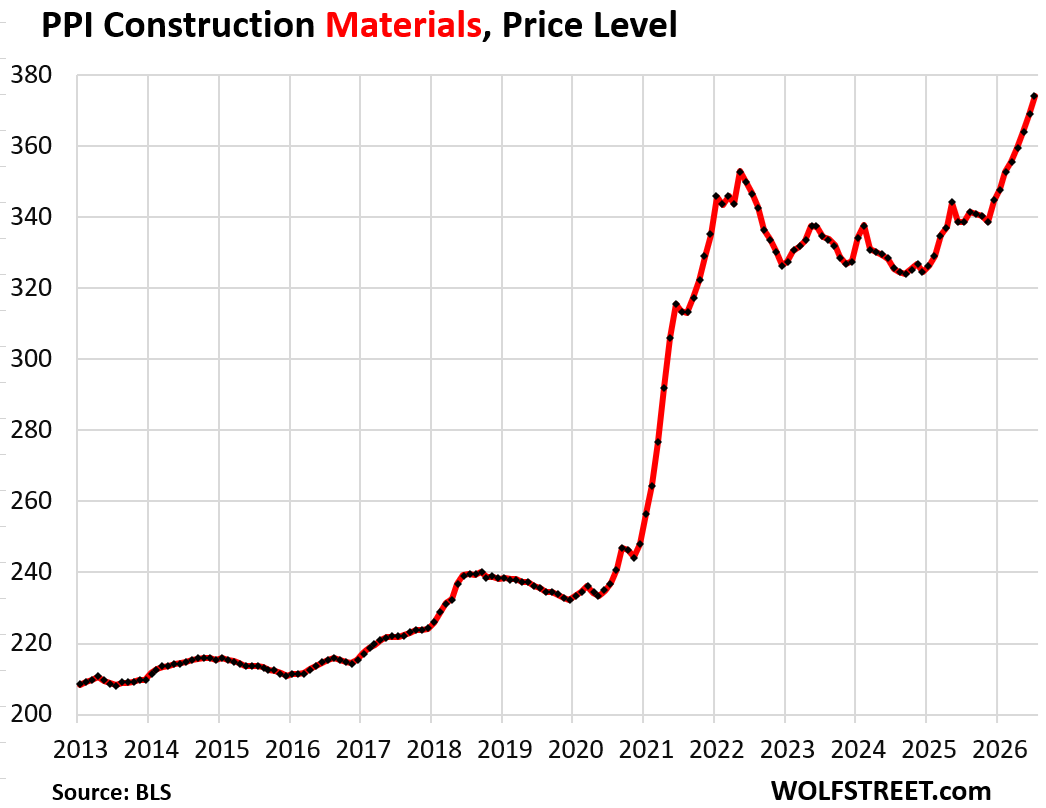
For example, the Producer Price Index for construction materials – steel mill products, concrete, lumber, gypsum, etc. – spiked by 10.5% year-over-year, the biggest increase since June 2022.
Drilling down into the product category level, the PPI for “Fabricated Structural Metal Bar Joists and Concrete Reinforcing Bars” – which includes steel joists and rebar – spiked by 17.7% year-over-year.
Since January 2021, the PPI for construction materials has spiked by 46%; since January 2020, by 58%. This chart shows the price level of the index.
For more, see our analysis: Construction Inflation for Nonresidential Buildings Soars amid AI Investment Mania