Fed leaves rates unchanged as it awaits ’accumulation of more information’


Fed leaves rates unchanged as it awaits ’accumulation of more information’
By Howard Schneider and Ann Saphir
WASHINGTON, Oct 28 (Reuters) - The Federal Reserve held interest rates steady on Wednesday, as expected, opting to delay any changes to borrowing costs until after next week’s US midterm elections while it awaits further data on inflation, which the central bank said "remains elevated."
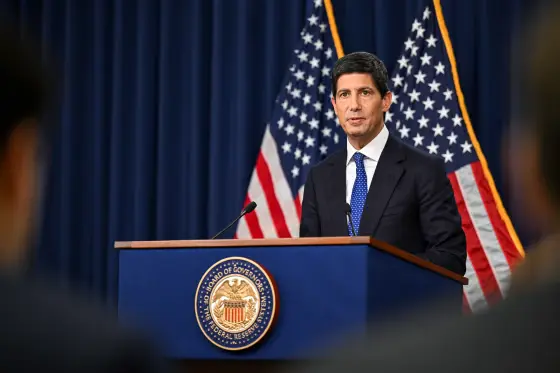
The 10-2 decision to maintain the Fed’s benchmark interest rate within the 3.75%-4.00% range came with an upgraded assessment of an economy that the central bank now says is growing at a "strong pace." Fed Chairman Kevin Warsh also expressed confidence that inflation can be lowered to the 2% target without having to "throw sand in the gears" and slow growth or raise unemployment.
Warsh, speaking at a press conference after the end of a two-day policy meeting, said he expects a report on third-quarter gross domestic product on Thursday to show strong investment and consumer spending and an acceleration of growth from the first half of the year. Warsh, however, said he still does not think the economy is "too hot" or generating demand-side inflation that needs to be curbed.
"The economy is pointing in the right direction. Is the economy running too hot? Is the economy running too strong? That isn’t the judgment of most of my colleagues," said Warsh, arguing, as he has before, that changes in productivity, even predating the artificial intelligence boom, may allow the US to grow faster without as much inflation.
"The goal, in my view ... isn’t to throw sand in the gears of the economy and throw people out of work. I don’t think we have to do that."
Rather, he said, a higher Fed policy rate is already showing its impact in slightly tighter credit conditions that could, for example, slow business investment and which arguably contributed to recent stock market declines, another potential source of "disinflation" if it slows spending among wealthier families.
In comments to CNBC on Thursday, US Treasury Secretary Scott Bessent said the administration continues to have faith that Warsh will "find the right balance" between the 2% inflation goal and continuing economic growth.
The rate-setting Federal Open Market Committee’s latest policy statement, however, hinted that more rate hikes may be needed, and some of Warsh’s colleagues have been explicit in their concerns that demand, fueled by AI and healthy consumer spending, is starting to drive prices higher.
Between now and the next policy meeting in December, "the accumulation of more information will help the Committee determine the policy stance appropriate to ensure a timely return of inflation to the Committee’s 2% goal," the FOMC said. "The Committee will deliver price stability."
TWO FED POLICYMAKERS DISSENT
Fed Governor Lisa Cook, currently being targeted by President Donald Trump for removal from the central bank, cast her first dissent on a central bank policy decision on Wednesday, favoring a quarter-percentage-point rate hike. Cleveland Fed President Beth Hammack, a consistently hawkish voice, also dissented in favor of a rate increase.
Market reaction was muted, with US stocks paring gains slightly after the decision but ending higher on the day. Longer-dated US Treasury yields extended their rise. Short-term interest-rate futures rose a bit, as traders scaled back a bit on bets of Fed rate hikes ahead.
"The forces keeping the Federal Reserve hawkish haven’t faded. Diesel and gasoline prices remain elevated, AI-driven inflation isn’t easing, and the labor market remains resilient," said Michael Pearce, chief US economist at Oxford Economics.
The outcome of this week’s meeting was widely expected after top Fed officials indicated they saw no rush to raise rates again following the quarter-percentage-point increase approved last month, despite inflation data in the meantime that was stronger than forecast and concerns that price pressures are broadening across the economy.
Energy costs remain high, including for diesel fuel, which is a key input for shipping, agriculture and other industries. Inflation and the cost of living in general have been central to the political races that will determine whether Trump’s Republican Party remains in control of both houses of Congress on November 3, or whether Democrats move into leadership positions and gain more robust oversight powers, including over the Fed.
Trump, during his first and second terms in the White House, has excoriated the Fed for failing to deliver big rate cuts. After its decision in September to raise rates, he blamed Warsh’s policymaking colleagues as "hostile" and "partisan."
Warsh told reporters on Wednesday that politics played no role in the decision to leave rates unchanged this week, rebutting, at least indirectly, Trump’s allegation of central bank bias.
Financial markets are still pricing in a couple of additional rate hikes in the coming months, though with slightly less conviction than before Warsh spoke on Wednesday. Pricing shows about an 80% chance of a rate hike at the Fed’s December 8-9 meeting, with another increase in borrowing costs likely by March.
Inflation, which is currently around a percentage point above the Fed’s target, has shown little progress in recent months.
The US central bank has missed its inflation target for more than half a decade, a fact that has left some officials worried that businesses and households are becoming accustomed to faster price increases and may plan for them in ways that will make inflation harder to control.
Related Articles
- World News
Fed expected to hold interest rates steady as inflation tops midterm voters’ concerns
- Economy News
Dollar steady after Fed hold leaves rate path murky
- Forex News
Fed Holds Rates: Why USD Slipped on a Hawkish Pause
- Economy News
Fed’s Warsh says US economy not running too hot
- Economy News
Fed may hold in October, but analysts see a tougher call ahead