Why Is Terra Classic (LUNC) Pumping Today?

Why Is Terra Classic (LUNC) Pumping Today?
The pump currently looks more consistent with a supply-structure repricing than with a broad fundamental usage comeback. The cleanest onchain evidence is that Terra Classic still has a very large token base, but a meaningful part of the non-circulating supply is visibly tied up in staking rather than freely moving through the market.
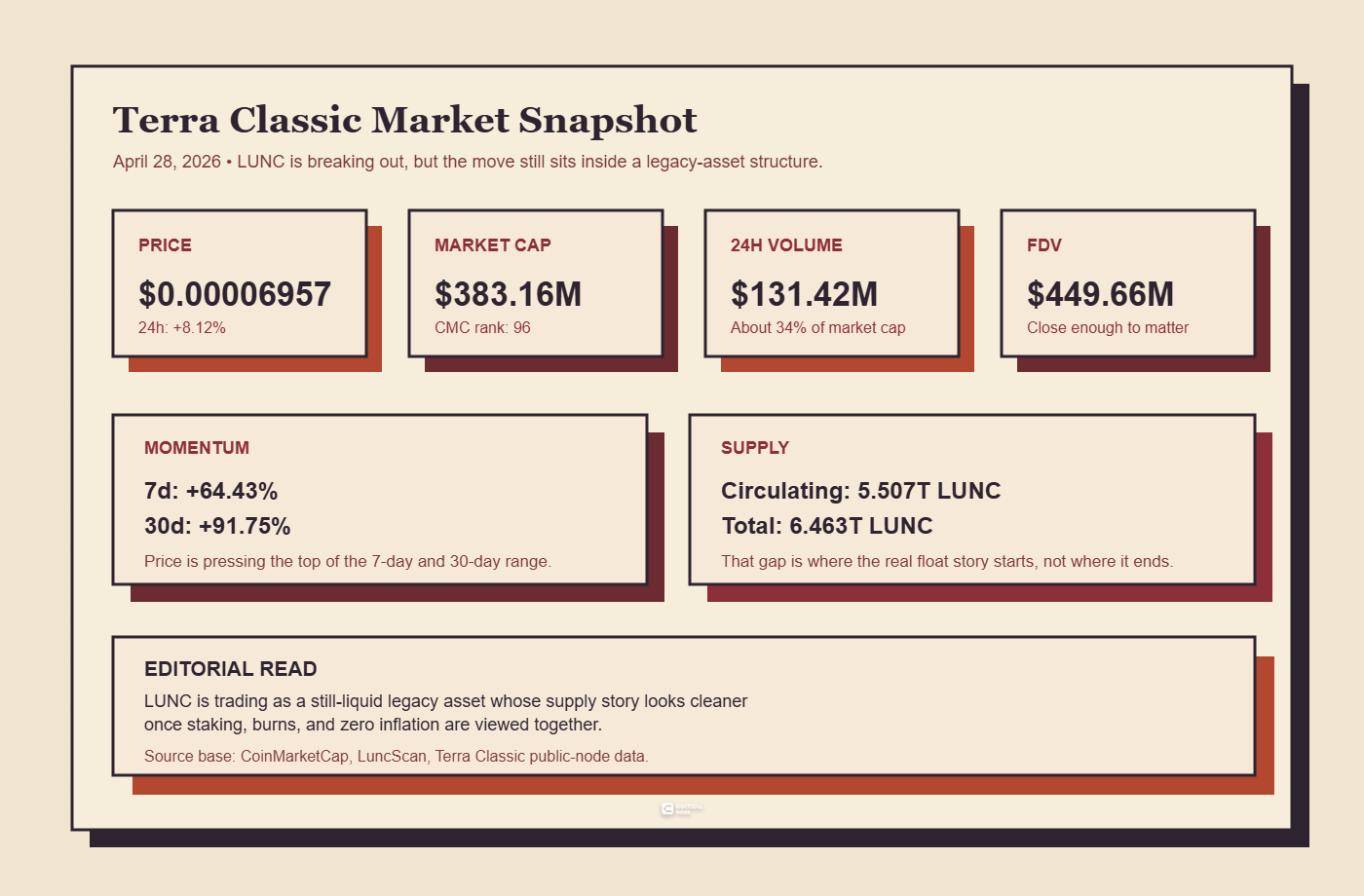
As of April 28, 2026, CoinMarketCap showed LUNC near $0.00006957, up 8.12% in 24 hours, 64.43% in seven days, and 91.75% in 30 days, with roughly $131.42 million in 24-hour volume against a market cap near $383.16 million.
CoinMarketCap currently shows about 5.507 trillion LUNC circulating against about 6.463 trillion total supply, leaving a gap of roughly 955.9 billion LUNC. A direct check of the Terra Classic PublicNode LCD staking endpoint, /cosmos/staking/v1beta1/pool, showed about 932.30 billion LUNC bonded at 08:41 UTC on April 28, 2026, which explains about 97.5% of that gap.
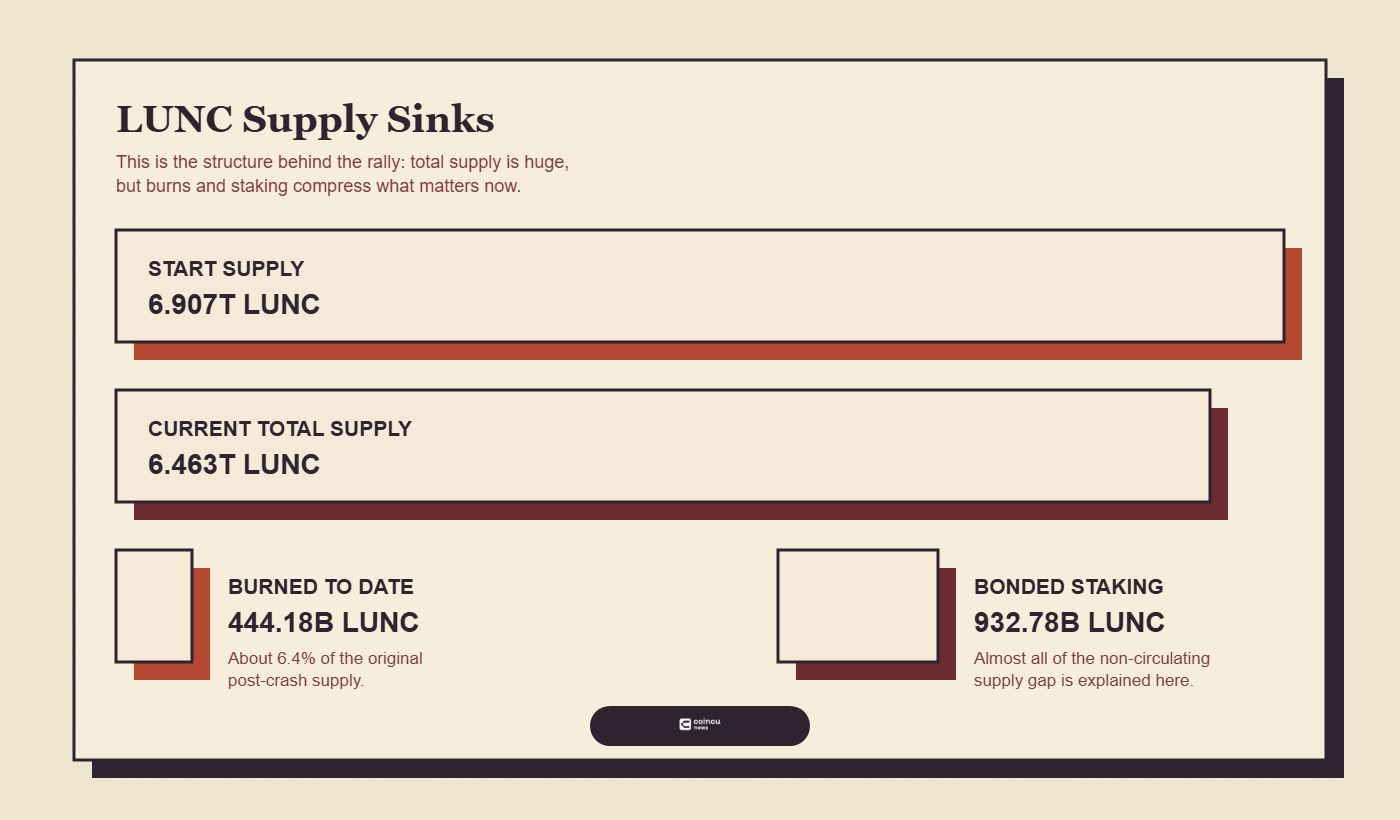
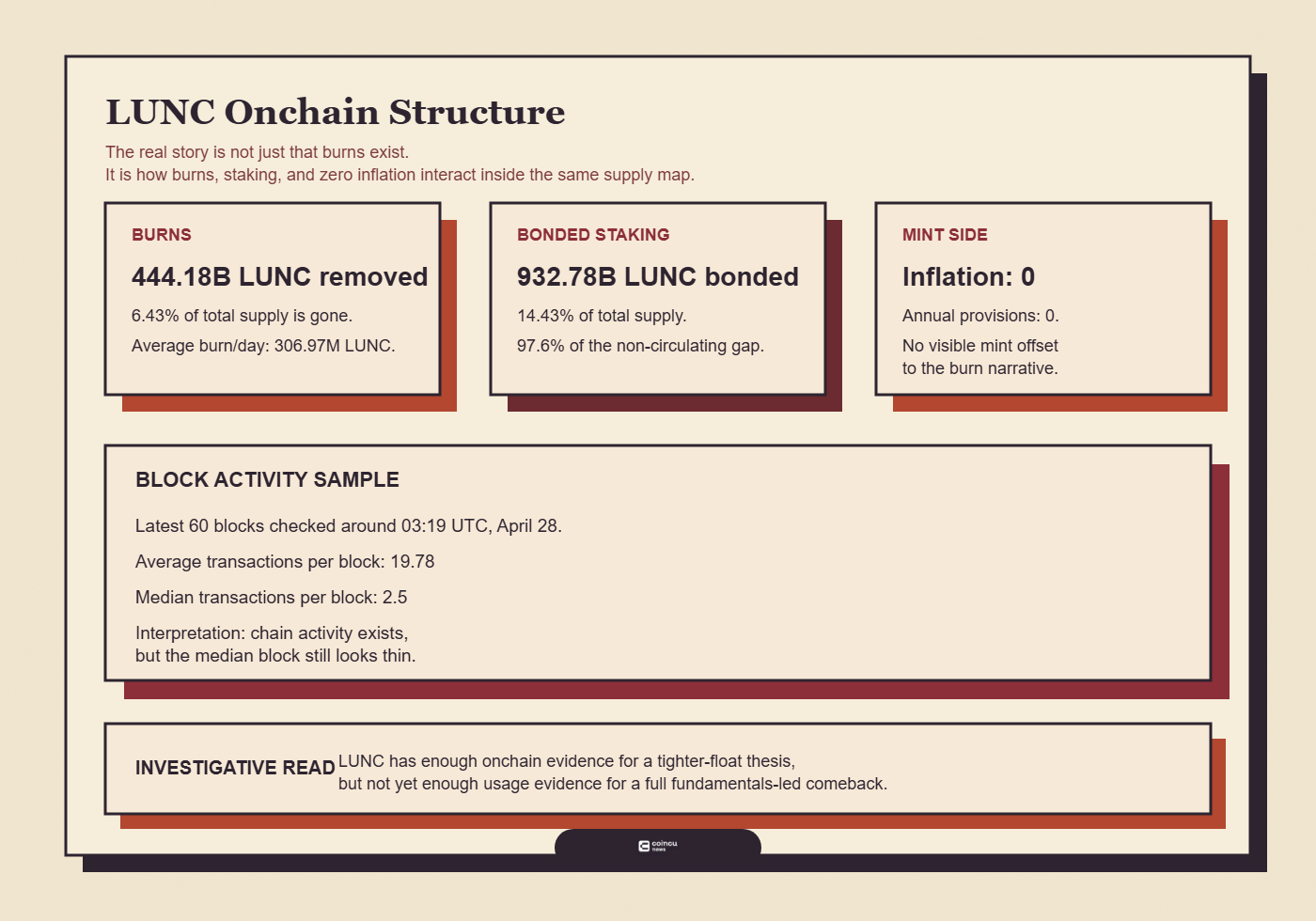
Burns matter too, but they do not explain the whole move by themselves. LuncScan’s burn tracker shows 444.18 billion LUNC burned to date, equal to 6.43% of total supply, while the same tracker shows an average daily burn of about 306.97 million LUNC.
That is real deflationary pressure, but still too slow to justify a near-doubling in 30 days on burn math alone. The more defensible reading is that LUNC is being repriced in a way that is consistent with a post-burn, zero-inflation, heavily staked supply structure becoming easier for the market to notice again.
Table of Contents
Key Takeaways
- LUNC is rising in a way that is consistent with the market repricing a legacy token whose visible float looks tighter than the headline supply first suggests.
- The strongest onchain point is staking, not just burning. Terra Classic’s bonded supply currently explains about 97.5% of the gap between total and circulating supply.
- Burns are real and cumulative. LuncScan shows 444.18 billion LUNC burned to date, but the current average burn rate is still slow relative to a 6.463 trillion supply base.
- The Terra Classic mint module currently reports zero inflation and zero annual provisions, which means burns are not being offset by visible fresh protocol issuance.
Quick Snapshot
Using CoinMarketCap, LuncScan, and direct Terra Classic PublicNode LCD endpoint checks completed at 08:41 UTC on April 28, 2026:
Those numbers point to a market that is still structurally small relative to its narrative. LUNC is trading nearly 0.34 times market cap in daily turnover, and its seven-day high is also its 30-day high. That usually means the market is not simply drifting higher. It is repricing aggressively into a breakout.
What Terra Classic Actually Is
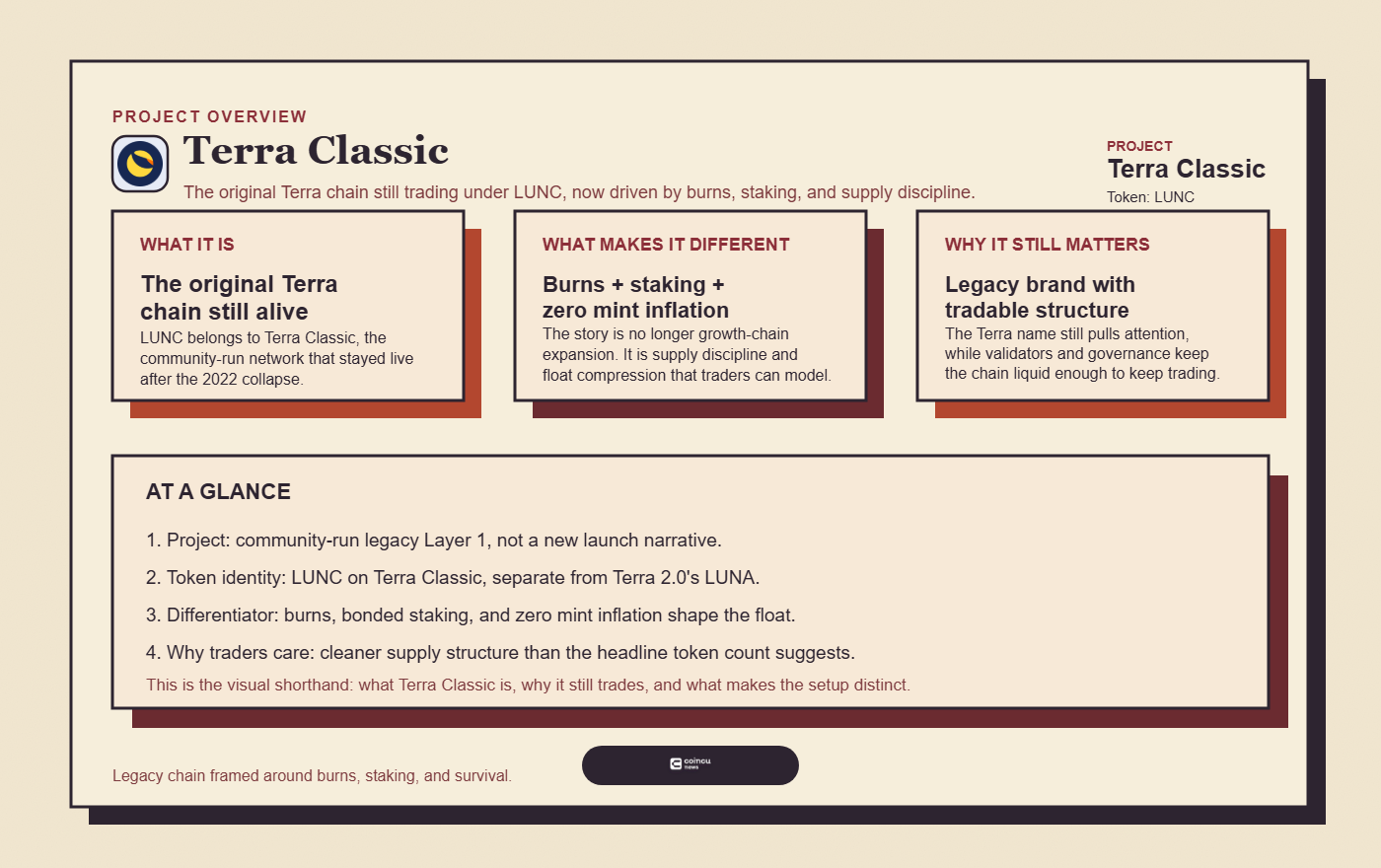
Terra Classic is the community-run chain that remained after the original Terra collapse and the later launch of Terra 2.0. The linked CoinMarketCap page is for that classic chain and its native token LUNC, not for the newer LUNA asset.
That distinction matters because LUNC is no longer trading on a simple growth-chain story. It trades on a recovery-and-supply story. The chain still supports staking, validators, governance, and an ongoing community-maintained ecosystem around the legacy Terra network. The community-run terra-classic.io homepage explicitly frames itself as a resource hub for Terra Classic applications, tooling, and infrastructure, while the official Terra Classic protocol documentation and staking specification show that validator, governance, and delegation mechanics remain live.
That legacy context is also why LUNC still carries unusual reputational baggage. Readers who want a quick refresher on how Terra-related headlines still affect narrative risk can see Coincu’s Do Kwon Faces Possible Second Trial in South Korea and the earlier Coincu market note Terra Classic and Terra Tokens Surge Amid Market Speculation.
The current bull case is therefore not “Terra is back” in the old sense. It is narrower and more technical:
Why LUNC Is Moving Higher
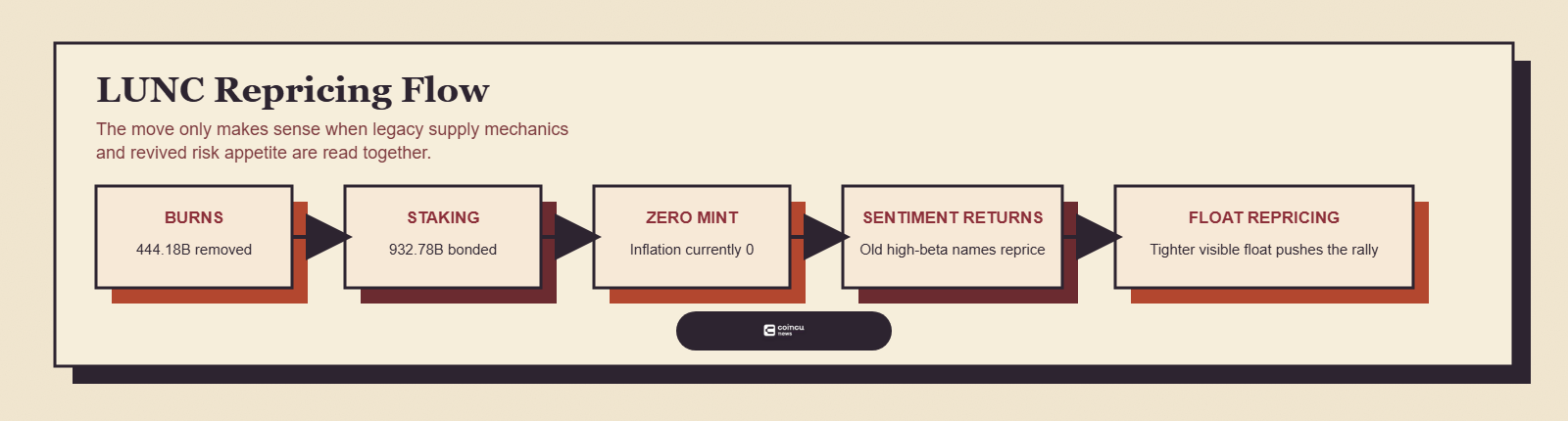
The market is repricing a tighter visible float
This is the clearest structural clue behind the move.
CoinMarketCap currently shows about 6.463 trillion total LUNC and about 5.507 trillion circulating. On its own, that still looks like a huge supply base. But the Terra Classic PublicNode LCD staking endpoint, /cosmos/staking/v1beta1/pool, showed about 932.30 billion LUNC bonded in staking when checked at 08:41 UTC on April 28, 2026. That means most of the gap between total and circulating supply is not abstract. It is visible in the staking layer.
Once that becomes the lens, the recent move makes more sense. Traders are not only looking at a very large total supply. They are looking at a token where a meaningful amount of supply is already burned, another meaningful amount is staked, and the tradable portion can tighten quickly when sentiment improves.
Burns help the story, but staking is doing more of the heavy lifting right now
LuncScan’s burn tracker currently shows 444.18 billion LUNC burned to date, reducing supply from about 6.907 trillion at the start of the post-crash journey to about 6.463 trillion now. That is a real reduction and one of the main reasons LUNC still has a live scarcity narrative.
At the same time, the same tracker shows an average daily burn near 306.97 million LUNC. That is meaningful, but still slow relative to a 6.463 trillion supply base. On burn pace alone, the market does not suddenly justify a 64.43% seven-day move.
The more complete explanation is that burned supply improved the base, while bonded supply appears to be doing more of the live-float tightening that traders actually care about today.
Zero inflation makes the supply narrative cleaner
This is a subtle but important point.
The Terra Classic PublicNode LCD mint endpoints, /cosmos/mint/v1beta1/inflation and /cosmos/mint/v1beta1/annual_provisions, both returned zero at 08:41 UTC on April 28, 2026. That means the protocol is not visibly printing fresh LUNC through the mint module to offset the supply reduction story.
For a market like LUNC, where perception of supply discipline matters more than almost anything else, that is a supportive signal.
Broader risk appetite can amplify the structure
Supply structure only matters when traders are willing to look at it.
Part of the recent backdrop is simply that crypto sentiment has improved enough for old high-beta names to start moving again. That does not prove broader mood caused the rally, but it does help explain why a cleaner supply story can suddenly matter more.
The deeper point is that LUNC did not need a perfect fundamental rebirth to rally. It only needed the market to re-engage with a token that already had a post-burn, post-collapse scarcity narrative sitting under the surface.
Deep Onchain Read
The onchain picture is what turns the LUNC move from a vague meme about burns into a cleaner supply-structure story.
Burned supply is large, but not large enough to explain the whole move alone
Using the LuncScan burn tracker checked at 01:59 UTC on April 28, 2026:
That is enough to prove the deflation story is not imaginary. But it is also enough to show its limits. A 306.97 million daily burn sounds large until it is compared with a supply base still measured in trillions.
Bonded staking explains most of the non-circulating gap
This is the most important onchain clue in the whole case.
CoinMarketCap currently shows about 5.507 trillion LUNC circulating and about 6.463 trillion total supply, leaving roughly 955.9 billion LUNC outside circulating supply. The Terra Classic PublicNode LCD staking endpoint, /cosmos/staking/v1beta1/pool, showed about 932.30 billion LUNC bonded at 08:41 UTC on April 28, 2026.
That means bonded staking alone explains about 97.5% of the total-minus-circulating gap.
That does not make staked LUNC permanently illiquid. Terra Classic’s staking specification still shows a 21-day unbonding time, so bonded supply can eventually come back. But for current market structure, it is a real friction layer between total supply and immediate float.
Mint-side inflation is currently zero
This point is easy to miss, but it matters.
The Terra Classic PublicNode LCD mint endpoints currently show:
That means the chain is not currently offsetting burn and staking narratives with visible protocol-side issuance from the mint module.
This review is strongest on supply structure, not on usage acceleration
This is where the article shifts from narrative to evidence discipline.
A point-in-time spot check of 60 recent Terra Classic blocks can be useful for editorial color, but it is too small to stand in for a broad demand study. This review therefore does not treat short-window block flow as decisive evidence either for or against the rally.
The disciplined reading is that the onchain evidence in this article directly verifies burns, staking, and zero mint issuance. It does not directly verify a broad usage breakout across a longer time window.
What onchain supports, and what remains open
What Could Reverse The Move
The current setup explains why LUNC can move quickly, but it also explains why the rally could cool sharply if the structure changes.
That same release-pressure logic is familiar across crypto. Coincu recently highlighted a different version of it in Arkham Reports Ethereum Foundation Unstaked $48.9M in ETH, where the key question was not whether staking existed, but when supply might come back to market.
Final Read
LUNC is moving higher in a way that is consistent with the market revisiting a token whose supply story is cleaner than many people assume at first glance.
Burns are real, inflation is currently zero, and bonded staking is doing most of the real work in tightening the visible float. That combination is enough to support a sharp repricing when sentiment improves. The strongest single onchain fact is that bonded supply explains almost all of the gap between total and circulating LUNC.
At the same time, the move still looks more like a supply-and-sentiment rally than a fully evidenced onchain fundamentals revival. This review directly proves the supply structure. It does not claim to prove that network usage has already expanded enough to match the speed of the price move.
That does not make the rally fake. It makes it conditional. LUNC is moving because the market sees a tighter live supply structure, not because Terra Classic has suddenly become a high-growth chain again.
Readers who want another Coincu example of a structure-led why-pumping framework can compare this setup with Katana Network (KAT) Jumped 55% in 24 Hours, These 5 On-Chain Signals Explain Why.
Methodology
This review is based on public materials checked on April 28, 2026, including the linked CoinMarketCap Terra Classic page, the LuncScan burn tracker, the Terra Classic community ecosystem hub, the Terra Classic protocol and staking docs, and direct PublicNode LCD queries for Terra Classic. The key supply-side endpoint checks were:
- Staking pool: https://terra-classic-lcd.publicnode.com/cosmos/staking/v1beta1/pool
- Mint inflation: https://terra-classic-lcd.publicnode.com/cosmos/mint/v1beta1/inflation
- Annual provisions: https://terra-classic-lcd.publicnode.com/cosmos/mint/v1beta1/annual_provisions
Those three LCD endpoints were checked at 08:41 UTC on April 28, 2026. This article does not rely on a long-window activity dataset, and any short-window block checks should be treated only as spot observations rather than as a full demand study. Market and onchain figures change quickly, so all values in this article should be read as point-in-time observations.
Disclaimer
This article is for research and informational purposes only and should not be treated as financial advice. Terra Classic remains a highly volatile legacy asset, and narrative-driven rallies can reverse quickly when liquidity or sentiment changes.
SourcesCoinMarketCap, Terra Classic page: https://coinmarketcap.com/currencies/terra-luna/
LuncScan, LUNC burn tracker: https://luncscan.com/burn/lunc
Terra Classic ecosystem hub: https://terra-classic.io/
Terra Classic docs, protocol overview: https://classic-docs.terra.money/docs/learn/protocol.html
Terra Classic docs, staking specification: https://classic-docs.terra.money/docs/develop/module-specifications/spec-staking.html
Terra Classic PublicNode LCD, staking pool: https://terra-classic-lcd.publicnode.com/cosmos/staking/v1beta1/pool
Terra Classic PublicNode LCD, mint inflation: https://terra-classic-lcd.publicnode.com/cosmos/mint/v1beta1/inflation
Terra Classic PublicNode LCD, annual provisions: https://terra-classic-lcd.publicnode.com/cosmos/mint/v1beta1/annual_provisions