What Is USD.AI (CHIP)? How the AI-Credit Protocol Works

What Is USD.AI (CHIP)? How the AI-Credit Protocol Works
What makes USD.AI interesting is that it sits at the intersection of synthetic dollars, real-yield products, and private-credit style AI infrastructure finance. It is also what makes the project harder to evaluate than a simpler DeFi protocol, because the thesis depends not only on token demand but on underwriting, legal enforceability, borrower quality, and whether AI hardware finance becomes a durable crypto narrative.
Key Takeaways
- USD.AI is not just an AI token. It is a synthetic-dollar and yield protocol tied to AIinfrastructure credit.
- CHIP is the governance and utility token, which means buyers are pricing exposure to the protocolnarrative, not just a standalone asset.
- The project stands out because it combines synthetic dollars, yield products, and GPU-backedcredit into one structure.
Table of Contents
What USD.AI Is
The clean way to read USD.AI is to separate the protocol from the token.
The asset trading on CoinMarketCap is CHIP, but CHIP is not the synthetic dollar itself. It sits above a broader system designed to connect depositors, a savings layer, and AI-infrastructure borrowers.
At a high level, the structure looks like this:
That distinction matters because many readers instinctively compare CHIP to a stablecoin or to a generic DeFi launch token. Neither comparison is quite right. CHIP functions more like the speculative and governance layer sitting on top of the protocol’s monetary and credit engine.
The deeper thesis is that USD.AI wants to connect three demands that usually live in separate conversations:
The project is therefore not just saying “hold a dollar and earn yield.” It is saying that the yield side can be connected to a specific real-economy financing market, namely AI compute infrastructure.
How the machine is supposed to work
Depositors enter the USD.AI system through the dollar side, those dollars connect to a credit engine, that credit engine is aimed at financing AI infrastructure borrowers, and the yield from that system then supports the savings layer. CHIP sits above that structure as the token that governs and captures protocol-level upside if the whole mechanism grows.
In other words, the protocol is trying to connect:
- onchain dollar demand
- onchain yield demand
- offchain-or-hybrid AI infrastructure credit demand
into one stack.
That is precisely what makes the protocol more interesting than a normal launch and, at the same time, harder to evaluate. A simple stablecoin can mostly be judged on backing and redemption, whereas USD.AI has to be judged on backing, redemption, credit quality, legal enforceability, and borrower demand all at once.
Why the market can take this seriously
A lot of launch tokens tell a big story and show almost no operating surface underneath. USD.AI is different enough that the market can at least point to something real.

Public operating metrics are already visible:
Those numbers do not prove the token is cheap. They do prove that the story is not empty. That alone is enough to separate CHIP from the average AI-narrative launch.
Where USD.AI fits in the current market map
One reason this section needs more context is that crypto narratives in 2026 are not all competing in the same lane. Recent market attention has tended to cluster around a few recognizable categories:
USD.AI matters because it does not fit cleanly into only one of those boxes. It looks partly like Ethena because it has a synthetic dollar plus a savings wrapper, partly like the Pendle era because it sells a yield narrative rather than just a token narrative, and partly like Maple and other credit or RWA protocols because it is trying to monetize a real financing activity. At the same time, it differs from the perp category in a crucial way: it is not winning through pure trading velocity or fee reflexivity.
That last distinction is important because perp protocols are easy for the market to understand: more traders bring more fees, more attention, and a stronger token narrative. USD.AI runs on a slower, more institutional loop in which more credible borrowing demand should lead to more financed infrastructure, more sustainable yield, more trust in the dollar layer, and only then more value attributed to the governance token.
So why could it become more important from here?
USD.AI will probably not become a top-tier market story by trying to look like a perp exchange or a meme coin. It can only become important if the market decides that AI infrastructure finance deserves its own premium narrative.
That is not a crazy idea.
The reason is that AI infrastructure is increasingly being financed like a capital market, not just like a tech product category. Clifford Chance’s 2026 note on data centres and AI compute infrastructure explicitly points to the rise of GPU lease finance and large-scale GPU-collateralised credit structures. USD.AI is trying to build an onchain version of exposure to that world.
If the market keeps rotating toward:
- onchain real yield
- tokenized private credit
- AI infrastructure rails
- and systems with real economic throughput behind the token
then USD.AI becomes easier to understand and easier to re-rate higher.
And why might it fail to become a true trend?
The bearish case is not hard to see. USD.AI may simply be too complex for broad retail attention.
Perp exchanges are easy to explain. Users trade. Fees are generated. The token narrative is immediate. Synthetic-dollar systems are also relatively easy to explain once the user understands the hedge. Yield trading protocols at least have a simple user promise: lock fixed yield or speculate on future yield.
USD.AI asks the market to understand a more complicated chain:
A synthetic dollar, a yield-bearing wrapper, GPU-backed borrowing, legal tokenization of hard assets, queue-based redemptions, and a governance token sitting above all of it. That can absolutely work with sophisticated capital.
But it may struggle to become a broad retail trend unless one of two things happens:
Either the protocol starts showing unmistakably strong growth in deposits, loans, and revenue, or the market starts treating AI compute financing as one of the major investable narratives of the cycle. That is the key tradeoff.
USD.AI is not simple enough to go viral on structure alone. It has to earn attention either through real traction or through a bigger macro narrative around AI infrastructure finance.
Why It Is Different
The easiest way to misunderstand USD.AI is to treat it like just another synthetic-dollar protocol. That is too shallow. USD.AI is really trying to combine three layers that are usually discussed separately:
That is the core distinction. This is not only a tokenized-dollar story. It is a compute-financing story wrapped inside a synthetic-dollar system.
What is genuinely different here
From the public docs, USD.AI stands out in four ways:
None of that guarantees success, but it does show that the protocol is trying to solve a harder and more differentiated problem than a normal yield-bearing stablecoin.
What The Website And Docs Actually Show
One useful filter for projects like USD.AI is simple:
- if the website only sells a story, the token usually trades like a story.
- USD.AI’s public site and docs show a fuller operating surface than that.
What a user can actually see from the public product stack
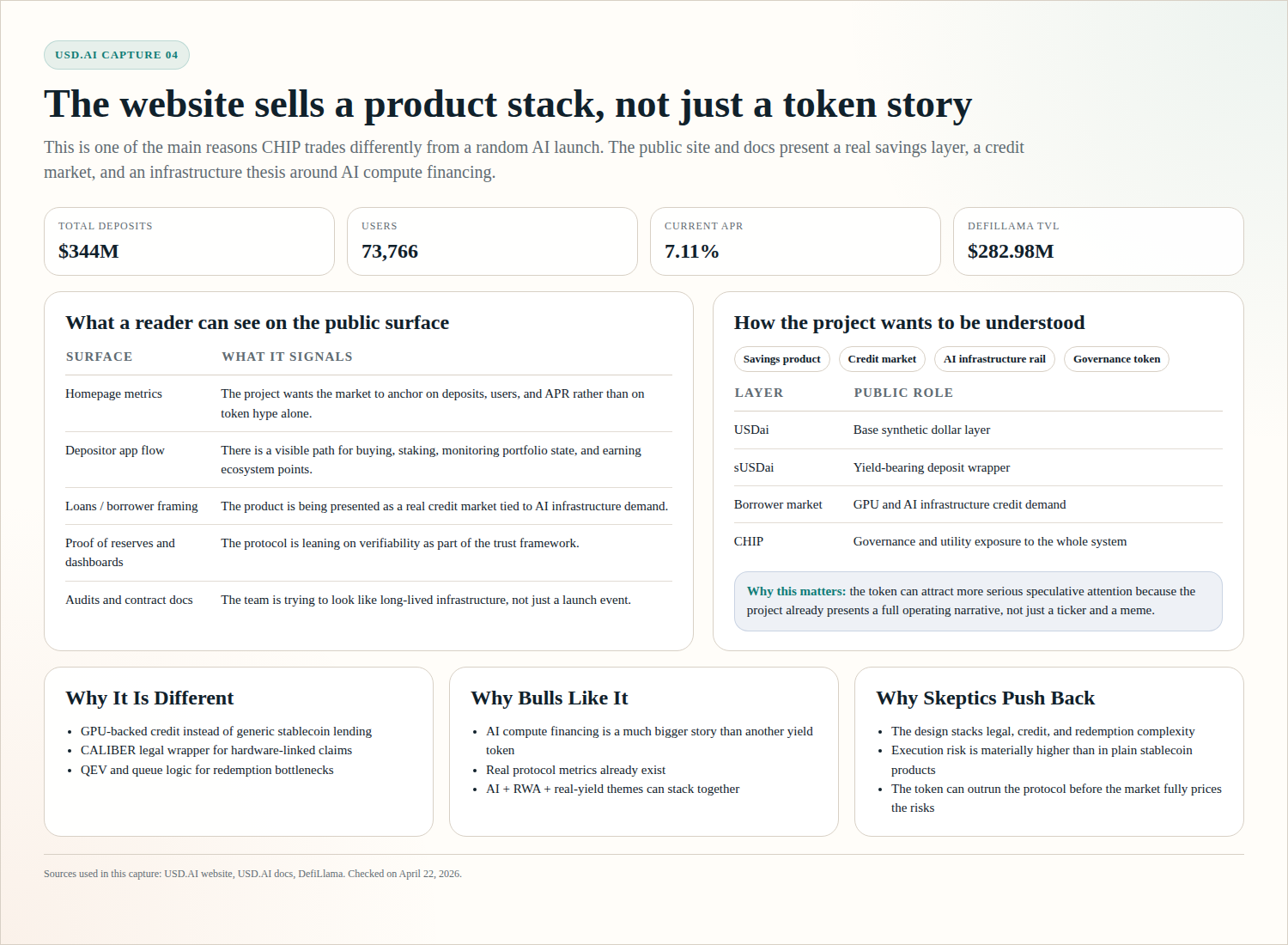
From the website and docs, the protocol is already presenting multiple live surfaces:

Raw homepage screenshot from USD.AI checked on April 22, 2026, showing the live product framing around deposits, users, APR, and the protocol’s AI-credit positioning.
What that means in practice
The public product experience suggests USD.AI wants to be understood in three roles at once:
Altogether, that is a more serious surface area than what you usually see in a short-lived listing pump. It still does not prove the economics are durable, but it does explain why traders can justify giving this launch more attention than they would give to a narrative-only token.
Is This Already A Trend, Or Just Trend-Adjacent?
The best answer is:
USD.AI is not the main retail trend by itself yet, but it sits directly inside two trends that are very real in 2026.
Trend 1: Real-world asset and private-credit tokenization
This is a live trend, not a hypothetical one.
The broad RWA market has continued to scale in 2026, and private credit is one of the strongest segments inside it. Framed that way, USD.AI becomes easier to understand as an RWA or private-credit project first, a stablecoin and yield product second, and only then an AI narrative token.
Trend 2: AI infrastructure financing is becoming a real capital market
This is the more important trend for the long-term thesis.
Clifford Chance’s 2026 data-centre financing note says the market is increasingly financing data centres as compute-first infrastructure rather than simple real estate, and explicitly highlights the rise of GPU lease finance and multibillion-dollar GPU-collateralised credit programmes.
That supports a broader inference that AI hardware financing is increasingly being treated as its own capital market rather than as a side note to software growth, which is exactly the lane USD.AI is trying to occupy on-chain.
So is USD.AI “in trend” right now?
Yes, but in a specific way.
Right now, USD.AI is best described not as a mass-retail mega-trend, but as a high-quality trend-adjacent narrative with a real chance to become stronger if AI infrastructure finance keeps institutionalizing. If the market stays focused on fast meme rotation, it may remain only a niche but credible story; if the market instead starts rewarding AI infrastructure rails, tokenized private credit, real yield, and asset-backed financing, the narrative can strengthen from here rather than fade.
Tokenomics And Supply Structure
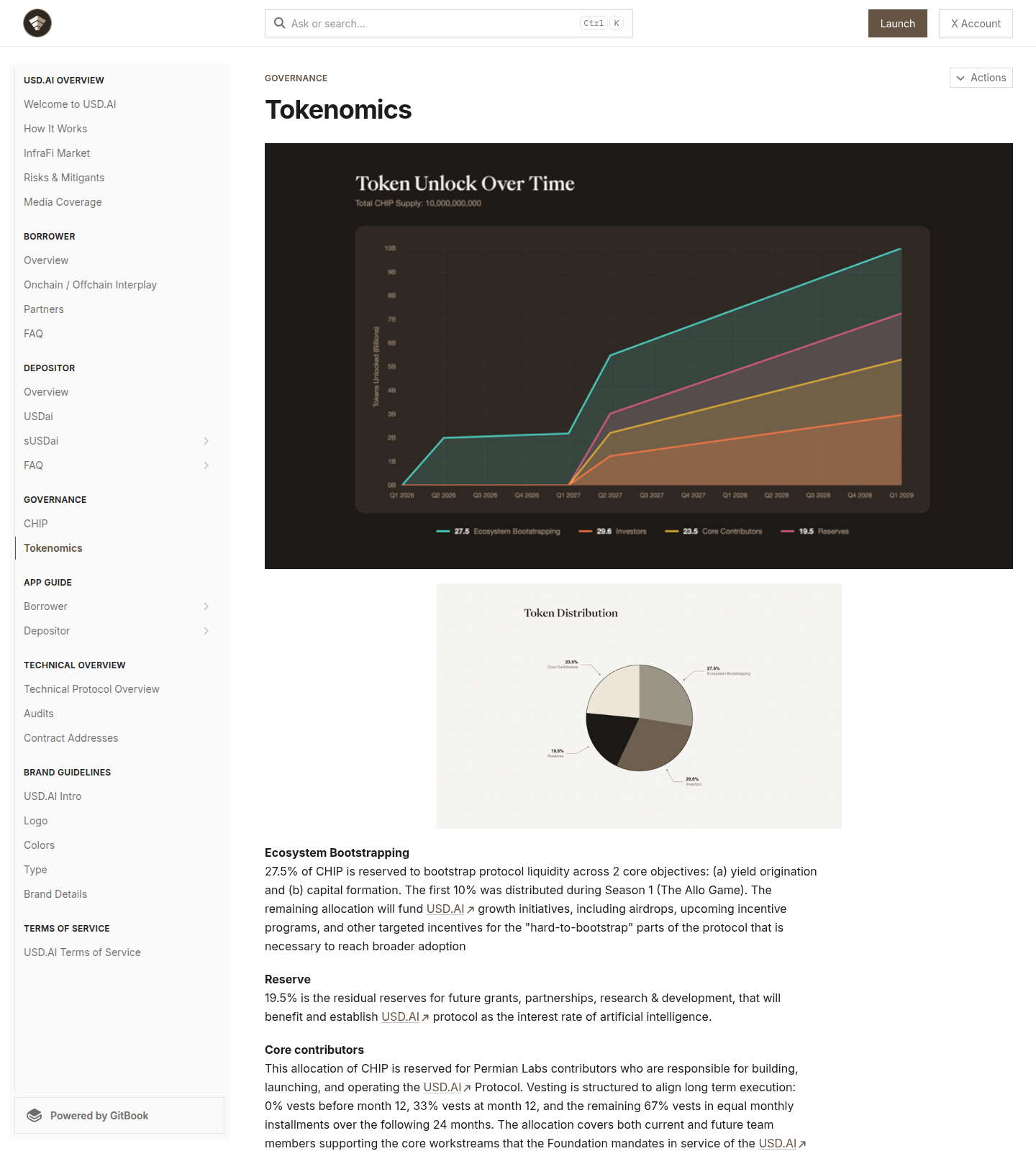
The tokenomics matter here because CHIP is not moving inside a fully open float.
It is moving inside a managed float.
What is confirmed publicly
From CoinMarketCap, CoinList, and USD.AI docs:
Why this structure matters more than the headline supply
There are three tokenomics tensions sitting on top of each other:
As a result, CHIP can look legitimate on a protocol basis, bullish on a narrative basis, and still dangerous on a market-structure basis.
What this means for price behavior
In a normal token, a bigger float can stabilize price.
In CHIP, the current tokenomics do the opposite by creating room for launch squeezes, keeping traders focused on the visible float instead of full supply, and making every new listing or venue expansion more important.
This is also why future unlock perception matters even before actual unlocks arrive.
If the market believes most near-term supply is still boxed away, it will price CHIP like a scarce launch asset. If the market starts believing more sale or treasury-linked inventory is reaching exchanges, the same structure can reverse fast.

Why the Market Is Watching
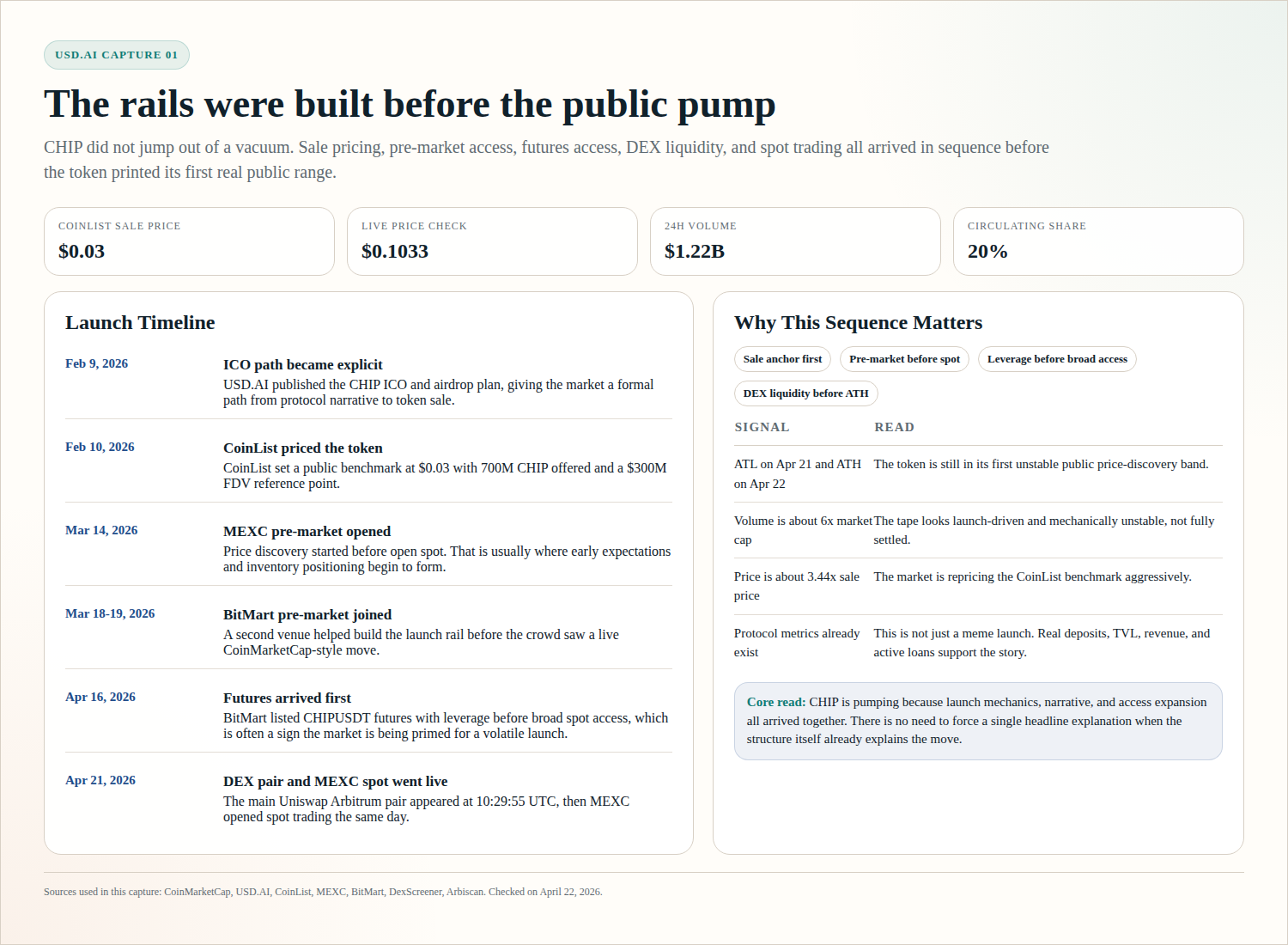
The cleanest explanation for the pump is not one news item. It is the sequence.
This is the strongest parallel with RAVE.
In both cases, the market move did not appear from nowhere. The rails existed before the public explosion.
Final Read
USD.AI matters because it is trying to occupy a lane that crypto still has not fully priced: onchain exposure to AI-infrastructure finance through a synthetic-dollar and savings framework.
That does not make the project safe by default. It remains complex, execution-heavy, and dependent on both credit quality and market trust. But it does make the protocol more substantial than a typical AI-themed token launch. The website, docs, and tokenomics all point to a system that is attempting to build a real financing stack rather than a simple speculative wrapper.
The clean conclusion is that USD.AI is best understood as a specialized yield-and-credit protocol whose main bet is that AI compute becomes an investable financing market onchain. If that broader market matures, the project becomes easier to value and easier to explain. If it does not, CHIP may remain interesting but niche.
SourcesCoinMarketCap, USD.AI market page: https://coinmarketcap.com/currencies/usd-ai/
USD.AI website: https://usd.ai/
USD.AI docs, CHIP tokenomics: https://docs.usd.ai/faq/usdchip/tokenomics
USD.AI docs, technical overview: https://docs.usd.ai/technical-overview/technical-protocol-overview
USD.AI docs, contract addresses: https://docs.usd.ai/technical-overview/contract-addresses
USD.AI article, CHIP ICO and airdrop: https://usd.ai/insights/chip-ico-airdrop
USD.AI article, Foundation and CHIP: https://usd.ai/insights/usdai-foundation-chip
CoinList blog, USD.AI token sale: https://blog.coinlist.co/announcing-the-usd-ai-token-sale-on-coinlist/
CoinList sale page: https://coinlist.co/usdai
MEXC pre-market announcement: https://www.mexc.com/announcements/article/mexc-pre-market-trading-17827791534233
MEXC spot listing announcement: https://www.mexc.com/announcements/article/first-in-market-17827791534985
BitMart pre-market announcement:
BitMart futures announcement:
DefiLlama USD AI page: https://defillama.com/protocol/usd-ai
Clifford Chance, Data Centres & AI Compute Infrastructure Insights 2026: https://www.cliffordchance.com/content/dam/cliffordchance/briefings/2026/03/data-centres-and-ai-compute-infrastructure-insights-2026.pdf