Crypto Fear And Greed Index: Is The Bitcoin Crash Over?

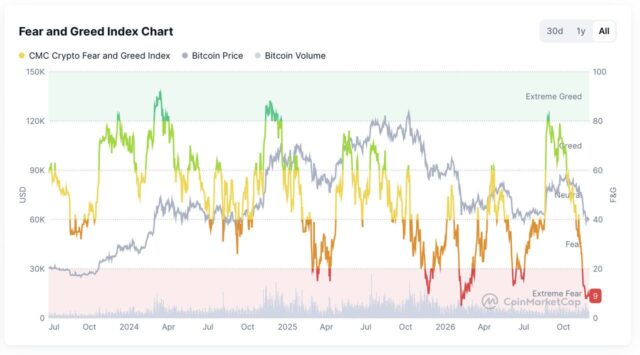
- CoinMarketCap’s Crypto Fear and Greed Index read 9 out of 100 on Saturday, reportedly its 16th straight day in extreme fear.
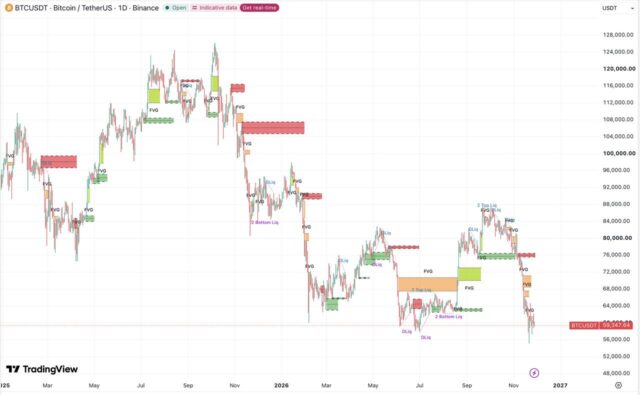
- Bitcoin briefly approached $55,000 last week, a two-year low.
- Extreme fear is partly a product of falling prices, so it is a weak buy signal on its own.
- In March, Alternative.me’s index stayed in extreme fear for 35 days even as BTC recovered above $72,000.
- Monday’s ETF flows, exchange activity and futures positioning will say more about a real bottom than the fear score.
The crypto market has reportedly spent 16 consecutive days in extreme fear, with the latest CoinMarketCap Crypto Fear and Greed Index snapshot showing a score of just 9 out of 100 on Saturday.
For anyone who has spent the past few weeks watching Bitcoin crashing through levels that once looked like reliable support, the latest reading is hardly surprising.
Bitcoin briefly approached $55,000 last week, hitting a two-year low and prompting renewed speculation that the Bitcoin crash could finally be approaching its bottom.
The argument for buying at these levels is familiar: when everyone is afraid, prices are supposedly cheap.
Unfortunately, the market has never been particularly interested in rewarding investors simply for being contrarian.
Bitcoin Fear And Greed: What Extreme Fear Actually Tells Us
The Crypto Fear and Greed Index combines five categories of market information, including price momentum, expected volatility, options positioning, market composition and investor activity.
Some of those inputs deserve more attention than the headline number.
The ratio of put to call options, for example, offers insight into the demand for downside protection. Implied volatility reflects how large a price movement options traders anticipate. Meanwhile, deteriorating price momentum can push sentiment lower even without a significant change in investor expectations about Bitcoin’s long-term prospects.
A reading of 9 does not necessarily mean the market is irrationally pessimistic. It may simply mean investors have good reasons to be cautious.
There is also a problem with treating extreme fear as an independent buying signal. Falling prices contribute to lower sentiment readings in the first place.
Using that reading alone to conclude that Bitcoin must now be undervalued risks drawing two conclusions from essentially the same market development.
Bitcoin Has Been Here Before, And Fear Did Not Disappear Overnight
Earlier this year, the market experienced an even longer stretch of pessimism.
On March 5, Bitcoinist reported that Alternative.me’s Bitcoin Fear and Greed Index had remained in extreme fear for 35 consecutive days, even though BTC had recovered above $72,000.
Alternative.me and CoinMarketCap use different methodologies, so their scores should not be treated as interchangeable. Nevertheless, the March episode highlights something worth remembering: Bitcoin does not need investors to become optimistic before prices can recover.
Equally, a recovery does not guarantee that confidence will return.
This is where the distinction between a relief rally and a genuine market bottom becomes important.
A heavily shorted market can rebound sharply when bearish traders close their positions. That buying pressure can push Bitcoin higher without attracting significant new investment.
A more sustainable recovery requires buyers willing to absorb the supply coming onto the market beyond the immediate burst of short covering.
The sentiment index cannot tell us whether those buyers have arrived.
Is The Bitcoin Crash Creating A Real Buying Opportunity?
The bullish argument is not without merit. Lower prices can improve the long-term risk-to-reward proposition for investors who still believe in Bitcoin’s underlying investment case.
But there is a considerable difference between finding an attractive entry price and accurately identifying the market bottom.
With traditional financial markets closed for the weekend, Monday’s trading session will provide another opportunity to assess institutional demand through spot Bitcoin ETF flows. Exchange activity and futures positioning could also help determine whether a recovery is being supported by new capital or merely the unwinding of existing trades.
Those developments deserve more attention than whether the fear index climbs from 9 to 15.
Buying when everyone else is afraid can be a profitable strategy. Buying because everyone else is afraid is not much of a strategy at all.
The crypto market may be approaching an attractive accumulation period, but extreme fear alone is not enough evidence to declare the Bitcoin crash over.