Business rates revalution paused after outcry

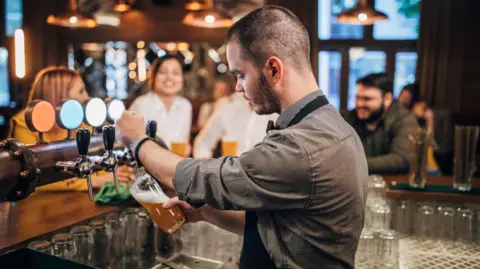
Finance Minister John O'Dowd has announced a pause in the process which would have seen large rates increases for many in the hospitality sector.
Draft property revaluations published last week by Land and Property services would have seen some businesses facing hugely increased rates bills from 1 April.
The pause announced by the minister means that will not happen – with next year's business rates calculated using the current valuation. For many businesses any change in the rates bill will now be much smaller.
O'Dowd defended the overall revaluation process as essential in ensuring fairness in the rates system, but said that this pause was focused on allowing "local businesses to thrive".
Inflation, post-Covid customer numbers, staff shortages were all major challenges faced by pubs and restaurants in the last few years.
First Minister Michelle O'Neill has acknowledged many pubs and restaurants were "getting it tight".
Some feared that potential rates increases could be the final straw.
From the Harbour View Hotel, in County Antrim, whose manager cast doubt on its ability to manage, to Canavan's bar and restaurant in County Tyrone, who described it as a slap in the face, the concern was widespread.
Published last week, a draft list of property valuations showed a marked increase for some businesses.
Those figures had meant some businesses were likely to see thousands of pounds in extra bills from 1 April.
The possibility of increased rates bills came after an exercise called Reval 2026, carried out by Stormont's Land and Property Services (LPS).
More than 75,000 non-domestic properties were revalued as part of a new list used in calculating business rates - an annual property tax that helps fund public services.
The draft revaluations, which will be used to calculate rates from 1 April, showed an 85% increase in the total value of hotels, while pubs have risen 47%.
Sharon Gallagher, chief executive of LPS, told a Stormont committee on Wednesday that calculating rates bills was "not about winners and losers".
She said many pubs and hotels had received temporary Covid allowances to reflect suppressed trading, but their removal was a "necessary part of restoring fairness and consistency" across LPS rates valuations.
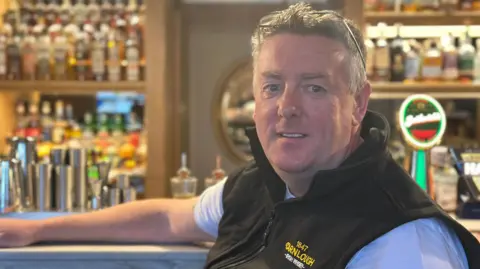
Adrian McLaughlin, manager of Carnlough's Harbour View Hotel, said it would be very difficult to absorb the rate bill increase.
The best way, he said, would be by additional sales or by cost reductions - but it's much harder to cut costs in 2026.
"They're much harder to come by because of National Insurance increases, utilities increases and the cost of goods.
"So, it's becoming very, very, difficult for us to find the space to accommodate large, incremental increases like this."
Colin Johnston, chief executive of the Galgorm Collection, estimated that the Galgorm resort's rates bill was set to go up from £585,000 to almost £1.5m - about £66,000 a month extra.
"To expect anyone to deal with this in eight weeks' time doesn't work, so there needs to be transitional relief and then some of the business genuinely needs looked at," he had told BBC News NI.
Canavan's in Ballygawley, in County Tyrone, took to social media to air its frustration about the revalation.
"Your pint has increased in price by 92%.
"Your room for the night is now nearly double the price it was yesterday, for no apparent reason.
"You wouldn't accept those price increases from us, but this is the hand which we have been dealt."
Gavin Bates, owner of Ryan's Bar in Belfast, said its rates would go £33,000 for the year under the revaluation.
"It's huge on our business, we haven't budgeted for it.
"We've got supplier pricing coming and we are already looking at putting a small increase on our drinks."

The rates valaution increases were not across the board - they would have affected some bars and restaurants. But for those affected, it could have led to price hikes.
Pearse Deeney, owner of The Bridge House in Park, County Londonderry, said they would have to look at putting up prices, not long after a price increase a couple of months ago due to drink supplier costs going up.
He told BBC Radio Foyle's North West Today programme that customers were already fed up.
"It's too expensive to go into a bar now, that's just the way it is," Deeney said, adding that he believed people would be put off going out for a drink.
Colin Neill, from representative body Hospitality Ulster, had warned that the measure would be the "ruination of the hospitality industry".
This week it was announced that pubs and music venues in England will be given a 15% discount on their business rates bills from April and will not see increases for two years.
It followed a backlash against November's Budget, which left many facing major increases in their business rates bills, and led to more than 1,000 pubs banning Labour MPs from their premises.
Sean McLaughlin, director of the Fullerton Arms and Guesthouse Inn in Ballintoy, told BBC Radio Ulster's Evening Extra programme that people in the hospitality sector work "extremely hard", adding: "I think this is a very unfair and inequitable process that has been put upon us at this stage."
"It's not just as easy as raising the price. That's the thing that we have to measure very difficulty every day, there's a fine line between profitability, feasibility and what customers can and are willing to pay," he said.
"We've seen decrease in terms of people going out, they're only going out now for more special occasions. People tell me they don't have the money."
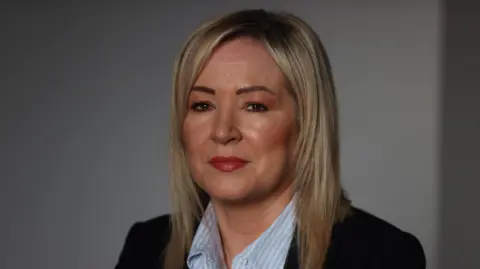
Speaking earlier, Michelle O'Neill acknowledged that "we need to work together to support our hospitality sector, in particular, to get through this period".
She said the finance minister was due to meet the sector to "find a way forward that allows us to support local businesses".
Previously, O'Dowd had defended the rates revaluation process as "fair and equitable".
The first minister said O'Dowd has set out "£10m in additional support for our small businesses to try to help them get through this period".
Democratic Unionist Party (DUP) assembly member Philip Brett said it was essential that any funding received by Stormont as a result of the bailout package for pubs in England "is ring-fenced here for the same purpose".