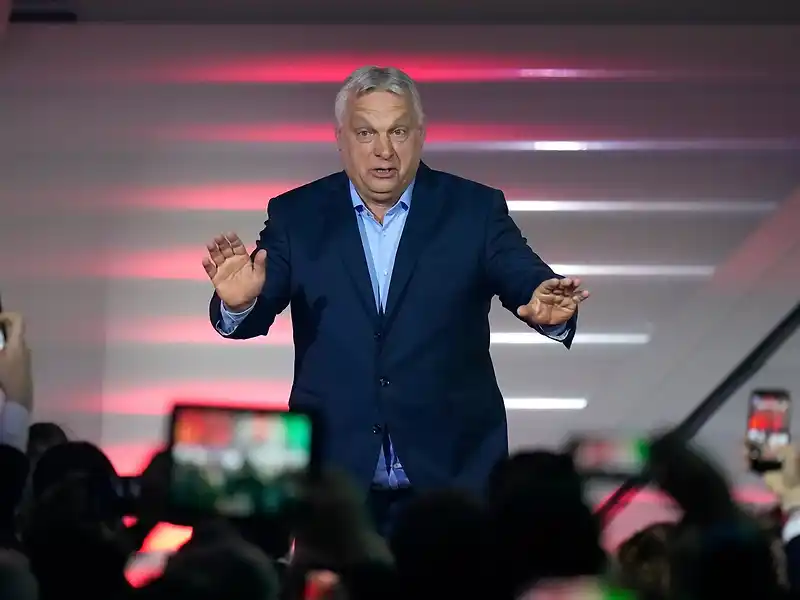
University hounded out of Hungary by Orbán reaches out to new government


Prospect of partial return to Budapest by Central European University suggests confidence in Hungary’s future A university that Viktor Orbán tried to chase out of Hungary is open to expanding its presence in Budapest, in a mark of confidence in the country’s democratic future. Carsten Q Schneider, the interim president and rector of Central European University (CEU), said it was interested in...
A university that Viktor Orbán tried to chase out of Hungary is open to expanding its presence in Budapest, in a mark of confidence in the country’s democratic future.
Carsten Q Schneider, the interim president and rector of Central European University (CEU), said it was interested in increasing its programmes in Budapest, as long as this did not damage the student experience.
So far the CEU has not held formal talks with Hungary’s new government, which has promised to restore academic freedom, “but our hand is reaching out, their hand is reaching out – it is just that they have many things to do”,the academic told the Guardian.
The CEU relocated its main activities to Vienna from Budapest in 2019, after pressure from the previous government led by Orbán. But the outlook changed when Péter Magyar won a landslide victory in April pledging to root out corruption and reform the state.
The CEU, founded by Hungarian-American financier and philanthropist George Soros in 1991 to entrench democratic change in the region, was forced to cease awarding degrees in Budapest in response to a law widely seen as targeting the institution.
The EU’s highest court struck down Hungary’s “Lex CEU” in 2020, finding that it violated the EU charter of fundamental rights, but the verdict came too late for the university. The CEU retains 312 staff in Budapest, mostly administrative, but the majority, 476, and all its teaching, are in Vienna.
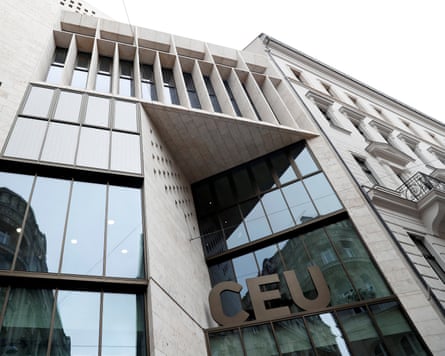
Schneider said upgrading the status of the CEU, which is privately funded, in Budapest would be“a symbol for academic freedom [and] of resilience” but depended on goodwill and funding independent of the Hungarian government. He said a decision on its future in Hungary would be taken by the CEU’s 13-member board, whose members include Soros and his son, Alexander Soros.
“We don’t want special treatment,” Schneider said. ‘“We are a great asset, so let’s work out something.”
But the CEU, which he said was “thriving tremendously” in Vienna, does not plan a wholesale return to Budapest. Any change would have to ensure the quality of the student experience, for instance, assuring that students would be able to combine courses, say in economics and history, without having to travel the 200km-plus distance between the two cities.
Focused on social sciences, law and humanities, the CEU has more than 1,400 students from 103 countries, mostly doing master’s and PhD programmes.
According to Schneider, for the first time in the CEU’s 25-year history, students from the US now make up the largest cohort of master’s students (10%). The CEU has seen an increase in US applicants since Donald Trump returned to the White House and launched a sweeping campaign against elite universities, including slashing federal funding and seeking to exert control over internal policies.
The CEU rector has had informal talks with US academics on how to maintain academic freedom under pressure from rightwing populists. He described his message as: “Don’t be naive for a second. These people have a plan, so it’s not by accident that they attack universities. They want to have cultural hegemony.” He added, however, that Trump and allied movements, such as Germany’s Alternative für Deutschland, have identified “real problems”, such as in the US how universities have entrenched “a reproduction of elites”
When coming under political pressure, he said universities needed “to look for allies”, among other academic institutions, students, alumni and parents. Institutions also had to stand up for disciplines under attack, such as gender studies, Schneider added.
He recalled the outpouring of support for CEU – when tens of thousands of people protested in Budapest in defence of the university – as “one of the most humbling experiences I have had”.
Schneider, a German political scientist who specialises in the study of democracies and regime transition, said Magyar had successfully used Orbán’s political machine against him.
“Nobody has a better idea than [Magyar] how to defeat the most potent and the most skilled illiberal populist [Orbán]. So he knows something.” He added: “The people and skills that you need to bring a non-democratic regime down are not the same and sometimes the opposite of what it takes to establish a democracy. So the question now is whether he [Magyar] has the skills to basically reinvent liberal democracy for the 21st century.”
Schneider said Hungary could be the world’s first “post-illiberal democracy” – a model for democratic restoration, just as Orbán inspired rightwing populists around the world. But he also raised doubts about this thesis, saying there were questions about how Magyar and his Tisza party might develop in the context of Hungary’s “very difficult economic situation”.
The test would be, he suggested, when Magyar faces losing support and, eventually, defeat at the ballot box. “So what happens when he loses support and then cracks in his movement appear? Will he be the visionary leader who manages … to establish a three, four, five-party system, where people compete? That is to be seen.”
Related Articles
 World News
Viktor Orbán's brother detained for suspected human trafficking
- Politics News
Both sides of the Atlantic sense more hope: voters are drawn to the ‘politics of love’ | Alexander Hurst
- World News
Hungarian police reportedly detain brother of ex-PM Viktor Orban
- World News
Hungarian authorities detain ex-PM Viktor Orbán’s brother for suspected human trafficking
- World News
Viktor Orbán’s brother detained in people-smuggling investigation, Hungarian PM says