Dow closes higher after erasing 1,100-point loss as S&P 500, Nasdaq slip

U.S. equities pared major losses on Wednesday as fresh tariff proposals rattled Wall Street ahead of the Thanksgiving holiday.
The Dow Jones Industrial Average staged a dramatic comeback, ending the session up 164.25 points, or 0.33%, after falling 1,100 at session lows. The tech-heavy Nasdaq Composite fell 0.62%, while the S&P 500 closed 0.25% lower.
Macroeconomic and trade pressures compounded the earlier tech-driven sell-off. The Trump administration proposed new duties on a wide range of imports from 14 major U.S. trading partners, including China, following a probe into excess industrial capacity. China faces the steepest levy at 20%, which would stack on top of roughly 25% tariffs enacted during President Donald Trump's first term.

The tech-heavy Nasdaq Composite plunged 3.75% on Wednesday. (Michael Nagle/Bloomberg via Getty Images)
Renewed trade friction – combined with rising oil prices linked to the unresolved U.S.-Iran war – has complicated the inflation picture. Traders are currently pricing in a 97% probability of a Federal Reserve interest rate hike in December and a 63% chance of another increase in January, according to CME Group's FedWatch tool.
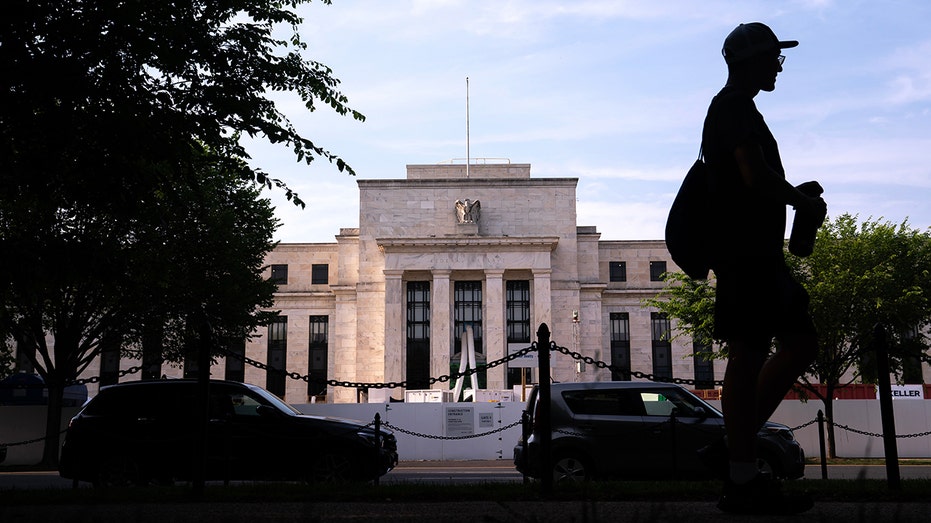
The Federal Reserve's preferred inflation gauge ticked higher in October as central bank policymakers weigh an interest rate hike next month. (Nathan Howard/Bloomberg)
The Federal Reserve's preferred inflation gauge ticked higher in October as central bank policymakers weigh an interest rate hike next month.
The Commerce Department on Wednesday reported that the personal consumption expenditures (PCE) index rose 0.3% on a monthly basis in October and was up 3.8% from a year ago. Both figures were in line with the expectations of economists polled by LSEG.
However, the core PCE index — which excludes volatile food and energy costs and serves as the Fed's primary inflation yardstick — climbed 3.3% annually, slightly ahead of the 3.2% forecast, alongside a preliminary third-quarter GDP reading showing 4.3% economic growth.
In corporate movers, semiconductor and Big Tech "hyperscaler" names were lower, erasing the brief relief sparked earlier in the week by CEO Jensen Huang's reinstatement at Nvidia after his removal earlier this month.
Nvidia fell 3.91% after dropping 5.9% on Tuesday, while Advanced Micro Devices dropped 1.75% and Micron Technology lost 4.57%.

Nvidia CEO Jensen Huang speaks on stage during the Invest in Germany Summit in Berlin, Oct. 19, 2026. (Reuters/Lisi Niesner/File)
U.S. markets will be closed Thursday for Thanksgiving and will operate on a shortened session Friday.
Reuters contributed to this report.