Stocks set for rebound after AI-driven selloff pushed major indexes into correction
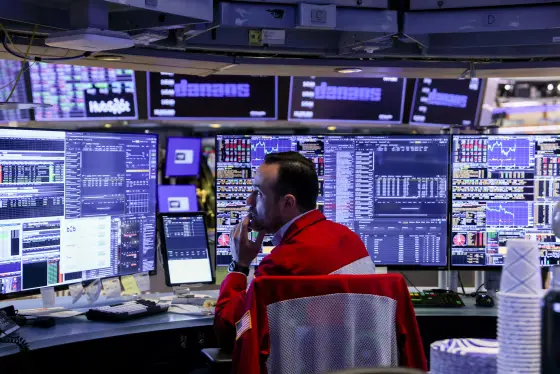
Major U.S. stock benchmarks surged in early trading on Monday, as Wall Street sought a rebound after AI-linked stocks dragged major indexes into correction territory on Friday.
Futures that track the S&P 500 rose 2.5%, while future contracts that follow the Nasdaq 100 index soared 3.5%.
Dow futures showed that the index was set to rise more than 1,000 points at the opening bell at 9:30 a.m. ET in New York.
Those moves would be sharp bounce backs from significant selling seen on Friday, driven largely by AI-linked stocks.
The Nasdaq 100, which was already in correction territory on Friday, suffered its worst one-week drop since 2020 and wiped out its gains for this year. Meanwhile, the S&P 500 and Dow fell into correction territory, a 10% drop from their most recent record highs.
The S&P 500 has seen little upward momentum recently, having fallen for seven straight days, its longest run of down days since the Covid pandemic began in February 2020, noted Deutsche Bank’s Jim Reid.
The broad selling started in earnest on Thursday once shares of frontier AI developer Anthropic made their market debut. While the company’s shares posted a 17% jump in its first day, shares closed less than $6 away from its IPO price on Friday.
Almost as soon as shares began trading on midday Thursday, investors saw tech stocks, chip companies and major indexes decline sharply. Anthropic shares were higher by 4% in pre-market trading on Monday.
“Last week was brutal,” said Ed Yardeni, a widely respected Wall Street watcher and founder of Yardeni Research.
He said that he had “expected a pullback” but got more than he bargained for. Yardeni sounded a note of optimism though, writing that he doesn’t think last week’s moves into correction territory will become a “bear market, simply because we don’t see an impending recession.” A bear market is when an index or stock falls 20% from its last record high.
Still, Yardeni, one of the most optimistic analysts on Wall Street this year, cut his year-end S&P 500 target for the second time since September. He now sees the benchmark index ending 2026 at 7,500, which would be a gain of more than 8.5% from current levels. As of Friday, the S&P 500 is holding on to a less than 1% gain for the year.
Some analysts are warning that even if this is ultimately a correction and doesn’t lead to a more dramatic bear market or worse, “the process may still take time,” as Deutsche Bank’s Reid wrote on Monday morning. “Similar volatility shocks have typically taken 6-8 weeks to subside,” he wrote, adding that “history would argue that further downside and volatility remain plausible before a durable bottom forms.”

Also providing headwinds for the market, Nvidia is facing its own troubles after the removal of its CEO, Jensen Huang, who departed the company after admitting that he was unfaithful to his wife. One of the women who Huang allegedly had a relationship with was a Chinese asset, which has thrown the company whose products effectively underpin the entire AI boom into turmoil.
Nvidia shares sank almost 23% last week, deepening its losses for the year to 33%.
The revelations related to Huang have reportedly sparked an SEC investigation of the company, according to multiple reports. Nvidia did not respond to requests for comment, while the SEC declined to comment on Friday regarding the reports.
The selling in Nvidia shares have also driven its peers lower. “The fear is that tighter export controls will lower the demand for chips and depress their prices,” said Yardeni of the drop in chip stocks.
But in early trading, just like Nvidia, chip stocks also were poised for a major rebound. An ETF that tracks the Philadelphia Semiconductor index rose 6%, while an ETF that follows companies that make computer memory and storage rose 9%.
One of the potential candidates to replace Huang at Nvidia took himself out of the running on Monday. Arm Holdings announced early Monday that CEO Rene Haas signed a new contract that runs through 2033. Shares of Arm, one of Nvidia’s largest peers, jumped 10% in pre-market trading.
European stocks also traded sharply higher on Monday, with the benchmark stock index in Germany rising 1%, as did the European-wide Stoxx 600 index. Stocks in France and the U.K. were higher by about 0.8%.
Major indexes in Asia broadly ended lower as those markets effectively caught up to Friday’s U.S. trading action, however the sharp gains in U.S. futures helped boost Asian indexes off their worst levels overnight.
After falling at the end of last week, U.S. Treasury yields also rose early Monday. Treasuries are often seen by investors as a safe haven in times of market turmoil, leading to higher demand and lower yields.