Neighbour of new Montenegro embassy in London sues council over impact on mental health


Case in Pimlico is latest instance of tensions between small countries seeking a space in capital and residents It is not a classic neighbour-from-hell dispute, what with the protagonist inviting everyone over for evening drinks and canapés. But the sudden conversion of a five-bedroom family home in Pimlico, central London, into the embassy of Montenegro has triggered a neighbourhood row that has...
It is not a classic neighbour-from-hell dispute, what with the protagonist inviting everyone over for evening drinks and canapés. But the sudden conversion of a five-bedroom family home in Pimlico, central London, into the embassy of Montenegro has triggered a neighbourhood row that has gone all the way to the desk of a high court judge.
The first stirrings of trouble came when one resident argued in a submission to the council this spring that the new embassy’s “flagpole and rather tacky-looking flag stick out like a sore thumb” among Cambridge Street’s Grade II-listed homes.
A second person, who described Montenegro’s red flag with gold border as “gaudy”, suggested the embassy was “out of keeping with the quietly dignified” whitewash late-Regency frontages designed by Thomas Cubitt.
Some of those critics, frustrated by the lack of planning application before the installation of the embassy flagpole and plaque, were somewhat placated when drinks were put on by the chargé d’affairs of the west Balkans state. “Perhaps it would have been diplomatic to have done that at the start,” one resident commented drily.
But the party did not convince everyone, and an involuntary nextdoor neighbour to the embassy has now taken matters to the courts.
Diana Simpson, 35, a Stanford graduate who lives with her parents on Cambridge Street, is suing Westminster city council. She is applying for judicial review and potential damages on the grounds that when the embassy did belatedly seek planning permission for its change of use and flagpole, the local authority failed to take into account the impact on her mental health of the arrival next door of Montenegro, a country that has been involved in recent scrapes with Russia.
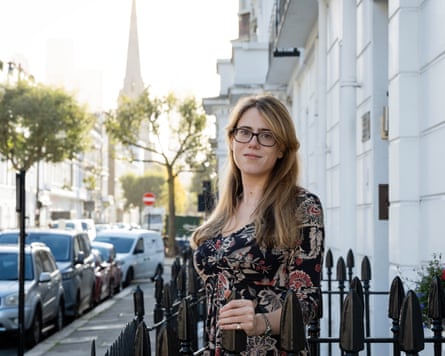
Simpson, the daughter of a former US diplomat who has lived on the street for more than three decades, is in receipt of disability benefits after being diagnosed with clinical anxiety, long Covid and a functional neurological disorder. So unsettling has the arrival of the embassy been to Simpson that her nights are regularly affected, she claims in her statement of grounds.
She alleges: “I frequently feel the need to sleep in an alternative to my lifelong bedroom, to gain some marginal relief; sometimes pre-emptively, sometimes in the middle of the night when I cannot reason with my activated primal ‘fear’ brain response (for example, upon hearing a creak, and immediately fearing an intruder accessing my room from the embassy, despite knowing the possibility is very slim and that this response is mostly irrational).”
Citing breaches of the human rights and equality acts, Simpson has said she had considered whether it “remains tenable for me to continue to live in this house, which I had anticipated having the option of living in for the rest of my life”, adding that leaving would wrench her from a “local tight-knit community”.
Simpson told the Guardian she was confident in her case, which alleges the council failed to take into account her conditions, acted irrationally and delivered a flawed public consultation by having a closed mind to objections after the Foreign Office gave its permission.
In its defence statement, Westminster city council denies the allegations and writes: “There is no plausible interference with the claimant’s home or her private and family life.” The council is seeking a summary judgment without a hearing.
The case in front of Justice Mould for consideration is perhaps unusual but it has highlighted a more common clash between smaller countries – as they move their embassies due to rent hikes or landlords selling up – and the residents of some of London’s more affluent streets.
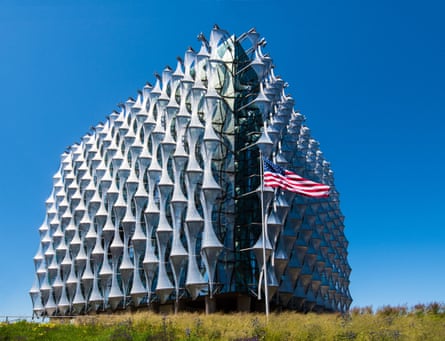
The US has its London home in an intimidating purpose-built 12-storey cube structure south of the Thames. But for most of the major nations the natural home is Belgravia or perhaps South Kensington, Knightsbridge and Mayfair. There is a tendency for the lower-tier states to want to be close to these luminaries but spend not quite the same sums on rent.
It is for that reason that Montenegro has alighted in Pimlico, near Victoria coach station, and the Turkmenistan embassy has recently opened in another adapted family home on Victoria Road, in Kensington but a telling 1.4 miles from the splendours of France’s home opposite the Natural History Museum.
The move by Turkmenistan has led to some rancour, too. “I cannot understand the lack of courtesy afforded to immediate neighbours,” submitted one local to a Royal Borough of Kensington and Chelsea consultation. “I will find out if anything untoward has taken place and, if so, further newspaper action might be necessary.”
The correspondent added of the house in which the embassy is now located, which is owned by Tengku Fahad, 32, the Eton-educated son of the late king of Malaysia, that another location should be found for Turkmenistan, a former Soviet republic in central Asia.
“I was quite happy with the late king of Malaysia [who] lived there and I believe the property is still owned by his son,” she wrote. “We had a family living there for four years who left a while ago for tax reasons but the house has not long been vacant … I have no doubt that they are very pleasant people but, however you bill it, I for one don’t feel totally safe and the idea that there be signage and a flag up leaves me speechless.”
When approached at her home, the complainant, who asked not to be named, said the Turkmens had turned out to be “actually quite quiet” and there had been no problems “so far”.
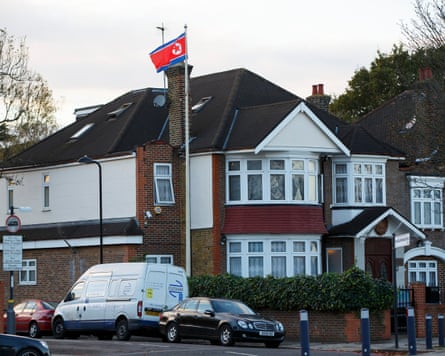
Risks of such local hostility and scrutiny appear to have led some nations to go another way. North Korea has for two decades had an embassy in something of a place of exile in a seven-bedroom 1920s home off the A406 in Ealing, west London.
Colin Flood, a retired solicitor who lives two doors down, said they never heard a peep from them. A workman renovating the house next to the North Korean delegation added: “They are lovely people – we tidied up their greenery at the front and hope to get more work. Lovely people.”
Related Articles
- World News
What Vucic’s defeat means for Serbia’s foreign policy
- World News
British man, 21, who founded his own country receives award from the United Nations
- World News
Italy sends hundreds of soldiers to Milan for protest, one of many planned across Europe
- Politics News
Keir Starmer's government discussed moving out of 10 Downing Street
- World News
Student movement takes Serbia's Vučić to the wire in neck-and-neck election