Ebola outbreak in DR Congo: More die as WHO warns that numbers will rise further

The World Health Organization (WHO) says there have now been 600 suspected cases of Ebola and 139 suspected deaths, with numbers expected to rise further given the time taken to detect the virus.
Fifty-one cases have now been confirmed in the Democratic Republic of Congo - where the first case was reported - and two in neighbouring Uganda, WHO chief Dr Tedros Adhanom Ghebreyesus said on Wednesday.
Speaking to journalists in Geneva, he said the outbreak of the Bundibugyo species of Ebola was likely to have started "a couple of months ago".
On Sunday, the WHO declared a public health emergency of international concern, but said it was not at pandemic level.
Ghebreyesus said that after meeting on Tuesday, the health organisation's emergency committee agreed the situation was "not a pandemic emergency".
"WHO assesses the risk of the epidemic as high at the national and regional levels and low at the global level," he explained.
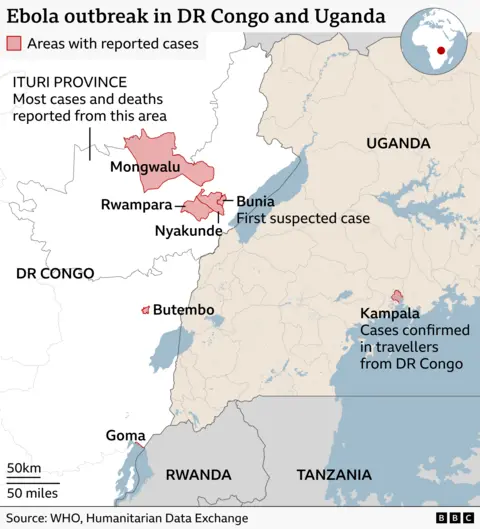
The 51 cases confirmed in DR Congo are in its eastern Ituri province - the epicentre of the outbreak - and the North Kivu province. Of the two confirmed in Uganda's capital, Kampala, both had travelled from DR Congo.
"We know the scale of the epidemic in DRC is much larger," the WHO chief added.
The first known case was a nurse who developed symptoms and died on 24 April, in Ituri's provincial capital Bunia.
The body was repatriated to Mongwalu, one of two gold-mining towns where the majority of cases have been reported.
Four areas in Ituri have been affected by the outbreak: Mongwalu, Bunia, Rwampara and Nyakunde.
In North Kivu, rebel-controlled Goma, eastern DR Congo's biggest city and Butembo have reported cases.
DR Congo is facing its 17th outbreak of Ebola, but the Bundibugyo species - which has not been seen for more than a decade - brings its own difficulties.
Bundibugyo has only caused two previous outbreaks, when it killed about a third of those infected.
There is no approved vaccine for Bundibugyo, but experimental ones are in development. It is possible that a vaccine for another species, Zaire - which the country has dealt with on numerous occasions - may offer some protection.
There are also no drugs that target Bundibugyo, making it harder to treat.
Eastern DR Congo is also badly hit by years of conflict, bringing additional difficulties in dealing with the virus.

Go to BBCAfrica.com for more news from the African continent.
Follow us on Twitter @BBCAfrica, on Facebook at BBC Africa or on Instagram at bbcafrica