Is there still hope for democracy in the Middle East?
Across wide swaths of the Middle East and North Africa (MENA), politics is perennially gasping for air inside a tightening web of geopolitical chokepoints. From maritime blockades to besieged cities and scorched farmland, much of the region is not merely experiencing a political recession; it is enduring structural strangulation.
Much like the Strait of Hormuz bottleneck, where geographic constriction turns localised friction into a global crisis, overlapping social and political precariousness across MENA locks states into a governance impasse, foreclosing pathways to democratic recovery.
In a landscape scarred by unrelenting carnage, speaking of “democratisation” through monotonous, sanitised Euro-American scripts feels less like political science and more like a performative distraction. Yet, it is precisely at this grim crossroads of brutal violence and systematic silencing that “repurposing democratisation” matters most.
Genuine democratic renewal in MENA requires breaking free from imported templates to reclaim the region’s own intellectual traditions and homegrown strategies of reconciliation.
Double standards and the ghost of colonialism
Democratic renewal in the region requires understanding why classic models of democratic transition failed and confronting the lingering ghost of empire.
At the turn of the millennium, dominant Western academic and policy circles triumphantly declared the “end of history”, marketing liberal capitalism as humanity’s destiny.
Applying neoliberal prescriptions to a region marked by entrenched external dependency and severe democratic deficits did not foster organic reform. Instead, it reinforced asymmetric power dynamics through which Western financial, political and security institutions continued to regulate and discipline the periphery.
Speaking from a detached, “all-knowing” vantage point, hegemonic theorists treated the region as a blank slate, dismissing its rich histories and legal traditions as mere “local culture” to be decoded by Western experts. Mainstream international frameworks painted Arab societies as inherently “pathological”, rebranding subtle civilising missions as “democracy promotion”.
MENA societies were forced to define freedom through what Kenyan writer Ngugi wa Thiong’o warned was the captive discourse of the coloniser. As a result, they remained alienated from their own historic practices of communal accountability and sovereignty.
Today, those one-size-fits-all models have shattered under glaring double standards. Nowhere is this more apparent than in the decision of major Western states to trade any pretence of democracy promotion for the hard security goal of policing migration, funding compliant rulers as outsourced border guards.
Not only is the West increasingly turning its back on its own discourse of democratic values abroad, but it is itself suffering from a crisis of democracy at home. Consecutive reports by the Gothenburg, Sweden-based Varieties of Democracy (V-Dem) Institute have documented a relentless wave of democratic erosion, with 74 percent of the world’s population now living under autocracies, dragging the global average back to 1978 levels.
This process is hollowing out major democracies from within, with the United States falling from 20th to 54th place in V-Dem’s 2026 rankings, alongside severe backsliding in countries like the United Kingdom and Italy.
Regional chokepoints
Against this backdrop of global democratic retreat, MENA faces intersecting military, economic, and ecological chokepoints that severely threaten its democratic prospects.
From the genocide in Gaza, which has killed over 74,000 Palestinians since October 2023, to the Israeli ground attacks on southern Syria and Lebanon, the suffocating blockade of Taiz in Yemen, and the US-Israel war on Iran that closed the Strait of Hormuz, cascading conflicts have aggravated already dire humanitarian conditions across the region.
Meanwhile, neoliberal austerity and protracted conflict have squeezed common citizens out of the economy, leaving Arab youth unemployment averages stuck at roughly 25 to 30 percent — one of the highest rates globally — while devastating livelihoods from Libya in the west to Iraq and the Gulf in the east.
At the same time, acute ecological crises, from chronic water scarcity and desertification to toxic pollution, have emerged as urgent political flashpoints in what is already the world’s most water-stressed region, where more than 80 percent of the population is exposed to extreme water scarcity.
Crushing economic pressures, deep public trust deficits, and predatory regional rivalries actively weaponise these chokepoints. When external power brokers, regional militias, and ecological collapse threaten water, food, borders, and survival itself, technocratic checklists on “electoral transparency” miss the point entirely. These overlapping crises erode society-based democratic resilience and block the rise of rival centres of power.
The primary chokepoint of Arab democracy is the denial of basic sovereignty and human dignity.
The way forward
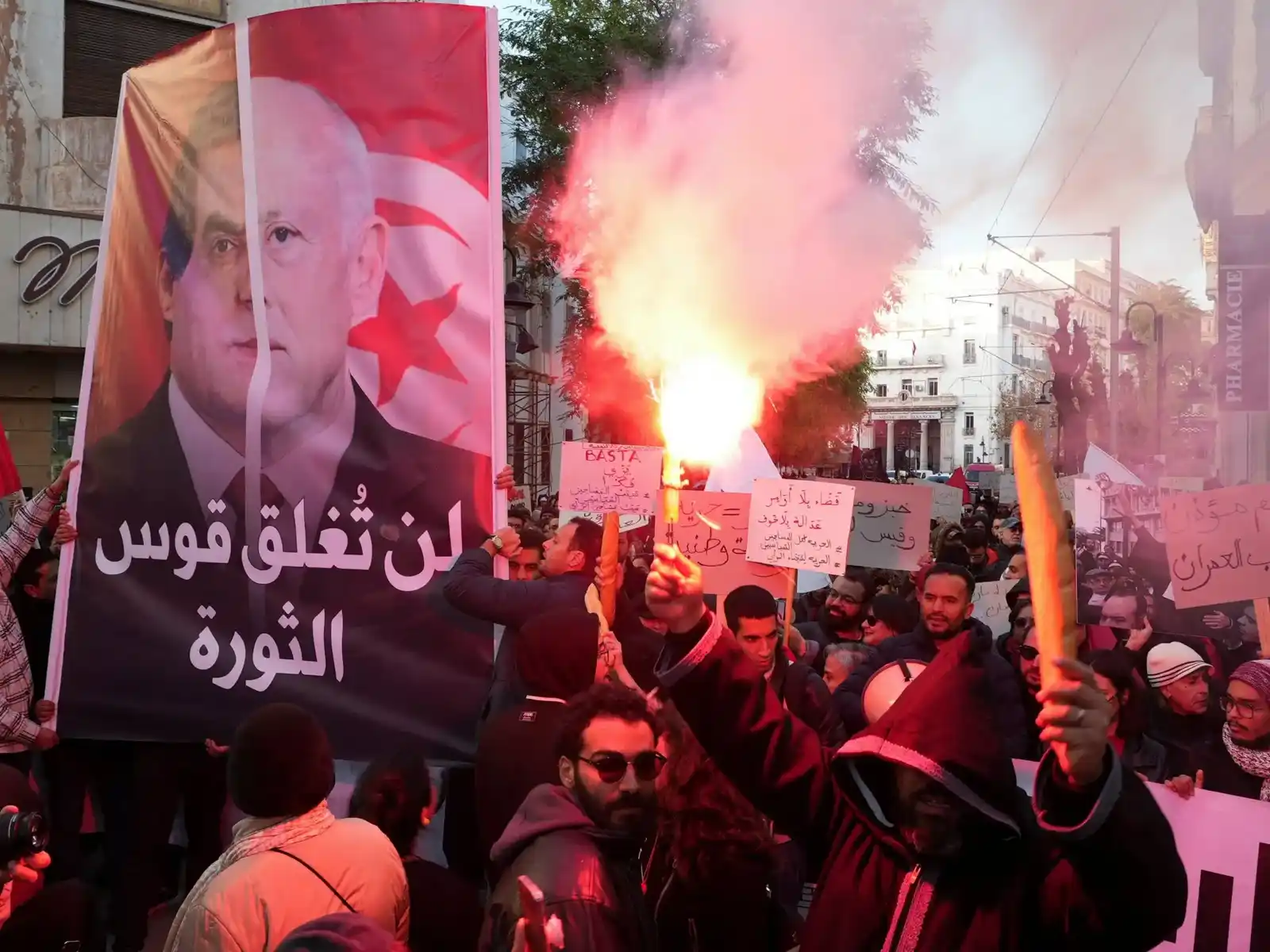
V-Dem’s 2026 Democracy Report ranks MENA as the world’s most autocratic region, placing more than 90 percent of its population under closed or electoral autocracies, including Tunisia following its post-2021 democratic breakdown. Yet surveys carried out by Arab Barometer suggest that across Arab countries, the majority of people still prefer democracy over any other system of government.
There is hope for the region, even when democracy indicators are as low as ever, and we can find it in the enduring political agency of Arab societies themselves.
Across the region, communities continue to organise mutual aid under siege, defend civic dignity, and reimagine solidarity, proving that the aspiration for self-determination cannot be bombed or legislated out of existence.
The conversation about democracy in MENA, therefore, must start with these lived experiences and practices of freedom in local communities and histories, doing away with the imperial baggage.
Rejecting hegemonic templates, however, does not mean shutting the door on dialogue with like-minded Western advocates of democracy and human rights; rather, it calls for genuine cross-cultural learning built on mutual respect rather than tutelage.
Instead of importing abstract blueprints, the process of repurposing democratisation can draw directly on local traditions of consensus-building and communal governance.
These include resource-gathering and sharing cooperatives, women-led credit and mutual aid funds, neighbourhood solidarity networks, decentralised peoples’ assemblies, labour syndicates and participatory municipal initiatives.
Such spaces of public sphere and civic engagement have historically saved and managed resources, and resolved disputes from the bottom up. This type of people-centred associational life has the potential to construct deep horizontal trust and mutual accountability outside formal state management.
Healthy political parties can also serve as vital mediators of fair contests and power-sharing, actively supervising executive power within pluralist parliaments. Even in deeply entrenched autocratic settings, opposition movements and civic coalitions can carve out incremental space by forging cross-ideological alliances around shared socioeconomic grievances, contesting municipal and syndicate elections, and leveraging independent digital media to hold power to account from the margins.
Ultimately, breaking free from MENA’s democratic chokepoints will not come from external rescue or recycled Western formulas. It will come from reclaiming politics as a sovereign, locally rooted practice – one built patiently by citizens who refuse to surrender their dignity, their land, or their right to shape their collective future.
The views expressed in this article are the author’s own and do not necessarily reflect Al Jazeera’s editorial stance.