Iran’s supreme leader signals harsher crackdown as protest movement swells
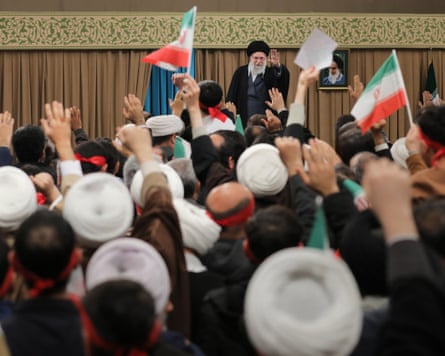
Iran’s supreme leader has vowed that authorities will “not back down” in the face of a rapidly growing protest movement, fuelling fears of an intensifying crackdown on the second day of a nationwide internet shutdown.
Protests have taken place in all 31 Iranian provinces in recent days, posing a threat to the authority of the regime, which has been significantly weakened since the last large protest movement in the country in 2022.
In his first speech since demonstrations started on 28 December, Ayatollah Ali Khamenei described protesters as “vandals” and “saboteurs”, and accused them of working on behalf of foreign agendas.
Protesters are “ruining their own streets to make the president of another country happy … because he said he would come to their aid”, Khamenei said – a reference to Donald Trump, who has threatened American intervention in Iran if authorities kill protesters.
The protests started after a sudden depreciation in the value of the country’s currency, but demands for political reform and an end to the regime’s rule quickly emerged.
The US president, in an interview with Fox News on Thursday, suggested the supreme leader was preparing to flee Iran. “He’s looking to go somewhere. It’s getting very bad,” Trump said.
The demonstrations on Thursday were the biggest since the 2022-2023 rallies sparked by the death in custody of Mahsa Amini. Authorities look more vulnerable this time around because of the dire economic situation and the aftermath of last year’s war with Israel and the US.
The head of Iran’s judiciary, Gholamhossein Mohseni Ejei, said consequences for demonstrators would be “decisive, maximum and without any legal leniency”.
An internet blackout introduced on Thursday has sharply reduced the amount of information flowing out of the country. The Iranian rights group Hengaw reported that a protest march after Friday prayers in Zahedan, where the Baluch minority predominates, had been met with gunfire that wounded several people.
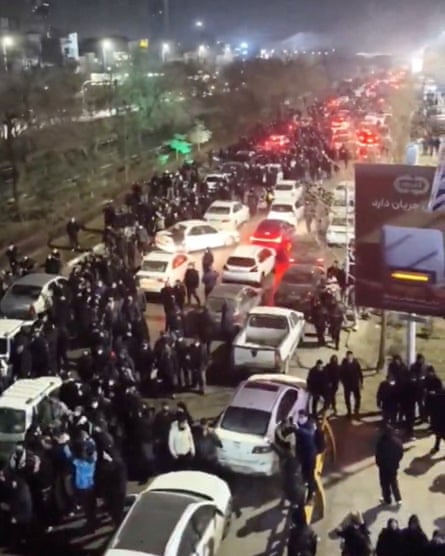
Videos showed crowds of thousands of people marching through the streets of Tehran on Thursday, setting fire to a building belonging to the Iranian state broadcasters and hoisting a flag bearing the lion and sun emblem –the flag of Iran before the 1979 revolution that brought the current regime to power.
Reza Pahlavi, the exiled son of the late shah of Iran, called for protests on Thursday evening. Footage showed protesters chanting in support of Pahlavi, including in Mashhad, Khamenei’s home town.
Protesters who went out on Thursday night said they were met with violence – part of what rights groups are calling an already brutal crackdown.
“They’re aiming for the eyes,” Maryam, a 25-year-old artist who was at protests in Tehran in the early hours of Friday, told the Guardian via text message. “The Faraja [uniformed police], the Basij [paramilitary militia] and even plainclothes kill-squads are driving into the crowds with motorbikes. I don’t know how long the internet will be working but we are thousands on the streets and I fear I will wake up to hundreds of casualties.”
At least 50 people have been killed in the violence surrounding protests, while more than 2,270 others have been detained, according to the US-based Human Rights Activists news agency.
Iranian state media acknowledged the protests for the first time on Friday, casting the unrest as violent riots instigated by “terrorist agents” of the US and Israel. State TV channels projected an air of normality, airing footage of pro-government demonstrations and insisting life went on as usual for most Iranians.
State media claimed Iran had caught agents from Israel’s Mossad who had infiltrated protest movements. The Iranian-owned Press TV reported that an Israeli spy cell was planning a “false-flag killing operation aimed at blaming the state for civilian deaths”.
Authorities cut off internet to Iran at about 8pm local time (4.30pm UK time) on Thursday, around the same time as Pahlavi’s call for protests. Understanding exactly what was happening in Iran and the true size of protests was difficult, with data and phone lines down. Human rights groups said documenting human rights violations was also hampered by the shutdown.
Students at a university in Tehran said they were trying to find a way to avoid the internet shutdown, relying on methods they developed during the war with Israel in the summer when authorities also shut down the internet.
Hossein, a 22-year-old university student, said: “Since June, we have been trying several ways to find these ‘secret tunnels’ that can route our messages outside the country. A group of us are able to still chat but I can see mobile lines are also getting disrupted.”
Demonstrators appeared to respond to Pahlavi’s call, with anti-government chants ringing out at 8pm, as well as calls for the exiled crown prince to return.
A protester who responded to his call on Thursday night said that she believed that Pahlavi could assist with a transition to democracy. “We failed to unify under a strong opposition last time [2022] but we have learned our lessons,” said 46-year-old Mehnaz. “We have to rally for him because we are desperate to survive.”
Elements of the protest movement, largely leaderless until now, have rallied around the figure, though it was unclear if chants were in support of the crown prince or the pre-1979 rule.
“I am proud of each and every one of you who conquered the streets across Iran on Thursday night,” Pahlavi said in a post on X. “I know that despite the internet shutdown and communication, you won’t leave the streets. Make sure that victory is yours!”
Pahlavi issued another call for demonstrations on Friday night at 8pm, which would be a further test for the exiled figure’s popularity and the staying power of protests in the face of the authorities’ crackdown.
Pahlavi’s organisation also alleged that “tens of thousands” of security officers had signalled their intentions to defect via a platform it had set up, and that the organisation had been “inundated” by requests from officers.
Human Rights Watch and Amnesty International condemned on Friday what they said was authorities’ use of force and mass arbitrary arrests. HRW has documented the deaths of 28 protesters who were shot by security forces between 31 December and 3 January, with instances of authorities using rifles and shotguns loaded with metal pellets.
“We have so far documented many of the harrowing patterns of human rights violations that authorities have repeatedly committed during the previous rounds of protest crackdowns, including in November 2019, and the Woman, Life, Freedom pretests of 2022,” said Bahar Saba, a senior HRW researcher on Iran and Kuwait.
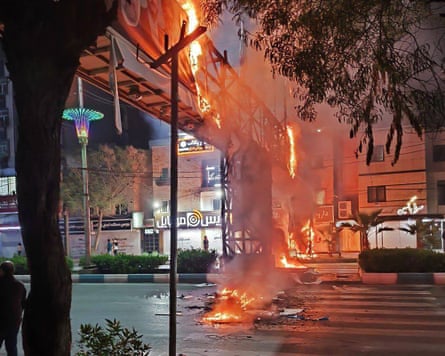
The crackdown seemed only to harden protesters’ resolve, many of whom described scenes of defiance, with rocks thrown at officers forcing them to retreat.
Ali, a 21-year-old student in Tehran, said via text message: “Fuck them! The cowards abandoned their vehicles and fled! We took over the streets tonight. We will burn their vans, the same that they use to drag our compatriots and kidnap our sisters from the streets. The country belongs to us!”
Anger at the regime and the clerics who form a backbone of the theocracy seemed to boil over throughout the week. On Wednesday, crowds of men streamed into a Shia seminary in the city of Gonabad, beating staff with sticks and damaging the facility, according to the director of the seminary, Ismail Tavakoli.
Another protester said unarmed protesters were confronting riot police, throwing rocks in response to bullets fired by officers.
“They are vulgar and are saying we are in bed with the Israelis and Americans,” said Farzad, a 37-year-old mobile shop owner in the city of Rasht in northern Iran. “They call us traitors. It’s them that have betrayed the very sense of being an Iranian.”