GOP’s redistricting gamble backfires in Florida as Democrats hold ground


Trump's party dealt a setback as Republican bid to tilt Florida's House map falters on a strong night for Democrats.
The Democratic Party has won several United States House of Representatives seats that Florida’s Republican-led legislature redrew to favour the GOP in a redistricting effort.
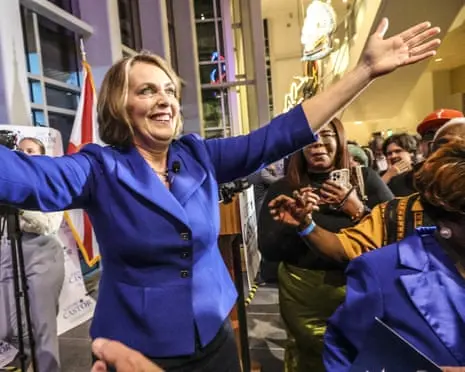
In a sweeping result reflecting Democrats’ broader midterm election victory, Kathy Castor held Florida’s 14th congressional district, which swung nearly 16 percentage points towards Democrats compared with its 2024 presidential vote.
Democratic first-time candidate Pia Dandiya won the 22nd district, and Jared Moskowitz retained the 25th.
Notably, the race between incumbent Darren Soto and Republican challenger Dan Green in Florida’s 9th district remained the closest of the four, with Soto holding a slim lead as the final votes were counted on Wednesday.
The wins add to a wave of Democratic victories across the nation, in an election widely cast as a referendum on President Donald Trump. Democrats won control of both chambers of Congress, including at least 54 Senate seats, a major setback for Trump that could provide a significant check on his power in his final two years in office.
Florida’s returns also offer another measure of the electoral headwinds facing Republicans this election cycle, despite tilting the district map in their favour to make several seats more Republican-friendly.
Longtime Trump ally and outgoing Florida Governor Ron DeSantis and the state’s Republican-controlled legislature redrew Florida’s congressional map in April, seeking to bolster the party’s chances of retaining control of the US House.
The move formed part of an unprecedented nationwide Republican effort to secure a structural advantage ahead of the midterms by reshaping the boundaries of congressional representation.
The revised boundaries gave Trump’s party a lead in four Democratic-held districts: the 9th, 14th, 22nd, and 25th, and were explicitly engineered to compress the state’s Democratic delegation in the US House.
Under the new map, signed into law by DeSantis in May, Trump would have carried three of the four districts by double-digit margins during his 2024 presidential campaign, and the fourth by roughly 9 percentage points.
At the time, some had argued that redrawing the map may backfire on Republicans, diluting the party’s strongholds and tightening margins at a time when Trump’s approval ratings had dipped to an all-time low amid the economic knock-ons of the US-Israel war on Iran.
Redistricting is the process of redrawing electoral boundaries, usually after the US census every 10 years, to account for population shifts and ensure districts maintain roughly equal populations.
The boundaries determine which voters are grouped together to elect a representative to the US House.
Because the party in power in a state legislature often has a hand in drawing the map, the process can be used to give one party an electoral advantage – a practice known as gerrymandering.
Following tit-for-tat map re-drawings, Republicans hoped to net at least 13 seats nationally, though polling had suggested their gains may be much more muted.
Related Articles
- Politics News
Democrats claim staggering victories in districts gerrymandered to favor Republicans across the US
- World News
Democrats poised to flip House in midterm elections after two turbulent years of Trump
- World News
Anthony Zurcher: Democrats push deep into Trump heartland on historic night
- World News
Democrats win control of Senate as US voters reject Trump’s agenda
- World News
Story of US 2026 midterm elections in maps and charts