‘Chock full of incredible animals’: marine expedition uncovers 31 new species in two weeks

A marine biology expedition in international waters off the coast of Brazil has discovered 31 new species in just two weeks.
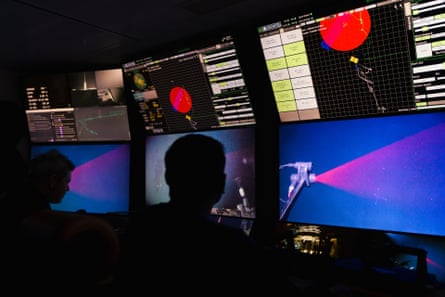
The researchers believe the speed at which the species were found and identified may be a record, in part because of the cutting-edge tech designed and built by the science and engineering team. For the first time on board a ship, the researchers were able to observe the living 3D cellular structure of microbial life thanks to a new technological breakthrough nicknamed the Squid.
Two dozen international experts, from the US, Australia, Brazil and Japan, carried out the survey onboard the Falkor (too), a research vessel operated by the Schmidt Ocean Institute with support from the University of Western Australia and several other institutions.
Setting out from Salvador, Bahia, their focus was on the ocean midwater – the area between the seafloor and the sunlit layer closer to the surface. The researchers said this was the largest habitat on Earth, encompassing 90% of the living space on our planet, and also one of the least explored.
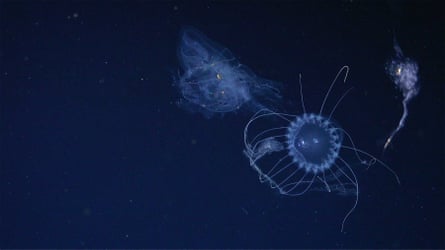
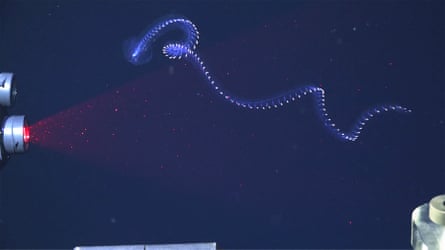
Among the new discoveries were an amphipod, a type of crustacean related to crabs and lobsters; a fast-moving gossamer worm; nine jellyfish; seven siphonophores, colonial organisms related to jellyfish and corals; seven comb jellies or ctenophores, famous for the glittering cilia they use to swim; four larvaceans, tadpole-like creatures that live in mucus houses and are more closely related to humans than invertebrates; and two giant rhizarians, single-celled organisms visible to the naked eye.
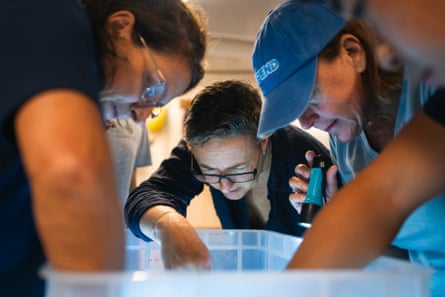
“It was pretty exciting,” said the expedition’s chief scientist, Dr Karen Osborn of the Smithsonian National Museum of Natural History. “The midwater is chock full of incredible animals that we don’t know much about. And this was an area that hadn’t been explored before so there were more opportunities to find new species. This must be close to a record for discoveries of new animals in a short space of time.”
One of the technological breakthroughs was the onboard use of a spinning wheel confocal microscope, nicknamed the Squid, which uses lasers to scan microscopic details of how organisms are put together. “That opens up a whole new world of exploring. We could see cells interacting with each other, exchanging material and building skeletons. And we could do that live on the ship, when usually it takes a couple of weeks of staining and mounting to see anything,” Osborne said.
The researchers also used prototype imaging systems, genetic analysis, and assembled a team of taxonomic experts for rapid identification of species.
The findings contribute to human understanding of the distribution of life in the oceans. “I think about it as a layer cake. It is common to find the same thing at similar depths in distance locations such as Japan and California,” Osborn explained.
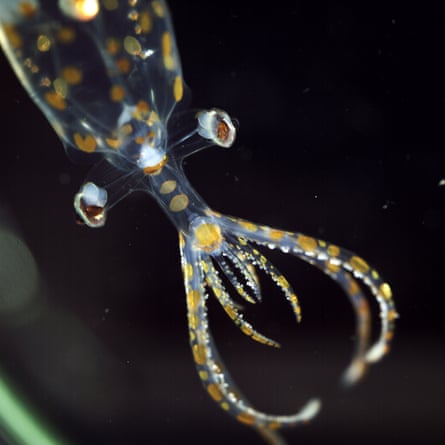
But there is also a huge vertical movement at night when creatures that have been hiding in the depths during the day go closer to the surface to eat under the cover of darkness. This has considerable influence on the drawdown of carbon by the oceans.
The expedition coincided with the unveiling of plans by the Trump administration to dismantle one of the world’s most important deep-sea observation systems – the $368m (£278m) Ocean Observatories Initiative, which uses more than 900 instruments to collect data on ocean health, including current patterns, climate variability and marine biodiversity.
Osborne said the latest expedition confirmed for her the importance of scientific collaboration and learning more about the ocean. “I think we should be doing this so much more. We need to bring together teams with a common goal to try out new ways of looking at things,” she said.
“What humanity has found so far is just the tip of the iceberg. There is an immense amount of life out there solving life’s challenges in unusual ways. Imagine what we can learn from them as we understand them better.”