Why this $25-billion money manager added Couche-Tard and sold Telus
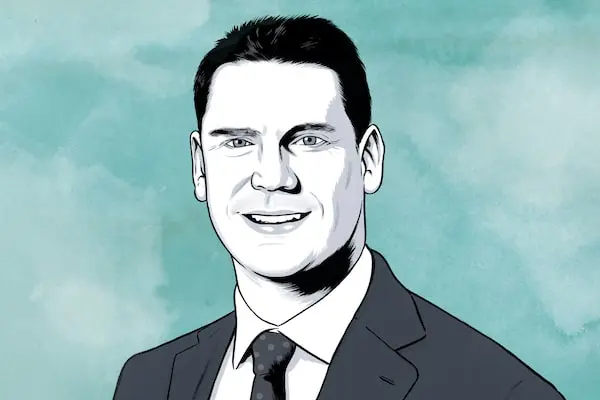

Scott Lysakowski, managing director and senior portfolio manager at RBC Global Asset Management in Vancouver. Illustration by Joel KimmelThe Globe and Mail
It’s not that Scott Lysakowski isn’t worried about the potential for a near-term market pullback, but the money manager remains “reasonably constructive” on equity markets, particularly in Canada.
“Over the short term, there’s lots of things to worry about, lots of volatility, lots of things happening that underneath the surface might cause [some investors] to dial back their risk,” says the managing director and senior portfolio manager at RBC Global Asset Management in Vancouver, who oversees about $25.6-billion in assets.
However, in the medium- to long-term, Mr. Lysakowski says he believes markets will be supported by accelerated earnings growth, driven by higher spending in areas such as artificial intelligence and infrastructure, as well as fiscal and monetary policy.
Mr. Lysakowski, head of the Phillips, Hager & North (PH&N) Canadian equity team, expects Canada’s growth to come from three main sectors: energy, materials and financials.
His $6-billion PH&N Dividend Income Fund currently has about 44 per cent financials, 17 per cent energy and 13 per cent industrials.
The fund returned 17.6 per cent year to date and 30.2 per cent over the past 12 months. Its three- and five-year annualized returns were 20.6 per cent and 15 per cent, respectively. The performance is based on total returns, net of fees, as of July 31.
The Globe spoke with Mr. Lysakowski recently about what he’s been buying and selling.
Name three stocks you’ve been buying recently and why.
Alimentation Couche-Tard Inc. ATD-T is a long-time core holding and a stock we’ve been adding to in the past three months.
Laval, Que.-based Couche-Tard is one of the largest convenience and fuel store operators in the world. It’s an exceptional operator with a long track record of earnings growth, return on invested capital and dividend growth. It has built its global footprint through disciplined and accretive mergers and acquisitions.
Last July, it walked away from a proposal to buy Seven & i Holdings, the parent company of 7-Eleven. The price was getting a little too rich. We thought it was a good decision. That’s one reason we decided to add to our position.
More importantly, we started seeing signs of improving fundamentals in the business. Same-store sales growth has been improving in the U.S., and we are starting to see early signs of improvement in Europe. It’s also generating very strong fuel margins right now.
Furthermore, Couche-Tard recently announced its intention to acquire [a controlling stake in Poland’s] Zabka Group, which includes a high-quality portfolio of retail convenience locations. The acquisition would increase its European footprint and we believe there are many opportunities for synergies.
Cenovus Energy Inc. CVE-T, the Calgary-based large-cap energy producer, is another long-term holding that we added to this year during this period of oil price volatility.
It recently acquired MEG Energy Corp. The deal closed late last year and added more than 100,000 barrels a day of production and significant reserves adjacent to its Christina Lake property in northeastern Alberta.
Cenovus expects to create value from this acquisition through operational and capital investment synergies.
The company has used some of the excess free cash flow generated by high oil prices this year to buy back stock and pay down debt it issued to finance the MEG Energy transaction. It has also shown some improvement in its U.S. refining business, which had challenging operational performance over the last couple of years.
So, the combination of those two provides good runway for the stock’s performance relative to its peers.
TFI International Inc. TFII-T, the Saint-Laurent, Que.-based mid-sized North American trucking company, is a stock we started buying earlier this year.
The move follows our increased exposure to Canadian railway stocks last year, as the sector emerged from a multi-year freight recession.
As with railway stocks, trucking companies benefit from these recoveries as weaker players exit the industry and steady demand from a robust economy leads to higher volumes.
The combination of higher rates and volumes leads to positive operating leverage as revenue grows and margins improve, resulting in a meaningful increase in free cash flow.
In the most recent quarter, TFII reported a 50-per-cent increase in operating income on a 7-per-cent increase in revenue.
Increased profitability and free cash flow generation also open the door to future growth through M&A, as well as to enhanced shareholder returns from share buybacks and debt reduction.
Name a stock you sold recently.
Telus Corp. T-T is a stock we started selling in October last year and exited in January this year, after adding to it last summer.
We believe our decision to sell illustrates our flexibility in correcting our actions after making a wrong decision.
When we added to the stock more than a year ago, our thesis was that the competitive threats of new entrants into the wireless industry were easing, valuations were very attractive and we had a view that once competition settled down, carriers would be able to show some better pricing discipline with their wireless products – and that would normalize free cash flow levels.
While we’ve seen some easing in the competitive pressures in parts of Canada, it hasn’t happened in the West, which is Telus’s backyard. That has put pressure on its free cash flow generation. Higher capital expenditures also stressed its payout ratio. It became apparent to us that Telus would need to cut its dividend substantially, so we decided it was time to exit our position.
Since then, the company changed its chief executive officer, hiring Victor Dodig – former CEO of CIBC – earlier this year, and it recently cut its dividend [by 55 per cent].
The company has done a major reset of its earnings outlook in this most recent quarter and the stock hasn’t performed well.
That said, we are still watching the stock and may consider buying it back. The valuation is very attractive, but we would want to spend some time with the management team before considering buying it back.
This interview has been edited and condensed.