Where does the price of gold go from here?
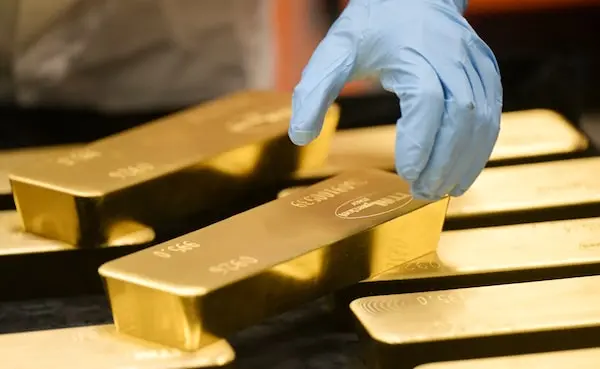

A 12,5kg gold bar at the Italpreziosi precious metals refinery in Arezzo, Italy, last month.STEFANO RELLANDINI/AFP/Getty Images
This year so far, gold has seen US$100 oil, renewed Fed tightening, 3-per-cent real Treasury yields, a strengthening U.S. dollar and a continuingIran war. Where does the price of gold go from here?
Background:
According to the CME FED watch site, the market sees a 67-per-cent probability of an increase in the FED Funds rate by the December meeting. Today’s price of gold atUS$4,181 comes after a 6-per-cent decline in September, and Friday’s softer inflation report has reduced the market implied probability of an October Fed hike from 69 per cent a week ago to 21 per cent now.
The U.S. unemployment rate moved to 4.2 per cent in August, up from 4.1 per cent in July. The number of employed persons increased by29,000, less than the 90,000 projected, with the labour-force participation rate rising slightly.
Adding to the mix are current conflicts and geopolitical trade tensions, which can drive flows into gold as a safe haven. Middle East oil exports, excluding Iran, surpassed their prewar levels last week, despite attacks on ships in the Strait of Hormuz, according to data from the maritime tracking firm Kpler. Also last week, the G7 countries agreed to release diesel stocks and OPEC+ agreed to keep November oil output targets steady.
Recent gold price moves:
The price of gold has declined from its high of US$5,586 on Jan. 29 to currently sit in the US$4,200 range. Let’s look at the factors that help us understand where gold may be heading.
Central banks buying:
According to the World Gold Council, central banks bought 289 tonnes of gold in Q2, up 62 per cent year-over-year. China also accelerated its purchases and Poland remains a very large buyer. Meanwhile, global gold ETFs added 121 tonnes in August, taking ETF holdings to a record 4,189 tonnes.
Interest rates and the U.S. dollar:
Rising interest rates are associated with a stronger U.S. dollar and a decline in the price of gold. When real interest rates (the stated or nominal rate less inflation) rise, investors move to higher-return opportunities such as bonds and stocks. The 10-year Treasury is now around 5.3 per cent, its highest level since 2002, while real yields are near 3 per cent, compared with 1.7 per cent before the Iran war. The USD index has also climbed to 102, an 18-month high.
Three scenarios for gold:
Under the first scenario we see the price of oil normalizing, which causes inflation to retreat and gold begins another major leg higher. If oil falls, the probability of gold returning to US$5,000 becomes quite high because the structural buyers are already present.
Under the second scenario, Brent remains in the US$100 to US$120 range, diesel and other refined product shortages persist, inflation remains above 3 per cent, U.S. economic growth remains resilient and the Fed delivers additional rate hikes.
Here, the Fed funds rate could consequently move toward 4.5 per cent to 5 per cent, while the 10-year Treasury would remain above 5 per cent. The main point is the Iran energy shock can keep U.S. inflation sufficiently high to force the Fed to continue tightening, which is bearish for gold.
A third scenario sees a U.S. bond market or fiscal problem where the 10-year Treasury reaching 5.3 per cent isn’t telling us just an inflation story any more. Fiscal concerns, enormous Treasury issuance and private-sector borrowing for AI infrastructure are increasingly contributing to the rise in long rates, and investors will want more compensation to hold long-dated U.S. government debt.
This scenario could keep long-term yields elevated even if energy-related inflation pressure diminishes. This is an environment where we could see rising yields and eventually, rising gold prices.
Analyst outlooks:
With all of the above, we are seeing a wide range of analyst target prices over the next 12 months. Goldman Sachs sees US$5,400 by end of 2027, noting even after September’s Fed hike, tighter monetary policy delays rather than eliminates the structural gold move. Goldman estimates that a considerably more hawkish Fed could drive gold toward US$4,070 first.
UBS see gold rising to US$5,000 during the first half of 2027 and extending to US$5,400 by the fall of 2027, based largely on falling real rates, dollar weakness and sustained investment demand.
HSBC is more conservative at US$4,825 for 2027, after recently reducing its forecasts.
There are two underlying messages evolving here: Analysts see gold at US$5,000 or more in 2027 but there will be price volatility on the way there.
Summary:
Most of these indicators (rising interest rates, rising inflation, geopolitical risk) tell us the price of gold still has support in the near term and should go higher if rates start to be cut next year and economic and geopolitical uncertainty begins to abate.
More about the author
Brian Donovan, CBV, is the president of StockCalc, a Canadian fintech based in Miramichi, N.B.